


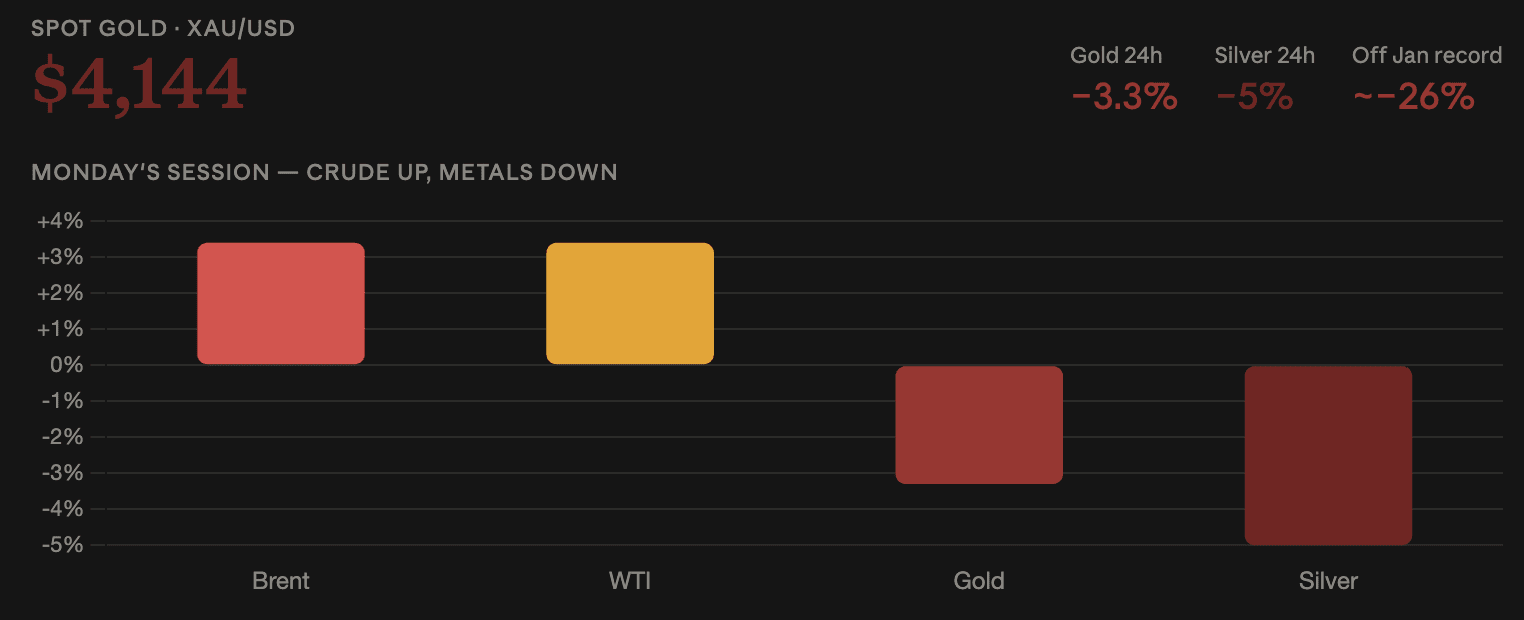
Precious metals extended their decline on Monday, with spot gold falling about 3.3% to roughly $4,144 a troy ounce and silver plunging 5%.
Both crude benchmarks moved the other way. Brent, the international marker that prices most globally traded crude, cleared $100, while US benchmark WTI rose about 3.4% to $95.60. Fading peace hopes and renewed Middle East geopolitical risk drove the move.
Comex gold futures traded near $4,176.
The Benchmark Spread Points to an Export Problem
The gap between the two contracts carries information the headline prices do not.
Brent above $100 against WTI at $95.60 is a spread of roughly $5, wider than the usual $2 to $4. Brent prices North Sea crude and serves as the benchmark for around two-thirds of globally traded oil. WTI prices light sweet crude delivered at Cushing, Oklahoma.
A widening spread in Brent's favour is consistent with a seaborne export constraint rather than a global demand shock. Saudi barrels that cannot clear the Strait of Hormuz or the Red Sea port of Yanbu affect internationally traded cargoes directly, but reach US inventories only indirectly.
That distinction matters for what would reverse it. A demand-driven rally fades when growth slows. An export bottleneck fades only when a route reopens.
The Peace Trade Has Unwound
Last week crude was falling on the prospect of a settlement. WTI reached $89, roughly 15% below its September high of $106, after reports that Iran could reopen Hormuz within seven days if the US eased its port blockade.
That prospect has faded, and WTI has recovered more than $6 from the low.
The physical constraint was never resolved by the talks. Saudi Arabia's East-West pipeline, which runs to Yanbu specifically to bypass Hormuz, remained shut throughout, holding production at 6.238 million barrels per day — the lowest since 1990.
Diplomacy only ever removed the risk premium. With the premium restored, the shortage is priced again.
Refined Products Are What Reach Inflation
Crude benchmarks are not what consumers pay, and the distinction matters for the rate argument.
Diesel, gasoline and jet fuel feed through to transport and logistics costs, and crack spreads — the margin between crude and refined products — can widen independently of the barrel. Diesel has been running near record highs, roughly 90% above pre-war levels.
That is the channel by which a crude move becomes a PCE print.
Gold Has Given Up Its September Floor
At $4,144, gold sits below the $4,296 it held on September 14 and roughly 26% under its January record of $5,600.
The tension in its position has defined the month. Bullion is held as protection against rising prices, but higher interest rates — the policy response to those prices — reduce its appeal directly, because gold pays no yield while competing risk-free returns climb.
Both forces run at once, and the rate response keeps winning. Gold falls on an energy shock that should support it.
Its 90-day correlation with the 10-year Treasury yield has run at −0.41, which is why rate repricing hits gold harder than most assets.
Silver Fell Nearly Twice as Hard
Silver's 5% decline against gold's 3.3% is roughly the ratio their relationship usually produces.
Silver carries both monetary and industrial demand, giving it higher beta to gold in either direction.
The ordering points to a rates-driven move rather than a growth scare. A session pricing weaker demand would show different damage across the complex, and would not lift crude at the same time.
Four Data Points This Week
Investors face job openings, the ADP employment report, the PCE inflation report and nonfarm payrolls.
KCM Trade chief market analyst Tim Waterer set out the risk: "If inflation or employment data comes in stronger than expected, it could continue to push bond yields higher and further weigh on gold prices."
He described the current pressure the same way. "The combination of high bond yields and elevated oil prices continues to weigh on gold. With uncertainty surrounding the oil supply outlook, crude prices have risen, bringing inflation back into the spotlight for investors."
PCE carries particular weight. Chair Kevin Warsh built his Jackson Hole case around it rather than CPI, citing a hotter six-month rate against the 12-month figure and arguing the recent trend was the operative one.
The Fed raised rates 25 basis points to 3.75%-4.00% on September 16, its first increase since July 2023, with a dot plot median pointing to one more move in 2026 — below what markets had priced going in. A hot PCE print would test that projection directly.
The Crypto Read-Through
Bitcoin sits on the other side of the correlation gap punishing gold.
At −0.17 against the 10-year, it absorbs rate moves with roughly half the sensitivity. Through mid-September it repeatedly rose on days gold fell, and the two assets' own correlation collapsed to 0.28 from 0.69 over 30 days.
That decoupling holds only while the rate channel dominates. If this week's data pushes yields sharply higher, a competing risk-free rate weighs on everything that pays no yield — the setup QCP Capital described as a competing 5% rate without the growth impulse that usually accompanies it.