

Micron Technology (Nasdaq: MU) $MUB reports fiscal fourth-quarter results after the market close on Sept. 30, closing out a fiscal year in which the stock has surged. The question for investors is no longer whether the memory maker can beat estimates. It is whether the results, and especially the guidance, can justify a valuation that has run well ahead of the sector.
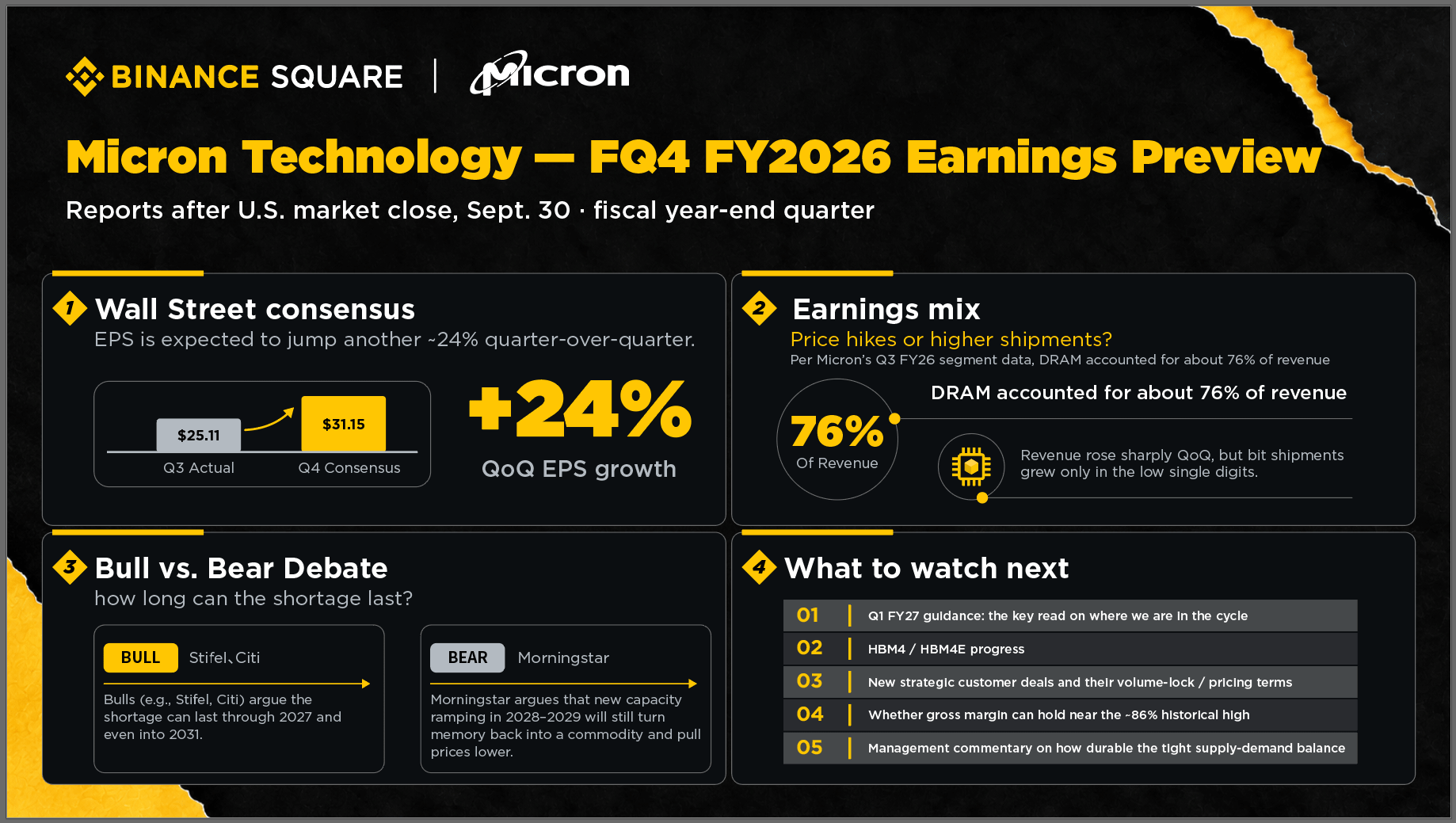
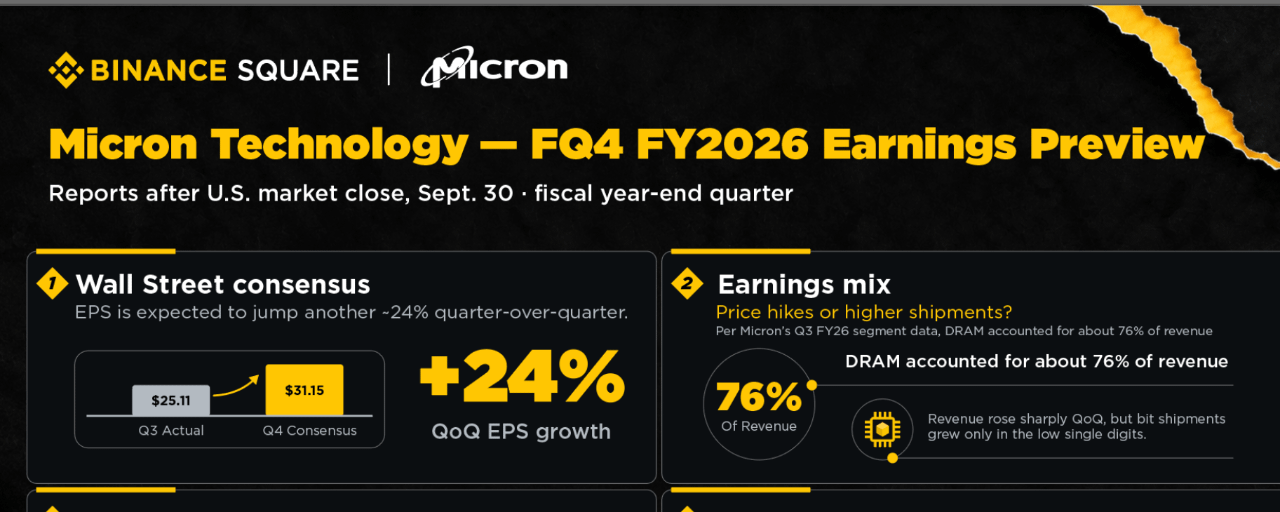
For the August quarter, Micron guided to revenue of 1 billion; non-GAAP earnings of 1; GAAP diluted earnings of 1; and gross margin of roughly 86%. Wall Street sits at or slightly above the midpoint of that range. According to TipRanks, the sell-side consensus calls for revenue of about 50.6 billion and adjusted earnings near 31.16. A quarter ago, in fiscal Q3, Micron earned $25.11 a share as revenue jumped about 346% from a year earlier. Hitting consensus would mean another roughly 24% sequential jump in earnings—a steep step-up for any chipmaker.
The earnings are coming from price, not volume
Most analysts trace this quarter's profit swing to tight supply and rising prices in high-bandwidth memory and AI-related DRAM, rather than to a surge in units shipped.
The mix in fiscal Q3 makes the point. DRAM accounted for about 76% of revenue, and while that revenue climbed sharply from the prior quarter, bit shipments rose only in the low single digits. The gains came from higher average selling prices; incremental volume contributed little.
What separates this cycle from earlier ones is the role of long-term supply agreements. On its earnings call, management said demand from some key customers now runs about 50% above the volume Micron can commit to supply. As of last quarter the company had signed 16 strategic customer agreements covering roughly 20% of its DRAM bits and about 30% of its NAND bits, tied to some 22 billion in customer cash deposits and commitments.
Analysts lean bullish, but price targets are all over the map
TipRanks data as of Sept. 24 shows 29 analysts rating the stock over the prior three months, with a consensus of Strong Buy—28 buys, one hold and no sells. The average price target is about 2,200 and a low of $1,100. That spread reflects a real disagreement about where the cycle stands.
Stifel rates Micron a buy with a $1,500 target and expects both the Q4 results and the guidance to top consensus, though it sees the upside as more measured than in recent quarters, given supply agreements with banded pricing and near-term limits on bit shipments. The firm also expects HBM4 pricing per bit to roughly double, with 2027 negotiations near a close.
TD Cowen analyst Krish Sankar carries a buy rating and a $1,600 target, and frames the case as a re-rating rather than an earnings story: Micron is about 80% of the way through an 18-month stretch of margin expansion, but growing confidence in the cycle's durability could still push the multiple higher.
Citi is bullish as well, arguing that AI demand can keep the memory market undersupplied through 2031.
Melius Research analyst Ben Reitzes holds the Street's highest target at $2,200, citing years of sold-out HBM capacity and the revenue visibility that comes with locked-in long-term contracts.
The cautious camp worries about normalization and valuation
The counterargument, from several named institutions and investors, centers less on any collapse in AI demand than on high margins reverting to normal and a stock that has already priced in a lot.
Goldman Sachs analyst James Schneider is the most cautious of the three major banks, with a neutral rating and a 62 in earnings. Even so, Goldman's own forecast for the quarter sits a few percent above consensus—32.54—and it looks for low-double-digit sequential revenue growth in fiscal Q1, flagging long-run capacity additions from Chinese producers as the main risk. In other words, Goldman's neutral stance rests on valuation, not on any doubt about the fundamentals.
Morningstar analyst William Kerwin rates the shares two stars, calls the business no-moat and assigns it "Very High" uncertainty. After the June quarter he raised his fair value to 455, yet still views the stock as expensive. His bearishness comes down to cyclicality: Kerwin sees memory as a fundamentally cyclical business and expects a wave of new capacity in 2028 and 2029 to create oversupply and pull prices down. Long-term agreements soften the blow, in his view, but do not prevent the downturn, since the revenue genuinely locked in by customer contracts covers only a fraction of the total.
Michael Burry, the "Big Short" investor and founder of Scion Asset Management, has added to bearish bets against Micron. According to Yahoo Finance, he is short the shares along with the iShares Semiconductor ETF. His fundamental case leans on industry signals: he has cited Acer's chairman describing a DDR4 market with more sellers than buyers, and he is watching China's CXMT, whose progress on DDR5 yields and volume production could add supply and cap any durable rise in memory prices.
The bull-bear split on supply ultimately turns on timing. The bulls—Stifel and Citi among them—see the shortage lasting into 2027 and even 2031. Morningstar counters that the capacity coming online in 2028 and 2029 will return memory to its commodity roots and drag prices back down.
Other variables worth watching
Tariffs. Investing.com reports that the Trump administration is weighing broader semiconductor tariffs that would reach servers and laptops, a move the industry fears could slow the pace of AI infrastructure spending.
Patent litigation. Netlist has filed a complaint against Micron's DDR5 memory with the U.S. International Trade Commission, and Micron recently lost a patent appeal against the company. An exclusion order looks unlikely in the near term but would be a material risk.
Capital returns. Per CNBC, Micron's roughly $6.165 billion in direct CHIPS Act funding, awarded in December 2024, came with guardrails restricting large-scale buybacks and dividends for recipients. Those company-specific restrictions expire after Dec. 9 this year. Chief Financial Officer Mark Murphy has said the company intends to step up capital returns after that date, with a long-term plan to return 100% of excess cash flow to shareholders. With rivals such as SK Hynix already announcing multibillion-dollar buybacks, investors will listen for any commitment on the call.
R&D. Micron plans to invest $10 billion over the next decade in a Boise, Idaho research center called Micron Research Labs.
What matters most on Sept. 30
The consensus view is that next quarter's guidance will count for more than the current quarter's numbers.
Fiscal Q1 guidance is the key read on where the cycle stands. TipRanks puts the sell-side consensus for the November quarter at about 46.9 billion to 31.49 in earnings (35.11); Goldman's own model for the quarter runs to about $57.7 billion, above the market figure it cites.
HBM4 and HBM4E progress, and whether Micron can hold or grow its roughly 20% share of the HBM market.
New strategic customer agreements, and their volume and pricing terms—particularly progress toward locking in half of revenue.
Whether gross margin holds near its 86% high, and whether the pace of price increases is starting to flatten.
Management's language on the durability of supply and demand. Any softening on HBM pricing or demand could trigger a sell-the-news reaction, even on a beat.