

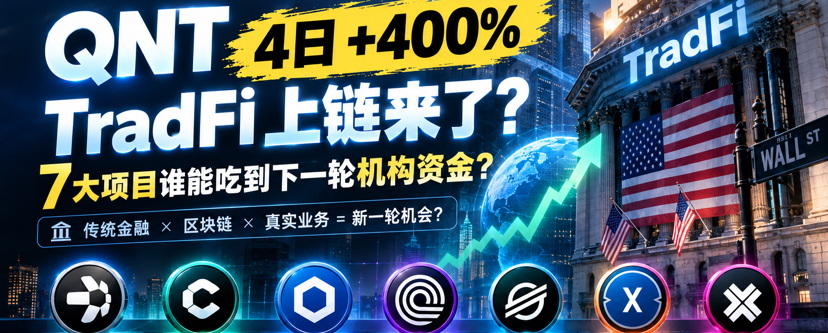

Recently, QNT’s price movement has brought a previously relatively niche sector back into focus for the market.
According to widely circulated market data, QNT’s single-day gain once exceeded 140%, with a cumulative gain of more than 400% over four days; afterward, there was a clear pullback.
Many people attribute this rally to social media spread.
But what’s truly worth paying attention to is what’s behind it:
🏦 TradFi on-chain
On September 24, The Clearing House chose Quant to provide interoperability, orchestration, and transaction management technology for its On-Chain Money Initiative.
This project plans to establish a network for financial institutions to clear and settle tokenized deposits, connecting existing payment systems such as RTP and CHIPS. It is expected to open to participating institutions in the first half of 2027.
This points to an important trend:
Traditional finance is gradually moving from “researching blockchain” to building real financial infrastructure.
But there’s a key issue to keep in mind here 👇
QNT’s biggest point of contention:
Institutional use of Quant ≠ institutions having to buy QNT.
Public information currently points primarily to Quant’s Overledger technology.
So what really needs to be verified is:
Is QNT involved in payments/settlement?
Do institutions have to hold QNT?
Can network usage translate into demand for QNT?
Can Quant’s enterprise revenue translate into value capture for the token?
If the answer remains unclear, there’s still a gap between “institutional partnerships” and the “QNT price appreciation thesis.”
👀 So, which other projects are worth watching?
I’ve broken down some of the more notable TradFi on-chain projects into 7 areas:
① QNT — Payments / Clearing
The Clearing House + Quant.
Key things to watch:
Interoperability between financial institutions.
② CC — Securities / Custody / Clearing
Canton’s narrative is more closely tied to securities infrastructure.
DTCC’s involvement in particular has drawn market attention to Canton’s potential in securities custody, collateral management, and clearing.
But this also needs to be verified:
Will institutional use of Canton generate real demand for CC?
③ LINK — Financial data infrastructure
DTCC’s Collateral AppChain will use Chainlink Runtime Environment (CRE) and Chainlink data standards.
These include:
📌 Price
📌 Valuation
📌 Collateral
📌 Margin
📌 Settlement
📌 Automated orchestration
If financial assets move on-chain at scale in the future, the importance of trusted data and automated execution may increase further.
Key things to watch:
Once the Collateral AppChain goes live, how much real business activity will it generate?
④ ONDO — RWA
Ondo’s core proposition is:
Bringing real-world assets on-chain.
Key products currently include:
OUSG
USDY
Ondo Stocks
According to Ondo’s website, Ondo Stocks offers more than 450 tokenized stocks and ETFs.
But here, too, we need to distinguish between:
Growth in RWA products ≠ the ONDO token necessarily capturing an equivalent amount of value.
⑤ XLM — DTCC × Stellar
DTCC and the Stellar Development Foundation have announced plans to bring DTC’s tokenized custody asset service to Stellar.
Assets under evaluation include:
Russell 1000 constituents
Major index ETFs
U.S. Treasuries
The relevant assets are expected to be available in the first half of 2027.
So the most important catalyst for XLM going forward isn’t news, but:
Once assets are actually live, how much real trading and settlement activity will they generate?
⑥ XDC — Trade finance
XDC focuses on:
Trade finance + corporate identity + accounts receivable + cross-border settlement.
In August 2026, SBI XDC Network APAC, TOPPAN, and Ginco were selected for a related Osaka Prefecture project. They will test a trade finance workflow combining vLEI corporate identities with on-chain export factoring.
What to focus on next:
Whether the pilot can move into real production environments at banks and businesses.
⑦ AXL — Cross-chain finance
If financial institutions use the following at the same time:
Public chains + private chains + banking systems + traditional financial infrastructure
That makes communication between different networks an important issue.
Axelar previously participated in Project Guardian proof-of-concepts involving institutions such as J.P. Morgan Onyx and Apollo.
The core logic:
Financial assets move on-chain → multiple chains coexist → demand for cross-chain communication increases.
🧠 Looking at these 7 projects together
The picture is actually very clear:
QNT → Payments / Clearing
CC → Securities / Custody
LINK → Data / Oracles
ONDO → RWA / Asset issuance
XLM → Asset tokenization
XDC → Trade finance
AXL → Cross-chain interoperability
They’re not competing for the same market.
But they share a broader narrative:
Traditional financial infrastructure is gradually moving on-chain.
⚠️ But there’s a very important investment consideration here:
Institutional partnerships ≠ token price increases, but they can fuel expectations of speculation.
What really matters is:
Institutional adoption → real business activity → on-chain transaction volume → network revenue → token value capture
Only when this chain of events gradually falls into place can institutional partnerships truly translate into token fundamentals.
So I’ll be keeping a close eye on:
① Live deployment in production environments
② On-chain transaction volume
③ Network revenue
④ The token’s actual utility
⑤ Whether institutions need to hold/use the token
This may matter more than simply asking, “Which bank announced a new partnership?”
🔥 QNT has reignited the TradFi sector.
What may really be worth watching in the market next is not:
“Who’s going to surge next?”
But rather:
“Who can truly turn Wall Street partnership announcements into real on-chain business?”
Which area are you most focused on?
QNT / CC / LINK / ONDO / XLM / XDC / AXL
Share your reasoning in the comments.