

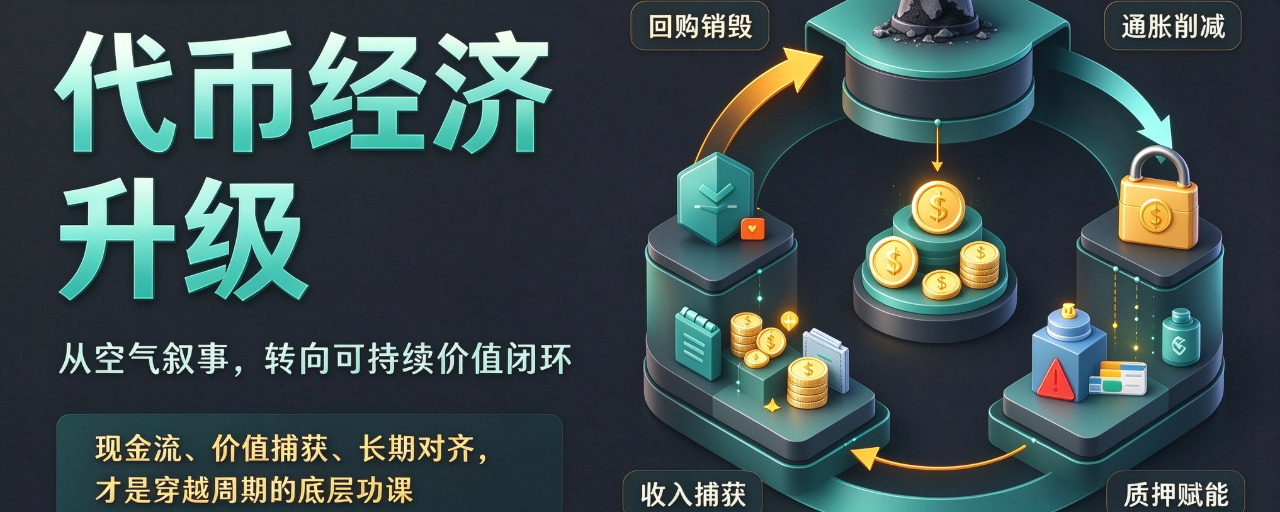

The market has shifted from a one-way bear market into a period of consolidation. The benefits of narrative-driven hype have completely vanished. The era when projects could attract capital purely by relying on grand visions and conceptual stories is gone for good. Whether it’s a public chain, DeFi, or various ecosystem projects, they all have to confront the same core issue: rebuilding tokenomics. In a choppy market, token models are no longer just a decorative addition in a whitepaper—they are a necessity that determines whether a project can survive the cycle and maintain community confidence.
In the last cycle, the common weaknesses of many projects were clear: token issuance relied on continuous inflation, rewards depended on additional token issuance subsidies, and token unlock schedules for the team and early investors were concentrated within the same period. The token itself only carried governance voting rights and could not capture the protocol’s real earnings. This model could still prop up valuations in a bull market by riding on sentiment. But once the market weakens, inflation-induced sell pressure combined with unlocking expectations causes fundamentals and token prices to fully decouple—ultimately turning the project into a pure ‘air’ narrative. When the market returns to rationality, the very first criteria for capital, community users, and institutional research is whether the token model can form a sustainable value feedback loop.
This round of tokenomics upgrades centers on five key areas: buybacks and burns, reduced inflation, optimized unlock schedules, protocol revenue capture, and staking incentives. At its core, this combination of mechanisms deeply ties token value to protocol revenue, allowing ecosystem growth to benefit token holders instead of relying solely on new entrants to buy up the supply.
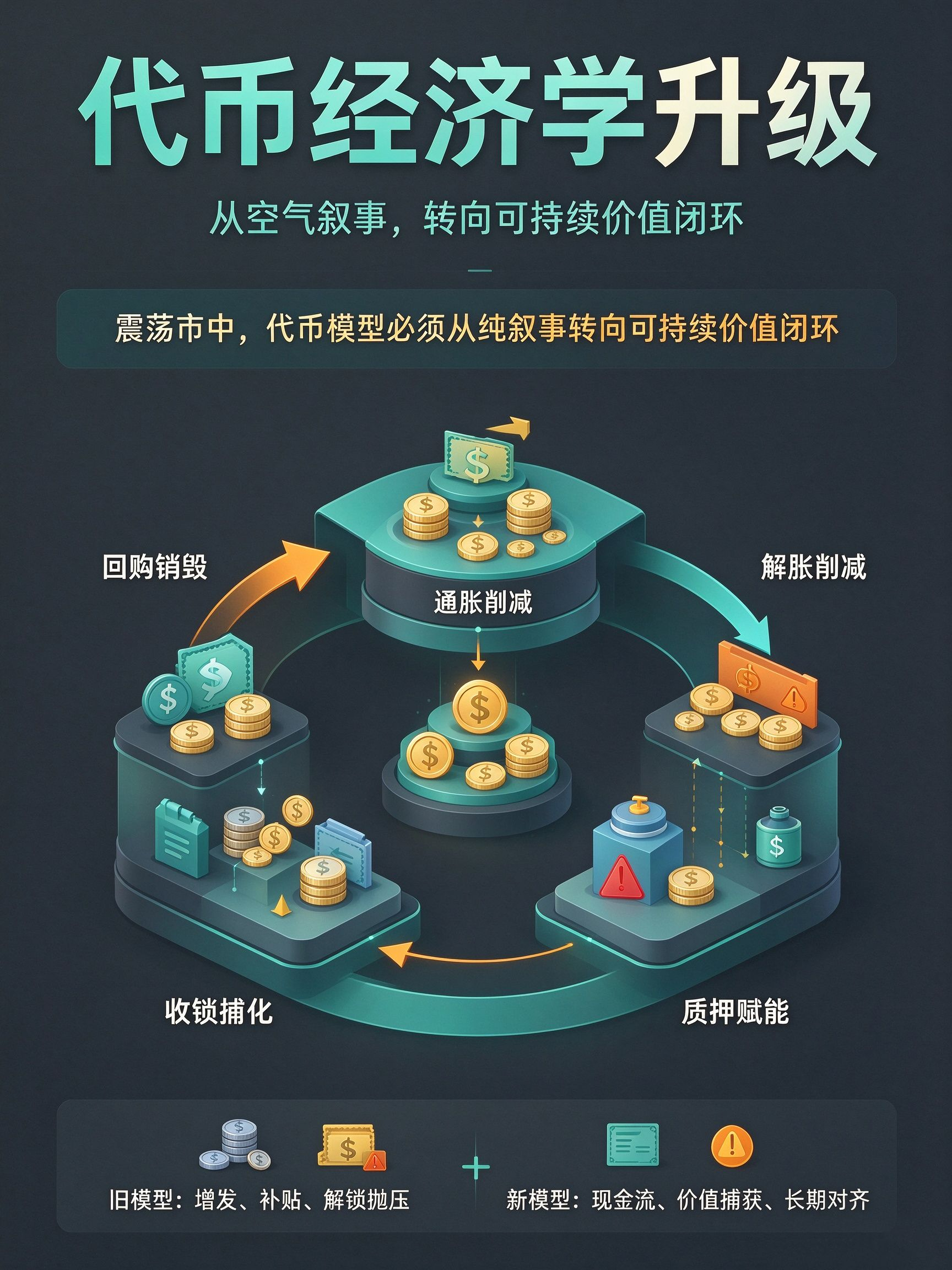
Buybacks and burns are currently the most direct way to return value to token holders. Projects use real cash flows, such as protocol fees and business surpluses, to buy back and burn tokens on the secondary market, directly reducing the circulating supply. Unlike burns funded by treasury tokens, buybacks based on actual revenue create a virtuous cycle: the higher the protocol’s trading volume and revenue, the stronger the buyback, and the more the circulating supply contracts. Many leading DeFi projects have already implemented this mechanism, using most of their fees for buybacks and burns. This turns tokens from mere governance credentials into assets that can share in protocol profits.
Reducing inflation is fundamental to addressing long-term supply dilution. Older models typically relied on ongoing linear issuance, continually distributing liquidity-mining and ecosystem incentive rewards and diluting the interests of existing holders. Today, projects are proactively lowering annual inflation rates, establishing declining inflation curves, and even setting hard supply caps. Incentives are also shifting from indiscriminate issuance to targeted distribution: resources are no longer used simply to subsidize activity farming, but to reward genuine on-chain engagement and long-term ecosystem contributions, reducing wasteful inflation.
Optimizing unlock schedules helps address the market’s greatest uncertainty: expectations of selling pressure. Traditional models, which unlock tokens at fixed calendar dates, create clear windows of selling pressure that the market prices in advance. Prices often drift downward as an unlock approaches. Projects are now adopting milestone-based unlocks, tying team and investor allocations to targets such as product metrics, protocol revenue, and ecosystem size rather than releasing them on a fixed schedule. Some projects choose to release the remaining tokens all at once, absorbing future selling pressure in a single event and clearing away the lingering uncertainty of long-term unlocks. Gradual releases, cliff adjustments, and tiered token allocations are all common ways for projects to manage selling pressure.
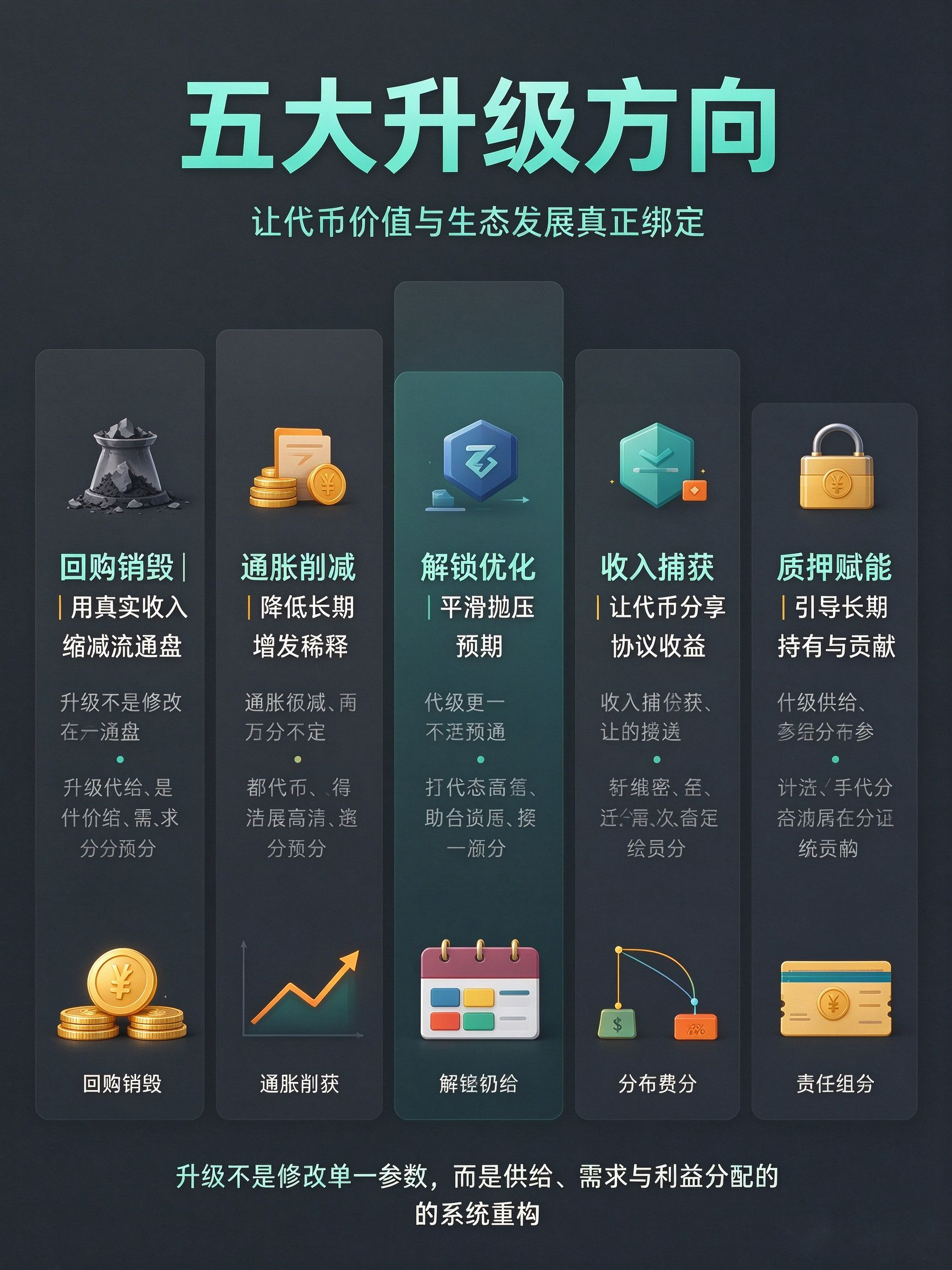
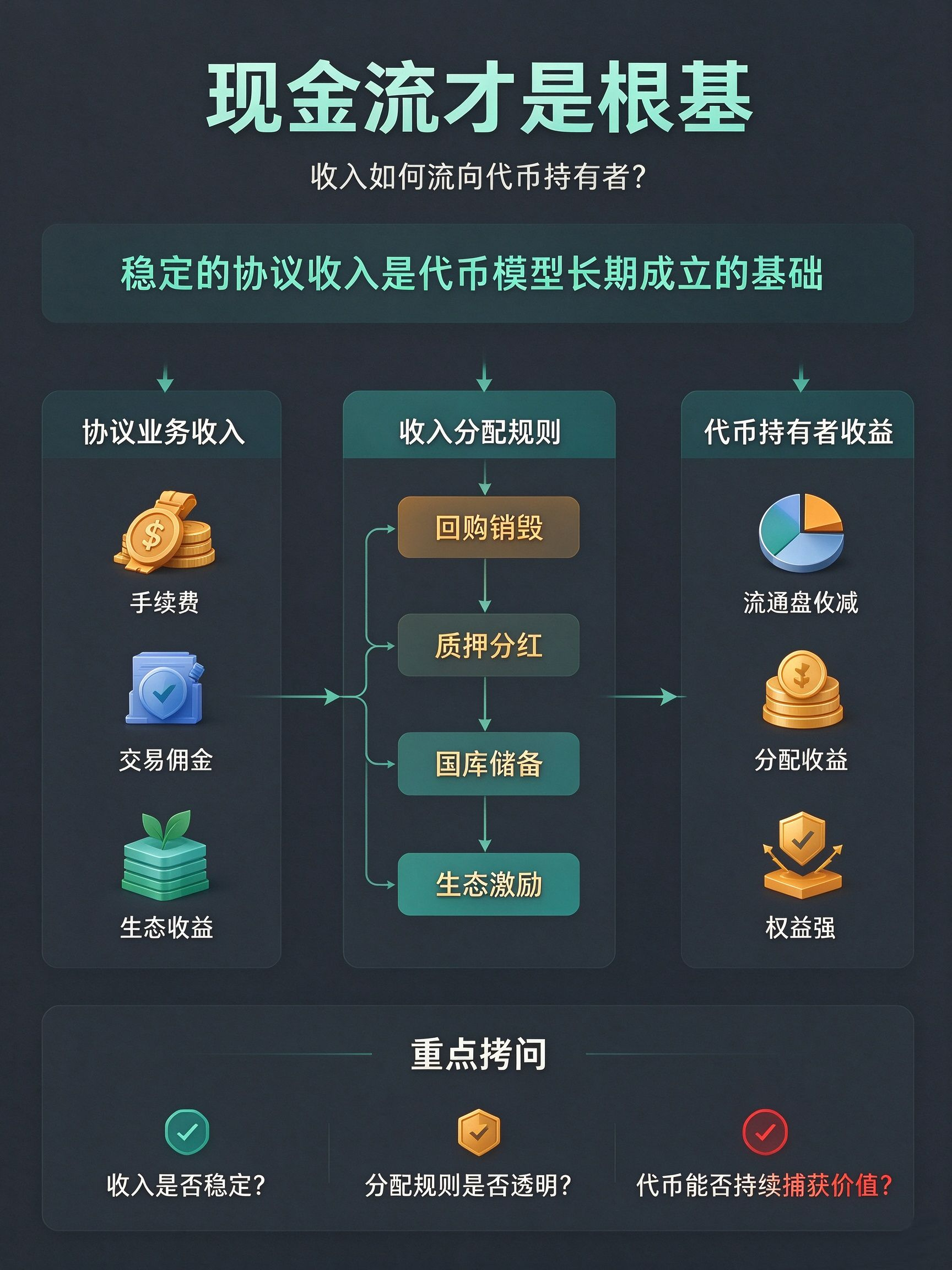
Protocol revenue capture is the foundation of the entire token economy and a prerequisite for any mechanism to work over the long term. Without real cash flow, buybacks and burns are nothing more than a short-term marketing tactic. The market is now asking projects a key question: Can the protocol generate stable, verifiable revenue? How will that revenue be distributed to token holders? In the past, many governance tokens offered only voting rights, with no share of platform fees. Protocols could earn enormous profits, while token holders received none of them. More and more DeFi projects are enabling fee switches, channeling trading fees back into their token ecosystems and linking business revenue to token value.
Staking, meanwhile, encourages long-term holding and helps balance the urge to sell in the short term. Well-designed staking is no longer about simply minting new tokens as rewards. Instead, it adds value through benefits such as governance weight, fee sharing, and ecosystem privileges, encouraging users to lock up their tokens and reducing the circulating supply. The core goal of staking mechanisms is to align the interests of teams, investors, and everyday users, steering the community away from short-term speculation and toward building the ecosystem for the long term.
When restructuring their token models, projects must confront three core questions. First, is the token backed by real cash flow? Deflationary mechanisms disconnected from business revenue can generate excitement in the short term, but cannot support long-term valuations. Second, how will selling pressure from token unlocks be managed? Any token model will fail, no matter how compelling its narrative, if large amounts of tokens are released all at once in the future. Third, how will governance tokens capture value? Voting rights are not the same as value. Governance tokens need a clear revenue-sharing mechanism, or they will struggle to earn the confidence of long-term investors.
This tokenomics overhaul applies to public blockchains, DeFi, and projects across all kinds of ecosystems. It also runs through the entire process, from community AMAs and white paper updates to airdrop design. When communicating with the community, projects need to make their token model transparent and clearly explain revenue sources, unlock schedules, and buyback rules. When updating a white paper, they should include dynamic token mechanisms, declining inflation, and revenue distribution in the core terms. When designing airdrops, they should move away from large, one-off distributions and instead release tokens in batches tied to ecosystem contributions, avoiding sell-offs of airdropped tokens.
The underlying dynamic in a volatile market is that capital is starting to price in real value. Upgrading tokenomics is not a marketing makeover involving simple parameter changes or adding a burn feature; it is a fundamental reshaping of a project’s business model. The projects that survive in the future will be those whose businesses generate cash flow, whose tokens can capture value, and whose supply-related selling pressure is manageable. Only by firmly linking token value to ecosystem growth can projects maintain community trust and weather market cycles amid ongoing volatility.