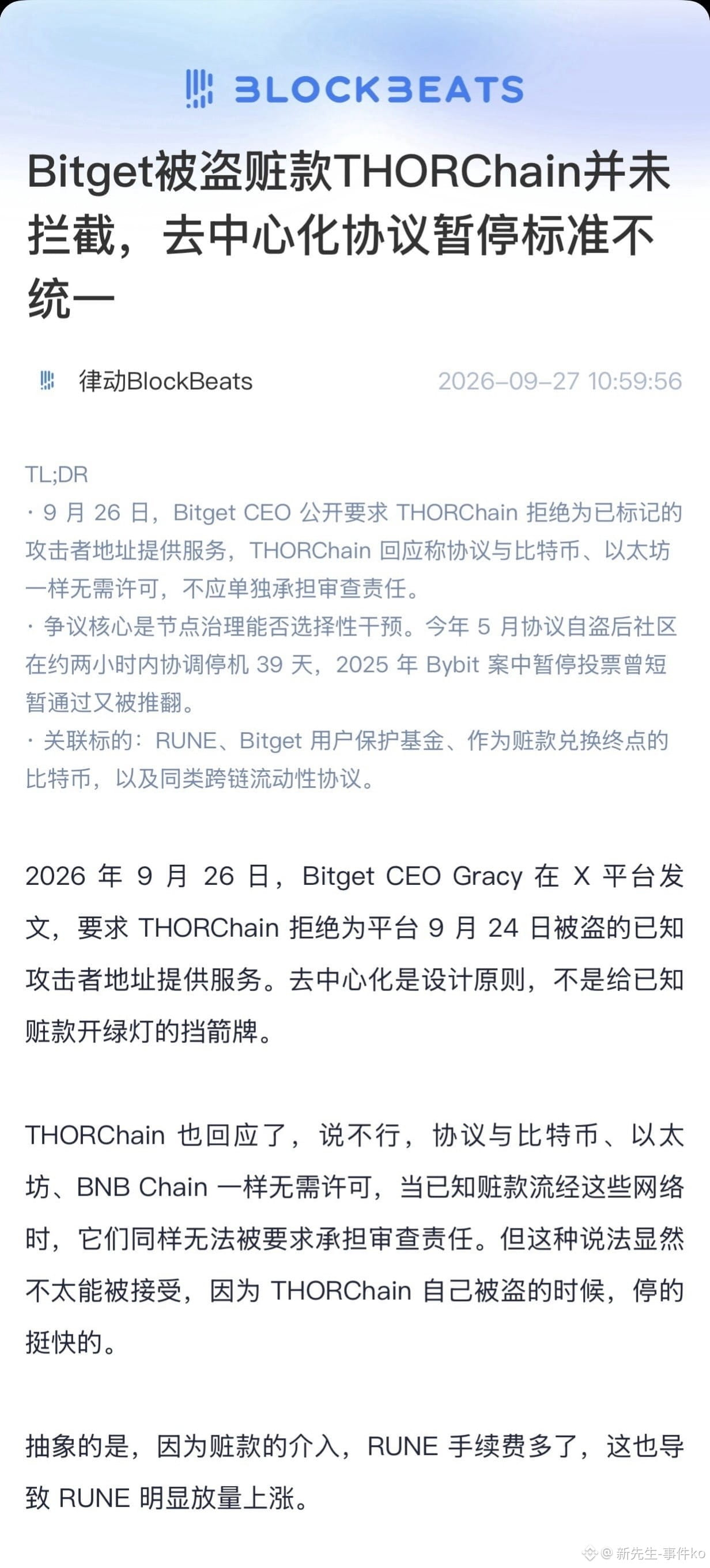
#Bitget The hacker has begun moving about $830 million in stolen funds from $XRP $ETH $BTC
But what keeps people up at night is not that number, but this: there is still $75 million worth of XRP sitting in the hacker’s wallet, and nobody can move it. So why can’t it be moved? Because XRP is a “native asset.”
The key takeaway is: as a native asset, XRP cannot be frozen directly by Ripple the way USDC can be frozen. That is the most important lesson from this incident.
Do you not understand what that means?
In plain language: if USDT is stolen, Tether can freeze it with one click. If USDC is stolen, Circle can blacklist the address. The hacker’s stablecoins in this case were only about 320,000 U in total, and the $ portion has already been frozen. But XRP is different. Ripple does not have that power. Under the rules of the XRP Ledger, there is simply no “freeze native assets” button.
The hacker can slowly transfer the coins to any exchange and swap them for $BTC , $ETH , or anything else.
No one can stop the process. On the first day after the incident, Richard Teng personally posted that Binance’s security team had been sharing intelligence with Bitget and tracking the funds since day one. CZ also publicly said he was willing to help. This time, the exchanges were not mocking each other; they joined forces.
The reason is simple: when an attacker moves funds across exchanges, freezing an address at a single exchange has limited effect. Today you laugh at Bitget; tomorrow the hacker may come to you. But Binance can only do one thing: if the hacker transfers XRP into Binance, Binance can lock that account and prevent withdrawals. But the hacker’s wallet is beyond Binance’s reach, and beyond Ripple’s reach too.
In my view, the most valuable lesson from this incident is not “will Bitget collapse?” nor “is the hacker North Korean?” It is that “native assets” and “issuer-issued tokens” are treated very differently after something goes wrong. The “decentralization” you hold also means “no backstop.”
This is not to say XRP is bad. What I mean is that when choosing assets, you need to be clear: for some coins, if something goes wrong, someone will step in; for others, if something goes wrong, you can only hope the hacker is in a good mood. Binance helping Bitget trace the money is worthy of praise 👍🏻, but Binance being unable to help XRP holders is the lesson that matters most from this incident.
Feel free to share your thoughts in the comments if you have other views~
#Bitget黑客转移8300万美元被盗XRP
But what keeps people up at night is not that number, but this: there is still $75 million worth of XRP sitting in the hacker’s wallet, and nobody can move it. So why can’t it be moved? Because XRP is a “native asset.”
The key takeaway is: as a native asset, XRP cannot be frozen directly by Ripple the way USDC can be frozen. That is the most important lesson from this incident.
Do you not understand what that means?
In plain language: if USDT is stolen, Tether can freeze it with one click. If USDC is stolen, Circle can blacklist the address. The hacker’s stablecoins in this case were only about 320,000 U in total, and the $ portion has already been frozen. But XRP is different. Ripple does not have that power. Under the rules of the XRP Ledger, there is simply no “freeze native assets” button.
The hacker can slowly transfer the coins to any exchange and swap them for $BTC , $ETH , or anything else.
No one can stop the process. On the first day after the incident, Richard Teng personally posted that Binance’s security team had been sharing intelligence with Bitget and tracking the funds since day one. CZ also publicly said he was willing to help. This time, the exchanges were not mocking each other; they joined forces.
The reason is simple: when an attacker moves funds across exchanges, freezing an address at a single exchange has limited effect. Today you laugh at Bitget; tomorrow the hacker may come to you. But Binance can only do one thing: if the hacker transfers XRP into Binance, Binance can lock that account and prevent withdrawals. But the hacker’s wallet is beyond Binance’s reach, and beyond Ripple’s reach too.
In my view, the most valuable lesson from this incident is not “will Bitget collapse?” nor “is the hacker North Korean?” It is that “native assets” and “issuer-issued tokens” are treated very differently after something goes wrong. The “decentralization” you hold also means “no backstop.”
This is not to say XRP is bad. What I mean is that when choosing assets, you need to be clear: for some coins, if something goes wrong, someone will step in; for others, if something goes wrong, you can only hope the hacker is in a good mood. Binance helping Bitget trace the money is worthy of praise 👍🏻, but Binance being unable to help XRP holders is the lesson that matters most from this incident.
Feel free to share your thoughts in the comments if you have other views~
#Bitget黑客转移8300万美元被盗XRP