

🤖 $VIRTUAL Deep Dive: The AI Agent Economy's Infrastructure Bet
Price Snapshot: VIRTUAL is trading in the roughly $0.56–$0.79 range as of late September 2026, with a market cap between roughly $370M–$520M depending on the exact print — CoinMarketCap has recently shown it around $0.79 with 24h volume near $108M, while Bybit data from Sep 21 put it at $0.69 with a $453M market cap, ranking #117. It's a volatile chart, so always check live price before trading.
🧠 What Virtuals Protocol Actually Is
Virtuals Protocol is a launchpad platform letting users create, tokenize, and monetize AI agents for gaming, entertainment, and virtual environments without needing technical expertise. But the real thesis in 2026 has shifted from "AI agent launchpad" toward agentic commerce infrastructure — essentially building the payment rails for AI agents to transact with each other.
🔑 Key Catalysts
1. Agent Commerce Protocol (ACP) expansion
Virtuals integrated its Agent Commerce Protocol with Arbitrum in March 2026, giving AI agents access to Arbitrum's deep liquidity (~$20B TVL) and lower transaction costs, with projects like Octodamus AI already confirming on-chain, per-job payments. This matters because every agent transaction routed through ACP requires VIRTUAL, creating structural buy pressure if adoption scales.
2. Multi-chain, multi-vertical build-out
The protocol isn't just software — it has deployed over 18,000 agents across execution, commerce, and banking layers, and is expanding to Robinhood Chain. It's also pushing into robotics: on July 14, machines running peaqOS gained the ability to pair with AI agents through Virtuals' ACP via robotic.sh, letting robots set onchain spending allowances and hire agents to shop, pay, and execute tasks.
3. Revenue Network incentives
In February 2026, Virtuals launched a Revenue Network distributing up to $1M monthly to agents actively selling services through ACP — not liquidity mining, but a direct subsidy for productive economic activity, weighted toward agents completing more tasks and generating more revenue.
⚠️ Risk Factors (Don't Skip These)
Revenue reality check: Protocol revenue has fallen sharply from its January 2025 peak, and cumulative gross ACP fees total roughly $4.5M since inception — only about $452K in actual protocol revenue — with completed jobs peaking near 414,000 in January and daily active users topping out around just 1,321 in March. That's still a small, early-stage user base relative to the market cap.
Concentration risk is severe: Top 100 wallets hold 96.81% of supply, and the top 5 holders alone account for 88.20% of market cap — a Gini score of 0.9966. Whale wallets are just 0.29% of holders but control 96.74% of market cap, meaning large-wallet moves can swing price sharply in either direction.
Mixed whale flows: Some smart-money wallets have been accumulating (one added $890K in 30 days), while other whales have exited large positions and realized millions in profit.
📊 Technical Picture
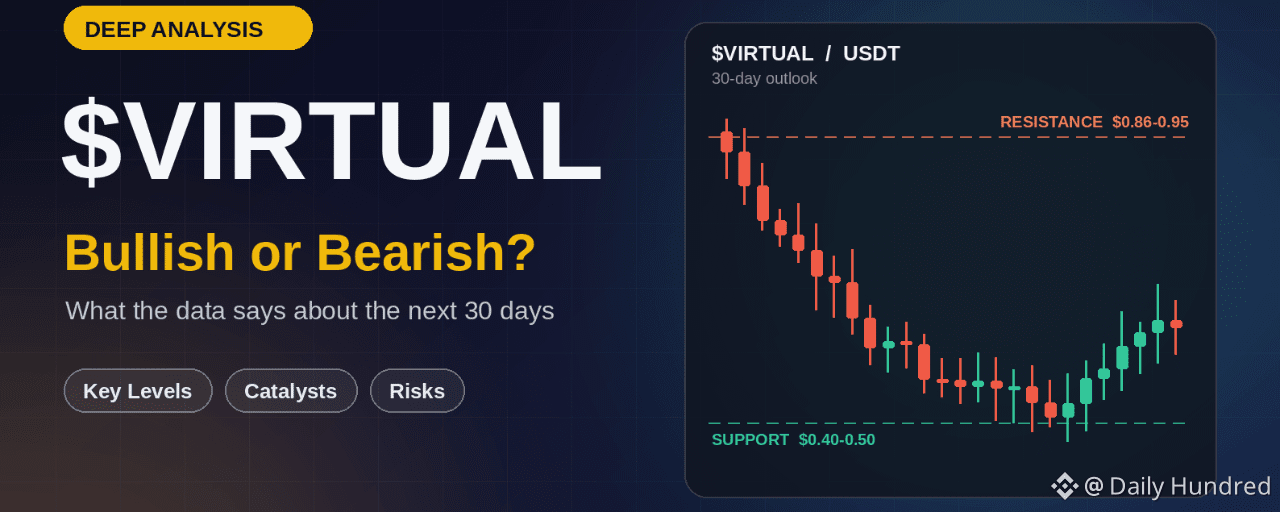
A weekly close above $0.9491 is the technical trigger many analysts are watching before targeting $1.19+, while $0.86 sits as near-term resistance. On the downside, longer-term chart structure points to a $0.40–$0.50 zone as the key support floor that bulls need to defend.
💭 The Bottom Line
VIRTUAL is a high-beta play on whether "agentic commerce" becomes a real economic category or stays a narrative. The infrastructure build (ACP, robotics integration, multi-chain expansion) is genuinely ahead of most AI-crypto competitors — but revenue and active-user numbers are still small, and heavy whale concentration means volatility cuts both ways.
