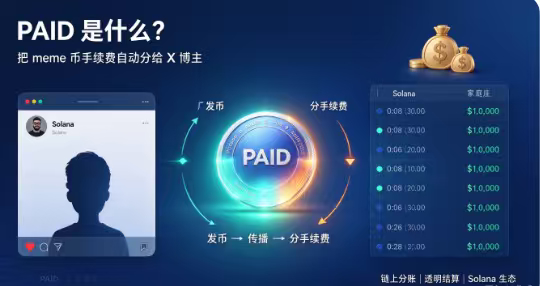
Recently, the PAID narrative in the Solana ecosystem has suddenly become popular. Many people are left confused, wondering what it’s trying to do. Let me explain it in plain language.
Simple understanding: when meme coins are issued now, a creator fee is generated. What PAID does is take this on-chain fee and directly route it to X (Twitter) influencers.
All the token issuer has to do is enter an X account in the project information, and the contract will automatically route the revenue: 80% of the fee is converted into USD and sent directly to the specified influencer via X Money. The influencer doesn’t even need to set up a wallet or buy any coins to receive the earnings. The remaining 20% is used to buy back and burn PAID tokens.
Previously, when influencers promoted coins, they mostly relied on private transfers—opaque and prone to disputes. PAID is essentially setting up an on-chain automatic revenue-splitting system, with monetization of meme project traffic written directly into smart contracts—public and automatically executed.
The engaging part of this story is that it bridges social platforms with on-chain revenue. Meme coins are inseparable from X’s distribution; PAID tries to turn the act of distribution directly into a business model that can be settled on-chain, forming a closed loop of “issuing the coin — distribution — sharing the fees.”
But we also need to face reality: the revenue is split with X influencers, not retail holders of PAID. $paid #paid