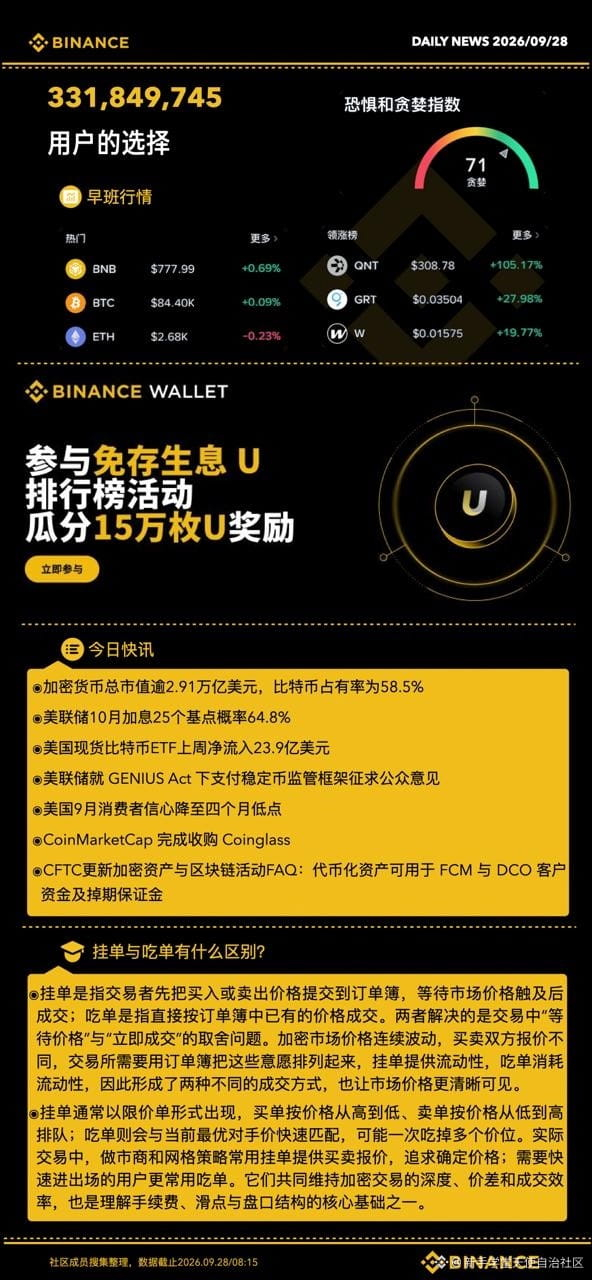

Gm,#学堂日报 9.28 Market Snapshot
1️⃣ Market Overview
▪ The total market capitalization of cryptocurrencies is about $2.91 trillion, with Bitcoin’s market share at 58.5%.
▪ The Fear & Greed Index is 71 (Greed), and market sentiment remains in a relatively strong range.
2️⃣ Binance Updates
▪ Binance Wallet has launched a “Earn Without Storing” (U holding not required) leaderboard campaign. Users can participate to split 150,000 U in rewards.
▪ Binance Wallet continues to expand “earn without storing” and on-chain yield scenarios, providing users with more asset management options.
▪ Binance continues to broaden Web3 use cases around Wallet, stablecoins, and yield-based products.
3️⃣ Industry Highlights
▪ The market estimates the probability of the Fed cutting rates by 25 bps in October at about 64.8%, with interest-rate expectations continuing to influence the performance of risk assets.
▪ U.S. spot Bitcoin ETFs saw net inflows of approximately $2.39 billion last week, as institutional funds keep flowing back.
▪ The U.S. Federal Reserve is seeking public feedback on a stablecoin regulatory framework for payments under the GENIUS Act.
▪ U.S. consumer confidence in September fell to a nearly 4-month low, and the market is watching for changes in subsequent economic data.
▪ CoinMarketCap completed the acquisition of Coinglass.
▪ The CFTC updated its FAQ on crypto assets and blockchain activities, clarifying that certain tokenized assets may be used for FCM and DCO customer funds and holding margin.
4️⃣ Today’s Quick Learn: What’s the difference between placing an order and taking an order?
🔸 What is placing an order (maker)?
▪ Placing an order means users first submit a buy or sell price to the order book and wait for other traders to match and execute.
▪ It effectively provides liquidity to the market, so it’s also often called a Maker.
🔸 What is taking an order (taker)?
▪ Taking an order means executing directly against existing orders already on the order book, emphasizing faster completion.
▪ This approach consumes the market’s existing liquidity, so it’s also called a Taker.
🔸 What are the differences?
▪ Maker: Focuses more on the execution price and requires a counterparty.
▪ Taker: Focuses more on execution speed and directly matches the current best quotes.
▪ Different platforms also typically have different fee standards for Maker and Taker.
🔸 Why does it matter?
▪ Understanding makers and takers helps you judge trading fees, slippage, and execution efficiency.
▪ For users who trade frequently or in large sizes, choosing the right order type directly affects trading costs.
Follow @新手学堂天使自治社区 to learn more 🚀
1️⃣ Market Overview
▪ The total market capitalization of cryptocurrencies is about $2.91 trillion, with Bitcoin’s market share at 58.5%.
▪ The Fear & Greed Index is 71 (Greed), and market sentiment remains in a relatively strong range.
2️⃣ Binance Updates
▪ Binance Wallet has launched a “Earn Without Storing” (U holding not required) leaderboard campaign. Users can participate to split 150,000 U in rewards.
▪ Binance Wallet continues to expand “earn without storing” and on-chain yield scenarios, providing users with more asset management options.
▪ Binance continues to broaden Web3 use cases around Wallet, stablecoins, and yield-based products.
3️⃣ Industry Highlights
▪ The market estimates the probability of the Fed cutting rates by 25 bps in October at about 64.8%, with interest-rate expectations continuing to influence the performance of risk assets.
▪ U.S. spot Bitcoin ETFs saw net inflows of approximately $2.39 billion last week, as institutional funds keep flowing back.
▪ The U.S. Federal Reserve is seeking public feedback on a stablecoin regulatory framework for payments under the GENIUS Act.
▪ U.S. consumer confidence in September fell to a nearly 4-month low, and the market is watching for changes in subsequent economic data.
▪ CoinMarketCap completed the acquisition of Coinglass.
▪ The CFTC updated its FAQ on crypto assets and blockchain activities, clarifying that certain tokenized assets may be used for FCM and DCO customer funds and holding margin.
4️⃣ Today’s Quick Learn: What’s the difference between placing an order and taking an order?
🔸 What is placing an order (maker)?
▪ Placing an order means users first submit a buy or sell price to the order book and wait for other traders to match and execute.
▪ It effectively provides liquidity to the market, so it’s also often called a Maker.
🔸 What is taking an order (taker)?
▪ Taking an order means executing directly against existing orders already on the order book, emphasizing faster completion.
▪ This approach consumes the market’s existing liquidity, so it’s also called a Taker.
🔸 What are the differences?
▪ Maker: Focuses more on the execution price and requires a counterparty.
▪ Taker: Focuses more on execution speed and directly matches the current best quotes.
▪ Different platforms also typically have different fee standards for Maker and Taker.
🔸 Why does it matter?
▪ Understanding makers and takers helps you judge trading fees, slippage, and execution efficiency.
▪ For users who trade frequently or in large sizes, choosing the right order type directly affects trading costs.
Follow @新手学堂天使自治社区 to learn more 🚀