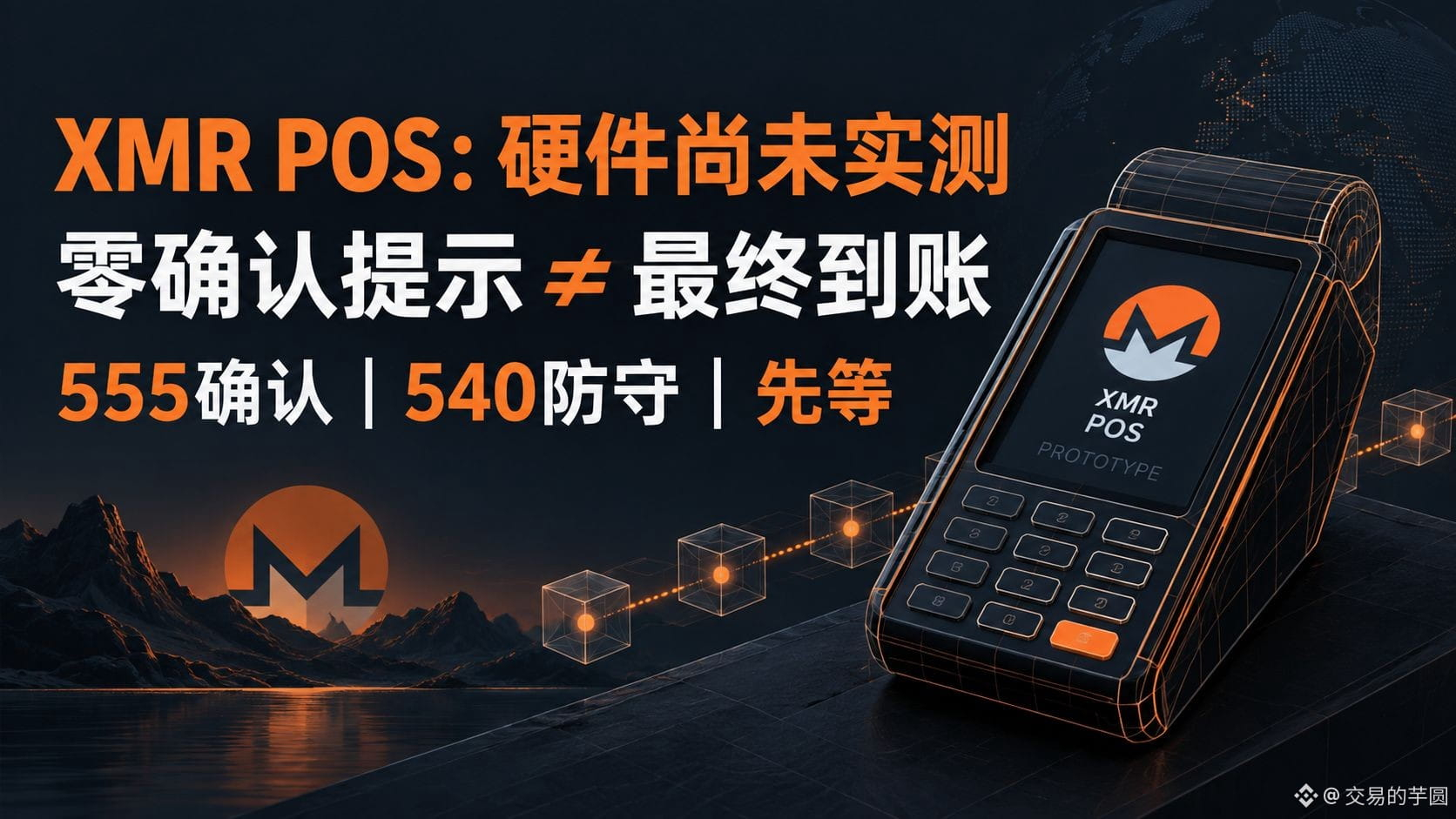
XMR payment terminal source code has been released|The zero-confirmation prompt is not the final settlement|Around $550 I’ll wait first
My stance is to observe first. Don’t treat an untested payment terminal as a new buy order for Monero just because it exists. Payment tools are worth tracking, but “it can display payment success” and “funds have obtained block confirmations” must be viewed separately. That’s more important than rushing to label it as a positive price catalyst.
The fact is: Monero Observer reported on September 23 that developer fujimoto44公开 shared XMR POS source code. The developer’s GitHub repository states the current status as v0.9 and that the hardware has not been tested; development was done in a desktop environment and on the Monero testnet. This is a community developer project, not an official Monero announcement of a mainnet upgrade—and you can’t claim that stores have already deployed it at scale based on this. I cross-read the project documentation and the SECURITY file. The discussion below is about the public design and its boundaries, not an independent audit conclusion.
It attempts to put fiat pricing, payment QR codes, transaction recognition, and receipt recording into the checkout flow of small merchants. The part most easily misread is the default zero-confirmation mode: if it matches a transaction found in the mempool, it can display payment success. If you configure it to require more confirmations, it waits for block confirmations. This design compresses the customer waiting time, but it does not eliminate the double-spend risk of unconfirmed transactions. Fast-food small payments and high-value goods deliveries can tolerate different levels of loss—so you can’t apply the same release criteria.
Another boundary is permissions. The terminal uses an address and a private view key; by design, it does not have the authority to spend funds. But the security file clearly warns that if the viewing key leaks, it would expose the merchant’s deposit history. “Cannot transfer coins away” doesn’t mean “no privacy loss.” Merchants also need to verify the software source, node trustworthiness, and how logs are handled. You can’t skip security checks just because it’s open source or you see a success screen.
Why is this related to XMR? A smoother payment process could lower the adoption barrier—that’s a mechanism-driven hypothesis. But the real need still depends on hardware testing, merchant usage, and retention. Even if someone pays with XMR, the merchant may immediately convert back to fiat, so the growth in payment counts does not automatically equal sustained net buying. There’s no reliable data showing that this source code release has brought in new capital, and certainly you can’t attribute subsequent rises and falls to it.
On price: this round’s Kraken XMR/USD rescan snapshot is around $549.83. The 24-hour range is $540 to $562.95. It’s still within the range, so you can’t write it as having already broken out. Short-term: whether 555 can secure an hourly close confirmation is the key. Above 560 and 563 are near the planned target area; below 546 and 540 are used to constrain risk. These are trade observation lines, not an estimate of project value.
If I were trading myself, I wouldn’t participate now. My position would be zero. I’d only consider a low-risk unleveraged spot attempt: enter only if the hourly close stands above 555, then a pullback to 552–555 holds, and the trading channel is normal. Then I’d use at most 0.4% of total funds to enter. Reduce by half at 560, and close the remainder at 563. If after execution the price falls to 546, I’d cut losses immediately; or if two consecutive hourly candles close below 552, I’d exit entirely. If price first breaks below 540 before entry, I cancel the plan. If there are payment identification issues or key security defects, I withdraw the decision to adopt improvements—not add more just because the “payment narrative” continues. No trigger means no trade—no execution, and therefore no profit to record.
Source: the developer’s GitHub project description and SECURITY, Monero Observer’s September 23 report, and Kraken’s public market data. #XMR
The above is only my personal market observation and does not constitute investment advice.
My stance is to observe first. Don’t treat an untested payment terminal as a new buy order for Monero just because it exists. Payment tools are worth tracking, but “it can display payment success” and “funds have obtained block confirmations” must be viewed separately. That’s more important than rushing to label it as a positive price catalyst.
The fact is: Monero Observer reported on September 23 that developer fujimoto44公开 shared XMR POS source code. The developer’s GitHub repository states the current status as v0.9 and that the hardware has not been tested; development was done in a desktop environment and on the Monero testnet. This is a community developer project, not an official Monero announcement of a mainnet upgrade—and you can’t claim that stores have already deployed it at scale based on this. I cross-read the project documentation and the SECURITY file. The discussion below is about the public design and its boundaries, not an independent audit conclusion.
It attempts to put fiat pricing, payment QR codes, transaction recognition, and receipt recording into the checkout flow of small merchants. The part most easily misread is the default zero-confirmation mode: if it matches a transaction found in the mempool, it can display payment success. If you configure it to require more confirmations, it waits for block confirmations. This design compresses the customer waiting time, but it does not eliminate the double-spend risk of unconfirmed transactions. Fast-food small payments and high-value goods deliveries can tolerate different levels of loss—so you can’t apply the same release criteria.
Another boundary is permissions. The terminal uses an address and a private view key; by design, it does not have the authority to spend funds. But the security file clearly warns that if the viewing key leaks, it would expose the merchant’s deposit history. “Cannot transfer coins away” doesn’t mean “no privacy loss.” Merchants also need to verify the software source, node trustworthiness, and how logs are handled. You can’t skip security checks just because it’s open source or you see a success screen.
Why is this related to XMR? A smoother payment process could lower the adoption barrier—that’s a mechanism-driven hypothesis. But the real need still depends on hardware testing, merchant usage, and retention. Even if someone pays with XMR, the merchant may immediately convert back to fiat, so the growth in payment counts does not automatically equal sustained net buying. There’s no reliable data showing that this source code release has brought in new capital, and certainly you can’t attribute subsequent rises and falls to it.
On price: this round’s Kraken XMR/USD rescan snapshot is around $549.83. The 24-hour range is $540 to $562.95. It’s still within the range, so you can’t write it as having already broken out. Short-term: whether 555 can secure an hourly close confirmation is the key. Above 560 and 563 are near the planned target area; below 546 and 540 are used to constrain risk. These are trade observation lines, not an estimate of project value.
If I were trading myself, I wouldn’t participate now. My position would be zero. I’d only consider a low-risk unleveraged spot attempt: enter only if the hourly close stands above 555, then a pullback to 552–555 holds, and the trading channel is normal. Then I’d use at most 0.4% of total funds to enter. Reduce by half at 560, and close the remainder at 563. If after execution the price falls to 546, I’d cut losses immediately; or if two consecutive hourly candles close below 552, I’d exit entirely. If price first breaks below 540 before entry, I cancel the plan. If there are payment identification issues or key security defects, I withdraw the decision to adopt improvements—not add more just because the “payment narrative” continues. No trigger means no trade—no execution, and therefore no profit to record.
Source: the developer’s GitHub project description and SECURITY, Monero Observer’s September 23 report, and Kraken’s public market data. #XMR
The above is only my personal market observation and does not constitute investment advice.