

One of the most common and exhausting mistakes when someone is just starting out in the crypto world is becoming obsessed with trying to "buy at the lowest point" (buy the dip) and "sell at the highest point" (sell the top). You spend hours looking at 5-minute charts, constantly refreshing the Binance app, and feeling anxious every time a red candle appears on the screen. This search for the perfect moment is known in finance as Market Timing, and the statistical reality is harsh: even professional investors constantly fail at trying to do it.
The main problem with trying to guess market movements is not only technical, but also psychological. When the market rises strongly, euphoria drives us to buy out of fear of missing out (FOMO), right when the asset is most expensive. Conversely, when the market suffers a severe correction, panic paralyzes us or forces us to sell at a loss out of fear that it will keep falling (FUD). In other words, our emotions lead us to do exactly the opposite of what financial logic dictates.
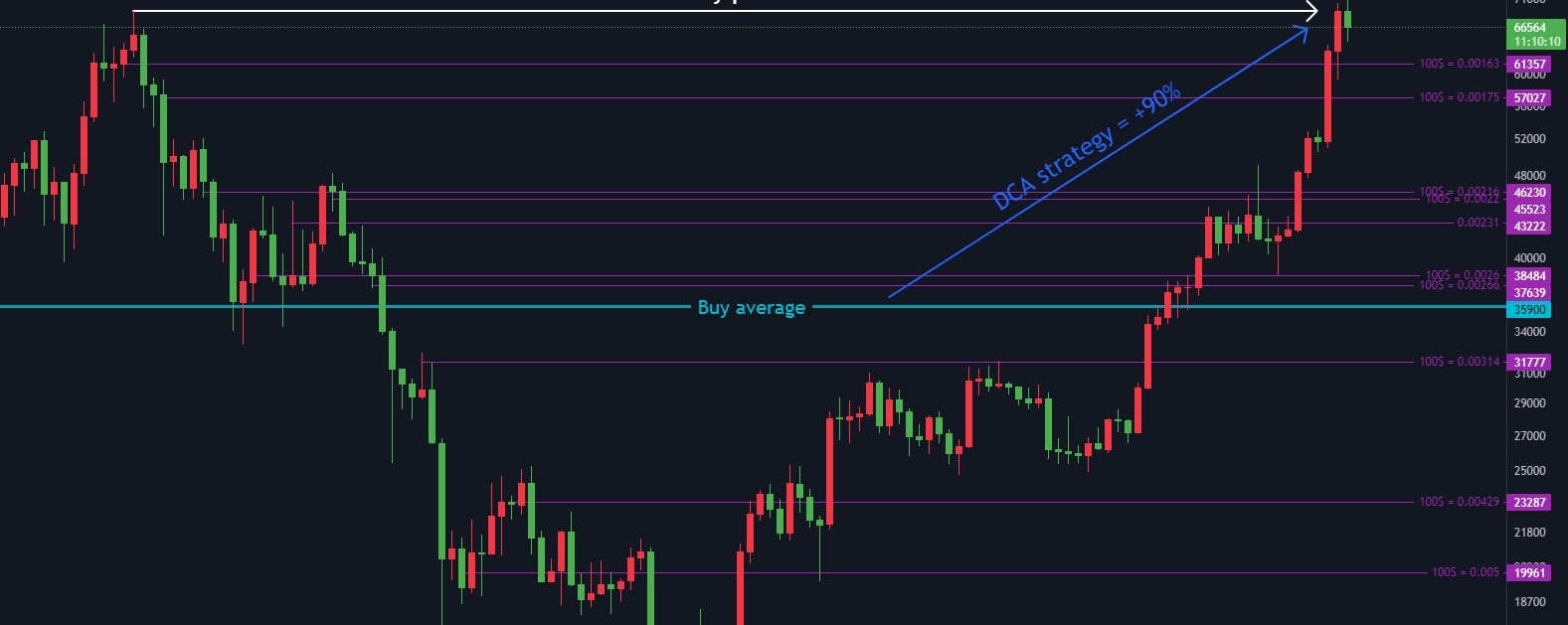
To break this emotional cycle, there’s a simple and highly effective mathematical methodology: Dollar-Cost Averaging (DCA), or Recurring Purchase Strategy.
The DCA principle is straightforward. Instead of taking $500 and investing it all at once in a single day, you split that capital into smaller fractions (for example, $25 each week) and make the purchases in a disciplined, scheduled way—regardless of whether the price of Bitcoin or your favorite token is going up or down at that moment.
Practical effect of DCA in different market scenarios:
In a bear market: When prices fall, your $25 buy a greater number of tokens. You don’t suffer from the drop; you take advantage of it to accumulate more units at a discounted price.
In a bull market: When the price goes up, your $25 buy fewer tokens, but the total value of the portfolio you accumulated previously increases.
Long-term outcome: By combining buys at both high and low points, you neutralize volatility and achieve a highly competitive average entry price, often outperforming those who tried to predict market turns.
The biggest advantage of DCA isn’t just financial, but mental. By automating your decisions, you eliminate daily anxiety, free up time to learn about technology or analyze the real usefulness of projects, and turn investing into a structured, sustainable financial habit over time.
Success in the crypto ecosystem rarely depends on guessing the future on a chart; it depends on discipline, patience, and intelligent risk management.
What do you think? Have you tried applying the DCA strategy to your portfolio, or do you still prefer to make one-time purchases when you see dips? I’d love to hear from you.