


weekend
Aave enabled on the Base network loans of up to 21 million in USDC against seven tokenized stock assets from Co1nbas3, but the price of those collateral freezes on Friday and leaves lenders exposed to a weekend gap.
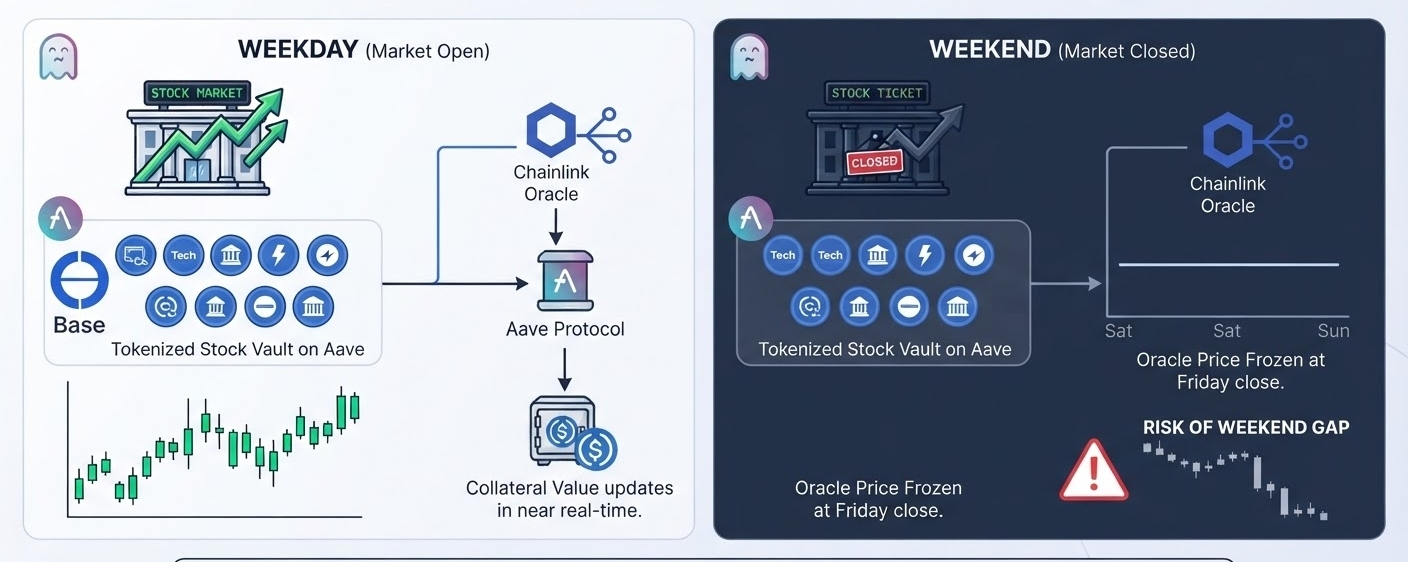
The Aave lending protocol activated, in its deployment on the Base network, a market that allows taking out loans of up to $21 million in USDC using tokenized shares from Co1nbas3 as collateral. The issue that several participants are already pointing out is that the prices of that collateral freeze at Friday’s value and remain that way throughout the entire weekend, when traditional stock exchanges are closed.
The structure works like this: a user deposits tokens representing seven different stocks listed by Co1nbas3 and, against that collateral, withdraws USDC. While the U.S. equity market remains open, the oracles update the value of those positions in near real time. But when Friday’s session closes, the price reference stops moving until Monday’s reopening.
Why tokenized stocks open up weekend risk
The timing mismatch matters because cryptocurrencies trade without interruption, while the underlying stocks do not. If a company publishes bad news on a Saturday or a market event occurs on Sunday, the true value of that stock can change a lot before the exchange reopens. During that window, Aave continues to value the collateral at Friday’s price.
That creates two uncomfortable scenarios. A borrower could be overcollateralized without realizing it, or—the more delicate case for lenders—could hold a position that, in practice, is already worth less than the protocol recognizes. Since liquidations depend on the price reported by the oracle, the system cannot react to a drop that happens while the traditional market is closed.
The reference data comes from Chainlink’s equity feeds, designed specifically to reflect the value of tokenized stocks. This oracle design is correct for trading hours, but by its very nature it cannot invent a price that doesn’t exist when the exchange is closed.
Who takes on the exposure
The risk falls primarily on those who provide liquidity in USDC. They are the ones funding these loans and, in the event of a sharp move over the weekend, could end up with positions that become insufficient before the protocol can liquidate them in an orderly way on Monday.
Aave’s governance community has been discussing these parameters for weeks. In the protocol forums, contributors detailed the deployment on Base and published a technical assessment of Co1nbas3’s tokenized equity assets that are accepted as collateral. This documentation includes exposure limits designed specifically to contain the impact of an adverse event.
The 21 million dollar cap on lendable USDC is no coincidence: it acts as a firewall. By limiting how much capital can be backed by these tokens, the protocol caps the maximum damage that a weekend price jump could cause to the entire pool of lenders.
An experiment at the border between the stock market and DeFi
Aave’s move is part of a broader trend: bringing assets from the traditional world into decentralized finance through tokenization. Tokenized equities promise to trade 24 hours a day and be used as collateral in on-chain loans, something impossible in conventional markets. The cost of that flexibility is precisely the friction with an asset that doesn’t trade nonstop.
Regulatory and commercial interest in bringing stocks into crypto territory is increasing. Recently, the OG.com platform asked the CFTC for authorization to offer perpetual futures on individual stocks in the United States—another sign that products mixing stock markets with crypto infrastructure are gaining traction despite the questions they still raise.
For the DeFi ecosystem, the Aave case serves as practical proof of a problem that theory had already anticipated: coupling an asset with fixed trading hours to a system that never sleeps forces new safeguards to be designed. Exposure limits, discounts on the collateral value, and liquidation mechanisms will have to be adjusted as this kind of collateral grows.
For now, the market on Base operates under conservative rules. The question is what will happen on the first weekend when one of these tokenized stocks records a big move outside trading hours—and whether the margin of safety set by Aave governance is enough to protect USDC lenders.
#USDC #Tokenization #Base #AaveProtocol #defi $AAVE $LINK $COIN