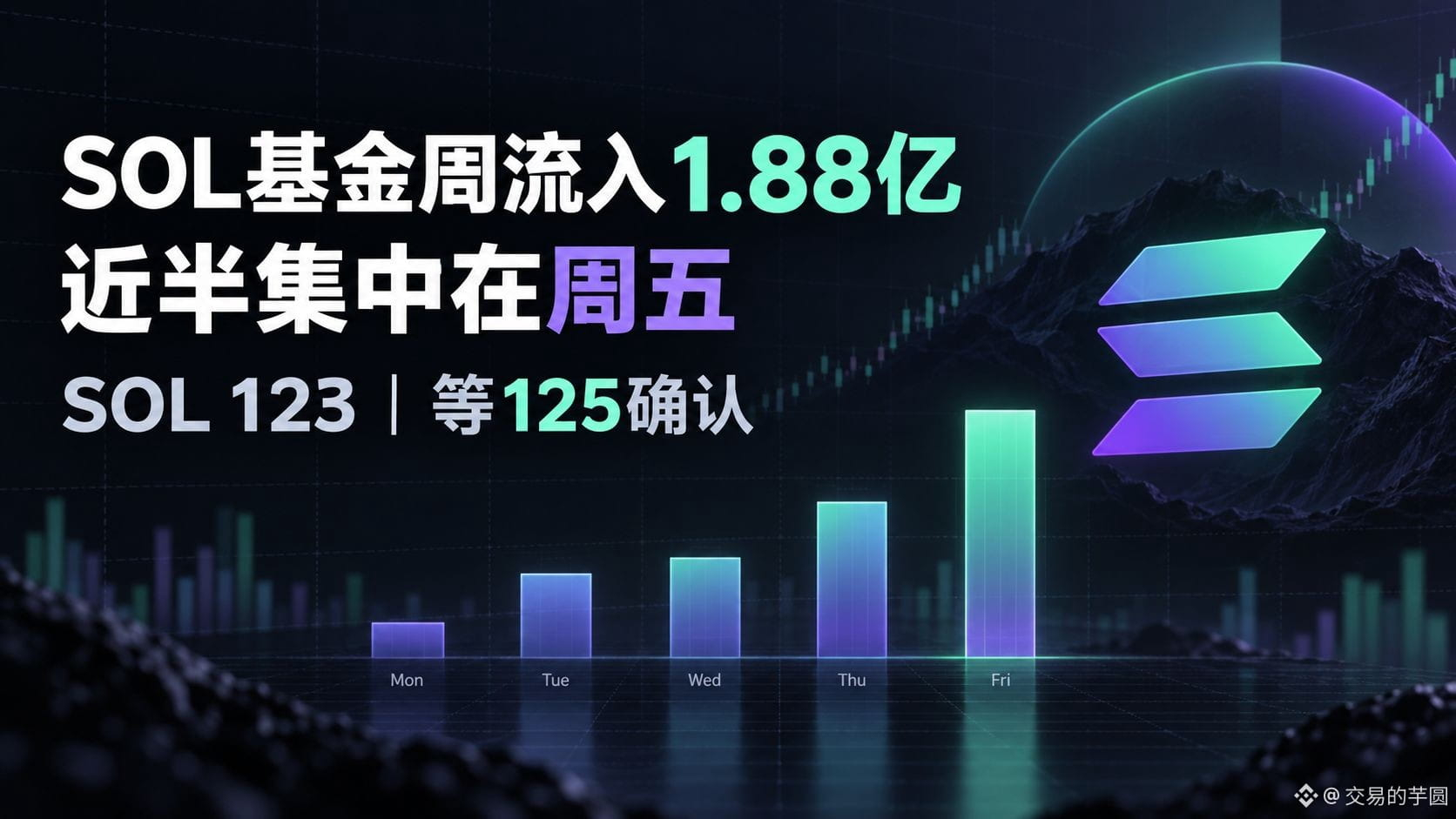
SOL fund sees about $188M inflow for the week|Nearly half on Friday|Around 123, I won’t chase the open
My stance is to acknowledge institutional demand, while refusing to treat the weekly figure as an immediate buy order that hits on Monday. The Binance Square Trending list #SOLSpotETFWeeklyInflow$188M is still climbing. Farside’s publicly available U.S. SOL fund daily flow data shows that from September 21 to 25—five trading days—net inflows, rounded to match the table, total about $188.1M; of that, September 25 alone was about $86.7M, or roughly 46% of the week. This is fund subscriptions/redemptions “already happened last week,” not another $188M flowing in again early this morning. The table involves rounding and different statistical platforms use different reporting conventions, so you can’t package differences in the decimal places as fresh capital.
Crypto spot markets trade all weekend, but U.S. fund shares don’t open in sync, so weekend SOL rises/falls can’t be tied to one-to-one causality with the Friday fund data.
This Trending list matters for SOL because sustained net fund inflows can widen allocation channels and potentially reduce reliance on buy orders from a single crypto trading platform; but the transmission isn’t mechanical. Funds may obtain the underlying assets through authorized participant creations/redemptions, cash or in-kind arrangements. Fund secondary-market trading and underlying spot purchases don’t happen at the exact same time. Bitwise’s BSOL SEC periodic filing further discloses staking, liquidity, and creation/redemption arrangements, reminding holders of SOL that they also need to manage liquidity. These mechanisms neither deny the disclosed net inflows nor equate them to a single “must go up” bullish K-line. The real new variable is whether, after the U.S. market reopens this week, the capital continues to be distributed across multiple trading days and issuers—rather than relying on just one high-value print from last Friday to keep the heat.
Market reaction should be judged by the current price. When I was writing, Kraken SOL/USD was about $123.2. Over the last 24 hours, the high was around $124.9 and the low around $120.1, with the opening near $121.4. Price is above the open, but it still hasn’t effectively broken through the $125 area’s short-term resistance. That suggests there’s still a gap between the bullish narrative and confirmed breakout. I’ll first watch whether it can close steadily above 125, then see whether pullbacks maintain volume. If the new week’s fund data turns negative, or SOL breaks down on heavy volume below $120, then any optimistic projection about capital continuation must be withdrawn. If it only taps 125 intraday and immediately falls back, that doesn’t count as holding.
If I were trading this myself, I wouldn’t participate. My position would be 0% of total capital, with the direction set only as a small spot long test. Only if the 1-hour close holds above 125, and on the retest 124.3–125 is defended, and the new trading day’s fund data shows no obvious net outflows in the opposite direction, would I consider using up to 0.5% of total capital—without leverage. At 127.8, I’d cut the position by half, and at 130 I’d close the remaining lot. After entry, if within an hour price falls back below 124.3, I’d cut by half; if it hits a hard stop at 122.8, I’d exit all positions. Before entry, if it first loses 120, the plan is canceled. I’d rather miss the first leg than write last Friday’s data as if I’d already profited.
Source: Farside SOL fund daily table; Bitwise BSOL 10-Q submitted to the SEC; Market: Kraken SOL/USD. #SOLSpotETFWeeklyInflow$188M #SOL
The above is only my personal market observation and does not constitute investment advice.
My stance is to acknowledge institutional demand, while refusing to treat the weekly figure as an immediate buy order that hits on Monday. The Binance Square Trending list #SOLSpotETFWeeklyInflow$188M is still climbing. Farside’s publicly available U.S. SOL fund daily flow data shows that from September 21 to 25—five trading days—net inflows, rounded to match the table, total about $188.1M; of that, September 25 alone was about $86.7M, or roughly 46% of the week. This is fund subscriptions/redemptions “already happened last week,” not another $188M flowing in again early this morning. The table involves rounding and different statistical platforms use different reporting conventions, so you can’t package differences in the decimal places as fresh capital.
Crypto spot markets trade all weekend, but U.S. fund shares don’t open in sync, so weekend SOL rises/falls can’t be tied to one-to-one causality with the Friday fund data.
This Trending list matters for SOL because sustained net fund inflows can widen allocation channels and potentially reduce reliance on buy orders from a single crypto trading platform; but the transmission isn’t mechanical. Funds may obtain the underlying assets through authorized participant creations/redemptions, cash or in-kind arrangements. Fund secondary-market trading and underlying spot purchases don’t happen at the exact same time. Bitwise’s BSOL SEC periodic filing further discloses staking, liquidity, and creation/redemption arrangements, reminding holders of SOL that they also need to manage liquidity. These mechanisms neither deny the disclosed net inflows nor equate them to a single “must go up” bullish K-line. The real new variable is whether, after the U.S. market reopens this week, the capital continues to be distributed across multiple trading days and issuers—rather than relying on just one high-value print from last Friday to keep the heat.
Market reaction should be judged by the current price. When I was writing, Kraken SOL/USD was about $123.2. Over the last 24 hours, the high was around $124.9 and the low around $120.1, with the opening near $121.4. Price is above the open, but it still hasn’t effectively broken through the $125 area’s short-term resistance. That suggests there’s still a gap between the bullish narrative and confirmed breakout. I’ll first watch whether it can close steadily above 125, then see whether pullbacks maintain volume. If the new week’s fund data turns negative, or SOL breaks down on heavy volume below $120, then any optimistic projection about capital continuation must be withdrawn. If it only taps 125 intraday and immediately falls back, that doesn’t count as holding.
If I were trading this myself, I wouldn’t participate. My position would be 0% of total capital, with the direction set only as a small spot long test. Only if the 1-hour close holds above 125, and on the retest 124.3–125 is defended, and the new trading day’s fund data shows no obvious net outflows in the opposite direction, would I consider using up to 0.5% of total capital—without leverage. At 127.8, I’d cut the position by half, and at 130 I’d close the remaining lot. After entry, if within an hour price falls back below 124.3, I’d cut by half; if it hits a hard stop at 122.8, I’d exit all positions. Before entry, if it first loses 120, the plan is canceled. I’d rather miss the first leg than write last Friday’s data as if I’d already profited.
Source: Farside SOL fund daily table; Bitwise BSOL 10-Q submitted to the SEC; Market: Kraken SOL/USD. #SOLSpotETFWeeklyInflow$188M #SOL
The above is only my personal market observation and does not constitute investment advice.