

长得帅不如跑的快1688
1.1k Posts

长得帅不如跑的快1688
Price is the surface — conviction wins the game. 13y in the trenches. Hard data, sharp calls, no shilling. I read the next move before the crowd. 📊
Open Trade

BNB Holder
Frequent Trader
7.5 Years
600 Following
20.9K+ Followers
5.7K+ Liked
Posts
Portfolio
All
Quotes
Live


静姐168
·
--
Brother Sun let go of what he could not obtain in his youth; but people who crave to show off can never let go.
Sun let go of what he could not obtain in his youth, yet those who crave pretense never will.
Sun let go of what he could not obtain in his youth, yet those who crave pretense never will.


光明社区-千慧
·
--
Close your eyes, let the sea breeze pass through your hair, let the sunlight kiss your skin. In this moment, time seems to stand still—only the blue sky, palm trees, and the azure ocean remain.🌴☀️



橙子Joyce
·
--
✨Orange Joyce|Live Stream Announcement✨
⏰ Time: 21:00–23:00 on September 28, 2026
⏰ Going forward, daily live stream time will be 21:00–23:00
📌 Theme: Analysis of US stock investment strategies and trading practices
Highlights:
✅ Underlying logic of the US stock market and judging market style
✅ Comparison of different strategies: value investing, growth stocks, swing trading
✅ Practical ideas for position management, take-profit and stop-loss
✅ Key points and warnings for US trading risks
Welcome everyone to the live room to chat and discuss!
Hello everyone, welcome to stream.
Today’s topic: US stock investment strategy analysis and trading practice.
We’ll discuss popular strategies, position management and risk control.
⏰ Time: 21:00–23:00 on September 28, 2026
⏰ Going forward, daily live stream time will be 21:00–23:00
📌 Theme: Analysis of US stock investment strategies and trading practices
Highlights:
✅ Underlying logic of the US stock market and judging market style
✅ Comparison of different strategies: value investing, growth stocks, swing trading
✅ Practical ideas for position management, take-profit and stop-loss
✅ Key points and warnings for US trading risks
Welcome everyone to the live room to chat and discuss!
Hello everyone, welcome to stream.
Today’s topic: US stock investment strategy analysis and trading practice.
We’ll discuss popular strategies, position management and risk control.


听澜321
·
--
#Bitget Hackers have started transferring about $83 million stolen $XRP
But what keeps people up at night isn’t that number.
It’s this: there are another $75 million worth of XRP sitting in the hackers’ wallet—no one can touch it.
Why can’t they move it? Because XRP is a “native asset.” The key takeaway is that, as a native asset, Ripple can’t directly freeze it the way it can freeze USDC. That’s the most important lesson from this incident.
Do you not understand what that means?
Plainly: USDT gets stolen, and Tether can freeze with one click. If USDC gets stolen, Circle can blacklist addresses. This time, the stablecoins the hacker has are only about 320k US dollars in total—and they’ve already been frozen.
But XRP is different. Ripple doesn’t have that power. In the XRP Ledger rules, there isn’t even a button for “freezing native assets.”
The hacker can take their time and move the coins to any exchange, swap them for $BTC , swap them for $ETH , or anything else.
Throughout the entire process, no one can stop them.
On the first day after the incident, Richard Teng personally posted that Binance’s security team has been sharing intelligence with Bitget since day one and tracking the funds.
CZ also publicly said he’s willing to help. Exchanges didn’t just trade jokes—this time they cooperated.
The reason is simple: when an attacker transfers funds across platforms, the freezing effect of any single exchange is limited. Today you laugh at Bitget; tomorrow the hacker might come to your place.
But what Binance can do is only one thing: if the hacker moves XRP into Binance, Binance can lock that account and prevent withdrawals. However, the hacker’s wallet itself—Binance can’t touch it, and Ripple can’t either.
I think the most valuable lesson of this incident isn’t whether “Bitget will go under,” and it isn’t whether “the hackers are North Korean.”
It’s that after something goes wrong, “native assets” and “issuer-issued tokens” receive radically different treatment. The “decentralization” you hold has another side: there’s “no safety net.”
This doesn’t mean XRP is bad. What I’m saying is: when choosing assets, you need to understand that some coins have someone to backstop them when things go wrong, while with others you can only hope for the hacker’s mood.
Binance helps Bitget track the stolen funds—credit where it’s due 👍🏻
But Binance can’t help XRP holders—that’s the part this incident is most important to remember.
If you have other views, feel free to comment in the comment section—
#Bitget黑客转移8300万美元被盗XRP
But what keeps people up at night isn’t that number.
It’s this: there are another $75 million worth of XRP sitting in the hackers’ wallet—no one can touch it.
Why can’t they move it? Because XRP is a “native asset.” The key takeaway is that, as a native asset, Ripple can’t directly freeze it the way it can freeze USDC. That’s the most important lesson from this incident.
Do you not understand what that means?
Plainly: USDT gets stolen, and Tether can freeze with one click. If USDC gets stolen, Circle can blacklist addresses. This time, the stablecoins the hacker has are only about 320k US dollars in total—and they’ve already been frozen.
But XRP is different. Ripple doesn’t have that power. In the XRP Ledger rules, there isn’t even a button for “freezing native assets.”
The hacker can take their time and move the coins to any exchange, swap them for $BTC , swap them for $ETH , or anything else.
Throughout the entire process, no one can stop them.
On the first day after the incident, Richard Teng personally posted that Binance’s security team has been sharing intelligence with Bitget since day one and tracking the funds.
CZ also publicly said he’s willing to help. Exchanges didn’t just trade jokes—this time they cooperated.
The reason is simple: when an attacker transfers funds across platforms, the freezing effect of any single exchange is limited. Today you laugh at Bitget; tomorrow the hacker might come to your place.
But what Binance can do is only one thing: if the hacker moves XRP into Binance, Binance can lock that account and prevent withdrawals. However, the hacker’s wallet itself—Binance can’t touch it, and Ripple can’t either.
I think the most valuable lesson of this incident isn’t whether “Bitget will go under,” and it isn’t whether “the hackers are North Korean.”
It’s that after something goes wrong, “native assets” and “issuer-issued tokens” receive radically different treatment. The “decentralization” you hold has another side: there’s “no safety net.”
This doesn’t mean XRP is bad. What I’m saying is: when choosing assets, you need to understand that some coins have someone to backstop them when things go wrong, while with others you can only hope for the hacker’s mood.
Binance helps Bitget track the stolen funds—credit where it’s due 👍🏻
But Binance can’t help XRP holders—that’s the part this incident is most important to remember.
If you have other views, feel free to comment in the comment section—
#Bitget黑客转移8300万美元被盗XRP


奋斗Hustle1688
·
--
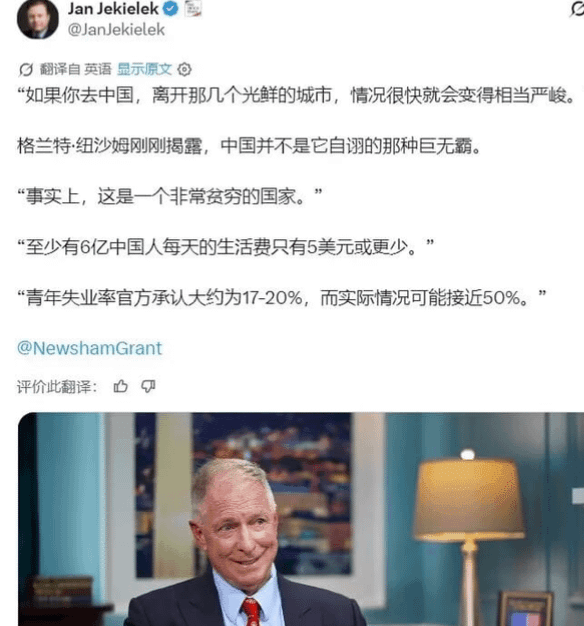
It’s basically going to dig everyone’s family assets out and talk about them~Honestly, have we really reached a living standard of $5 a day? Let’s be real—don’t fool ourselves, haha. If we haven’t, then isn’t hitting 50 yuan a day actually pretty easy?

安然Alpha
·
--
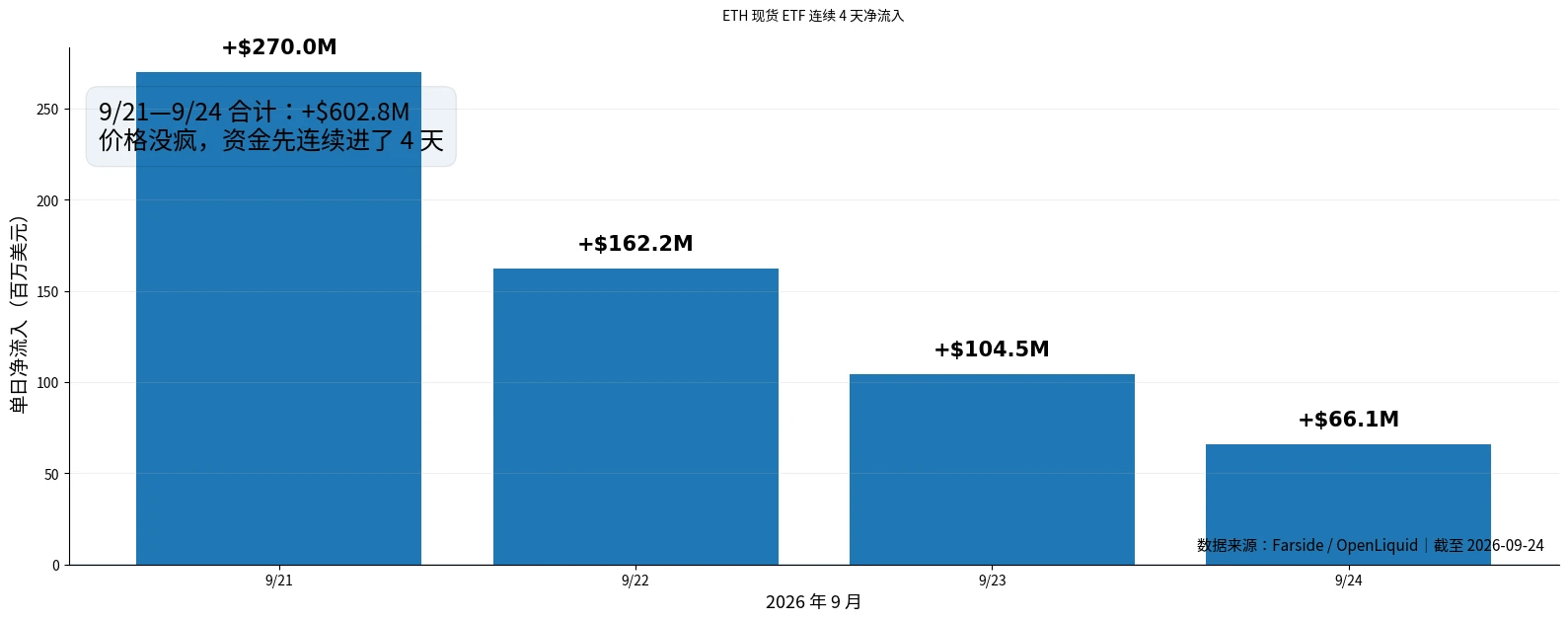
Bullish$ETH These past few days haven’t been that crazy; the ETF has already been fed in $600 million.
ETH is currently around 2710, and today it’s up only about 1%.
But these days the ETF flows are a bit eye-catching:
💰 9/21: +$270 million
💰 9/22: +$162 million
💰 9/23: +$105 million
💰 9/24: +$66.1 million
In four trading days, roughly $600 million has gone into the ETH spot ETF.
The wild part is that the price still hasn’t really cooperated.
There hasn’t been a continuous run of big bullish candles, and nobody across the whole internet has been screaming “ETH bull market is back”—but the money has been coming in, trade by trade. #eth
ETH is currently around 2710, and today it’s up only about 1%.
But these days the ETF flows are a bit eye-catching:
💰 9/21: +$270 million
💰 9/22: +$162 million
💰 9/23: +$105 million
💰 9/24: +$66.1 million
In four trading days, roughly $600 million has gone into the ETH spot ETF.
The wild part is that the price still hasn’t really cooperated.
There hasn’t been a continuous run of big bullish candles, and nobody across the whole internet has been screaming “ETH bull market is back”—but the money has been coming in, trade by trade. #eth

生蚝哥Oyster
·
--
Crypto Currency Daily Report (September 28, 2026)
Market Overview
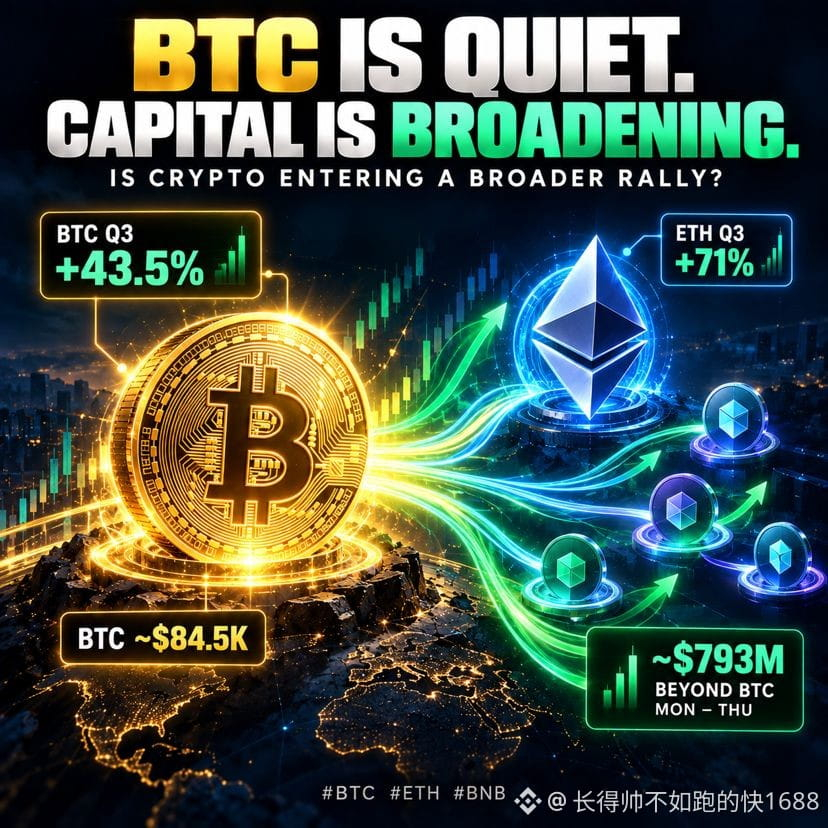
The global cryptocurrency total market cap is approximately $2.89T–$2.97T, largely flat or slightly up over the past 24 hours (0–1%). 24-hour trading volume is about $60B–$70B. Bitcoin’s dominance is around 57–58.6%.
The Fear & Greed Index from most sources is in the 70–74 range (Greed); some sources show neutral readings. Overall sentiment is optimistic but not extreme.
Major Coin Prices
- **Bitcoin (BTC)**: Approximately $84,400–$84,500 (24h basically flat to +0.3%, 7d about +3.5–5.5%). It briefly broke above $87,000 during the week, and is currently consolidating in the $84k–$85k range.
- **Ethereum (ETH)**: Approximately $2,685–$2,690 (24h basically flat).
- **BNB**: Approximately $778–$780.
- **Solana (SOL)**: Approximately $122 (24h +0.6%, and strong 7-day performance around +9–14%).
Overall, altcoins have performed better than BTC this week. Movers include SUI, NEAR, QNT, ADA, DOGE, and others.
Key Developments Today / Soon
- **Strong ETF fund inflows**: U.S. spot Bitcoin ETFs saw net inflows of about **$2.4B** last week (the strongest week since October 2025), helping turn the 2026 net flow back positive. Institutional demand remains a key support factor.
- **Bitget security incident**: Estimated losses have been revised up to **$387.5M**. The attacker has transferred about $83M worth of XRP. The exchange plans to resume withdrawals in phases starting today (September 28), with BTC prioritized and XRP later.
- **Quant (QNT) surges**: Driven by The Clearing House selecting it to support a tokenized deposits network for U.S. banks (On-Chain Money Initiative), the weekly jump ranges from over 100–300% (depending on the time-point data), while trading volume surged.
Brief Analysis
After breaking out, Bitcoin has moved into consolidation. The key thing to watch is whether $85,000 can become support. Altcoins (especially those related to Layer 1 and interoperability such as QNT, SOL, NEAR, SUI) have been active in the short term, indicating capital rotation. Institutional ETF inflows and the bank partnership narrative (tokenization) are positive catalysts right now, but macro interest rates and security incidents remain risks.
Market Overview
The global cryptocurrency total market cap is approximately $2.89T–$2.97T, largely flat or slightly up over the past 24 hours (0–1%). 24-hour trading volume is about $60B–$70B. Bitcoin’s dominance is around 57–58.6%.
The Fear & Greed Index from most sources is in the 70–74 range (Greed); some sources show neutral readings. Overall sentiment is optimistic but not extreme.
Major Coin Prices
- **Bitcoin (BTC)**: Approximately $84,400–$84,500 (24h basically flat to +0.3%, 7d about +3.5–5.5%). It briefly broke above $87,000 during the week, and is currently consolidating in the $84k–$85k range.
- **Ethereum (ETH)**: Approximately $2,685–$2,690 (24h basically flat).
- **BNB**: Approximately $778–$780.
- **Solana (SOL)**: Approximately $122 (24h +0.6%, and strong 7-day performance around +9–14%).
Overall, altcoins have performed better than BTC this week. Movers include SUI, NEAR, QNT, ADA, DOGE, and others.
Key Developments Today / Soon
- **Strong ETF fund inflows**: U.S. spot Bitcoin ETFs saw net inflows of about **$2.4B** last week (the strongest week since October 2025), helping turn the 2026 net flow back positive. Institutional demand remains a key support factor.
- **Bitget security incident**: Estimated losses have been revised up to **$387.5M**. The attacker has transferred about $83M worth of XRP. The exchange plans to resume withdrawals in phases starting today (September 28), with BTC prioritized and XRP later.
- **Quant (QNT) surges**: Driven by The Clearing House selecting it to support a tokenized deposits network for U.S. banks (On-Chain Money Initiative), the weekly jump ranges from over 100–300% (depending on the time-point data), while trading volume surged.
Brief Analysis
After breaking out, Bitcoin has moved into consolidation. The key thing to watch is whether $85,000 can become support. Altcoins (especially those related to Layer 1 and interoperability such as QNT, SOL, NEAR, SUI) have been active in the short term, indicating capital rotation. Institutional ETF inflows and the bank partnership narrative (tokenization) are positive catalysts right now, but macro interest rates and security incidents remain risks.

@听澜321
is speaking[LIVE] 🎙️ Build the Binance Plaza, hold BNB|A new Monday—will there be a good market? Let’s chat~
2.9k listens

KIM_加密 143
·
--
Bullish😂 Me & My Trading Partner:
Her: “Babe, remember all that money we saved for the house?” 🏠💰
Me: “Of course…” 👀
Also me: BTC dumped, so I used it for the dip. 📉😭
Her: “WHERE DID THE HOUSE MONEY GO?”
Me: “Into the candles… and now the candles are burning me.” 😂🔥
🎁 COIN GIVEAWAY ALERT 🪙
Maybe the next bag is yours! 👀💰
Follow • Like ❤️ • Comment • Share/Repost 🔄
Stay tuned for the giveaway details! 🎁🧧
#BTC #Crypto #Bitcoin #CryptoMeme #TradingMeme #CoinGiveaway #CryptoGiveaway #TraderLife #CryptoTrading #BinanceSquare
$SOL
$ETH $NVDA.US
Her: “Babe, remember all that money we saved for the house?” 🏠💰
Me: “Of course…” 👀
Also me: BTC dumped, so I used it for the dip. 📉😭
Her: “WHERE DID THE HOUSE MONEY GO?”
Me: “Into the candles… and now the candles are burning me.” 😂🔥
🎁 COIN GIVEAWAY ALERT 🪙
Maybe the next bag is yours! 👀💰
Follow • Like ❤️ • Comment • Share/Repost 🔄
Stay tuned for the giveaway details! 🎁🧧
#BTC #Crypto #Bitcoin #CryptoMeme #TradingMeme #CoinGiveaway #CryptoGiveaway #TraderLife #CryptoTrading #BinanceSquare
$SOL
$ETH $NVDA.US


Deepak_XBT
·
--
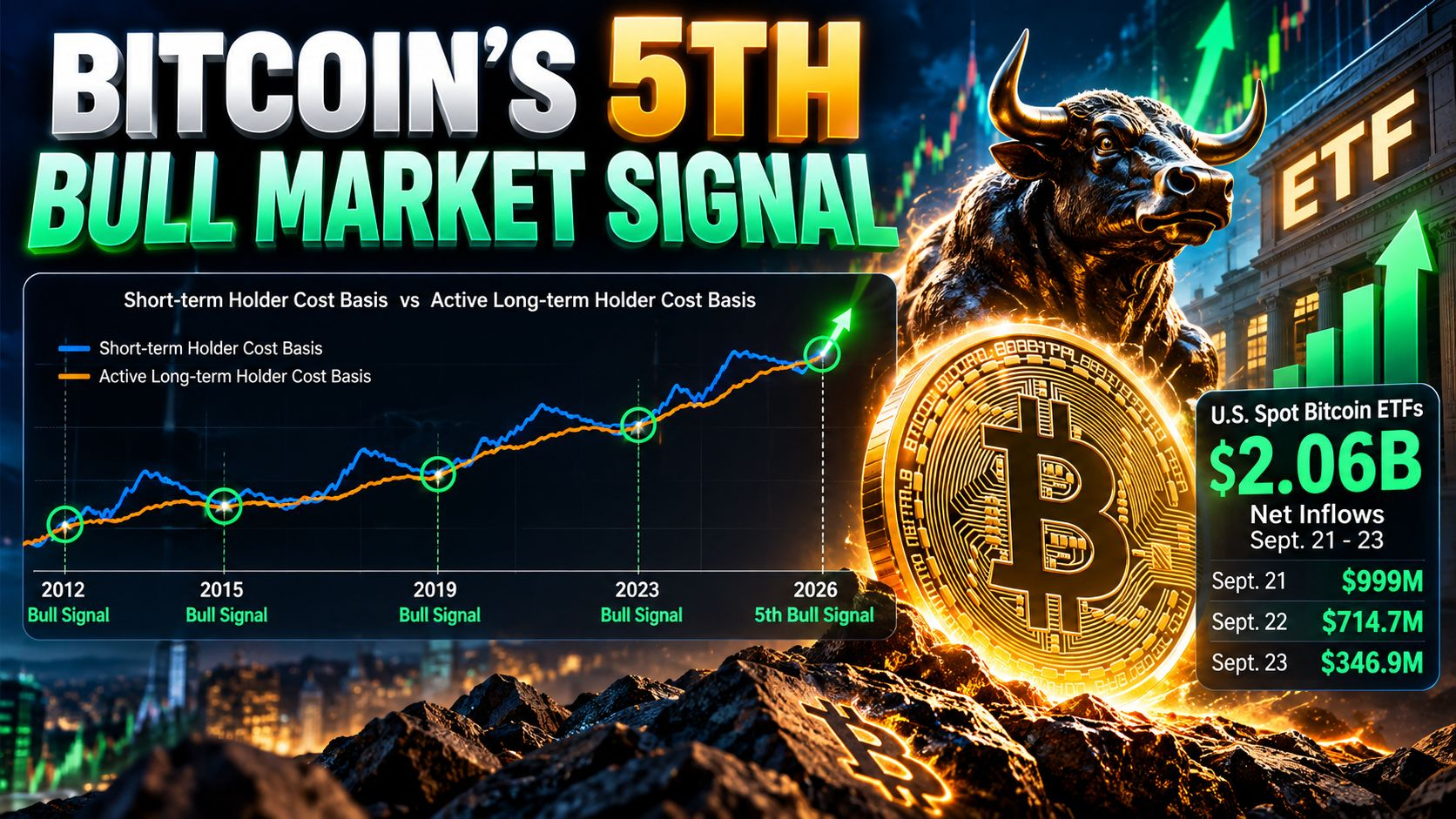
Bitcoin just flashed a signal that has appeared only four times before.
CryptoQuant contributor Darkfost says the latest crossover happened when Bitcoin’s short-term holder cost basis moved above the cost basis of active long-term holders.
The previous signals appeared in 2012, 2015, 2019 and 2023.
What makes this interesting is the context. U.S. spot Bitcoin ETFs recorded $2.06B in net inflows from Sept. 21–23, including a massive $999M on Sept. 21.
Still, one signal doesn’t guarantee anything. The analyst himself points out there is always a margin for error.
For me, the bigger question is whether this crossover is the start of another sustained cycle or simply another temporary shift in holder behavior.
What do you think?
$NVDAB
$BTC
CryptoQuant contributor Darkfost says the latest crossover happened when Bitcoin’s short-term holder cost basis moved above the cost basis of active long-term holders.
The previous signals appeared in 2012, 2015, 2019 and 2023.
What makes this interesting is the context. U.S. spot Bitcoin ETFs recorded $2.06B in net inflows from Sept. 21–23, including a massive $999M on Sept. 21.
Still, one signal doesn’t guarantee anything. The analyst himself points out there is always a margin for error.
For me, the bigger question is whether this crossover is the start of another sustained cycle or simply another temporary shift in holder behavior.
What do you think?
$NVDAB
$BTC

白鲨观点马来西亚
·
--
I know, a lot of people feel uncomfortable today.
It’s not that you lost money—it’s that you missed the move.
A few days ago, when it was dropping, you told yourself, “Wait a bit—there will be another dip.” “Buy only when it drops below 70,000.” “Once it stabilizes, I’ll decide.” So what happened? You waited and waited, and then a big bullish candle came—straight from 76,000 to 81,000. In two days, it jumped nearly 10%.
Then you started to feel bad.
“I wish I had bought at the recent low.”
“I was ready to place the order, but I hesitated.”
“Can I still get in now? What if I’m chasing and it keeps going up?”
“Wait for a pullback… but what if it never pulls back and keeps climbing?”
I totally understand that feeling.
Missing the trade is painful—sometimes it’s not any lighter than losing money. Losing money is at least, “I did it, and I was wrong.” Missing it is, “I clearly saw the opportunity, but I didn’t catch it.” That kind of regret and resentment is even more tormenting than losing money.
But I want to tell you the truth: missing the trade isn’t your fault.
No one can buy at the absolute bottom, and no one can sell at the absolute top. Those who say they “nailed the exact bottom” are either lucky or just bragging. If you check their past records, you’ll definitely find countless times they also bought their “bottom” in the middle of the mountain.
Trading isn’t an exam—you don’t have to get every question right. You just need to grab the opportunities you understand, and make the money that’s within your ability. What you miss, let it be missed. There’s nothing that big about it.
In the crypto market, opportunities are never in short supply.
If you miss this rebound today,
next month there may be another wave,
and next year there could be even bigger行情.
As long as you’re still in the market,
as long as you still have “ammunition,”
you’ll always have a chance.
What’s the worst part? It’s when you lose your composure after missing the trade, and you feel forced to chase in to “make up the loss.” Then you end up buying at the top, getting trapped in the position, and it becomes a loop: cutting loss, regret, chasing again, trapped again… a vicious cycle.
So what should you do if you miss the trade?
Two words: Accept.
Accept that you missed it.
Accept that others made money and you didn’t.
Accept that the market won’t follow your script.
Then quietly wait for the next opportunity.
You can’t make all the money,
but if you’re impatient,
you can lose it all.
#BinanceSquare #BTC #交易心态 #踏空 #Tradingers’ daily life
It’s not that you lost money—it’s that you missed the move.
A few days ago, when it was dropping, you told yourself, “Wait a bit—there will be another dip.” “Buy only when it drops below 70,000.” “Once it stabilizes, I’ll decide.” So what happened? You waited and waited, and then a big bullish candle came—straight from 76,000 to 81,000. In two days, it jumped nearly 10%.
Then you started to feel bad.
“I wish I had bought at the recent low.”
“I was ready to place the order, but I hesitated.”
“Can I still get in now? What if I’m chasing and it keeps going up?”
“Wait for a pullback… but what if it never pulls back and keeps climbing?”
I totally understand that feeling.
Missing the trade is painful—sometimes it’s not any lighter than losing money. Losing money is at least, “I did it, and I was wrong.” Missing it is, “I clearly saw the opportunity, but I didn’t catch it.” That kind of regret and resentment is even more tormenting than losing money.
But I want to tell you the truth: missing the trade isn’t your fault.
No one can buy at the absolute bottom, and no one can sell at the absolute top. Those who say they “nailed the exact bottom” are either lucky or just bragging. If you check their past records, you’ll definitely find countless times they also bought their “bottom” in the middle of the mountain.
Trading isn’t an exam—you don’t have to get every question right. You just need to grab the opportunities you understand, and make the money that’s within your ability. What you miss, let it be missed. There’s nothing that big about it.
In the crypto market, opportunities are never in short supply.
If you miss this rebound today,
next month there may be another wave,
and next year there could be even bigger行情.
As long as you’re still in the market,
as long as you still have “ammunition,”
you’ll always have a chance.
What’s the worst part? It’s when you lose your composure after missing the trade, and you feel forced to chase in to “make up the loss.” Then you end up buying at the top, getting trapped in the position, and it becomes a loop: cutting loss, regret, chasing again, trapped again… a vicious cycle.
So what should you do if you miss the trade?
Two words: Accept.
Accept that you missed it.
Accept that others made money and you didn’t.
Accept that the market won’t follow your script.
Then quietly wait for the next opportunity.
You can’t make all the money,
but if you’re impatient,
you can lose it all.
#BinanceSquare #BTC #交易心态 #踏空 #Tradingers’ daily life


奶龙Bit
·
--
Get 1,000 followers! Distributing 88 USDT rewards to everyone 🧧🧧🧧


北辰1688
·
--
Bullish$ADA This old guy finally isn’t just left with “faith” anymore
ADA is now around 0.25. Honestly, the price looks genuinely easy to stomach.
But lately, things under Cardano have started to change a bit.
🔥 On September 24, Fireblocks announced full support for Cardano native assets. This platform serves thousands of banks, exchanges, payment providers, and financial institutions. Official disclosures say the total value of digital asset transactions it has cumulatively protected exceeds $1.6 quadrillion. From now on, these institutions can directly custody and send Cardano native tokens.
Also, the Leios testnet is already running. Cardano is still working on the one part people have most complained about—performance.
📊 Over on-chain, it’s not like everything is just lying flat either. Cardano DeFi TVL is currently about $68.78 million, and it’s grown noticeably over the past month.
When I look at ADA now, I don’t really want to hear those old lines like “academically the strongest” or “technically the most stable.”
I’m only looking at one thing:
Whether those bank entry points, scaling efforts, and ecosystem funding can truly get the chain used.
ADA’s problem has never been that the story isn’t big enough.
It’s that the story has been told for too many years—the market is numb to it already 😂
If this time there’s actually something real, then let’s get the on-chain data moving first.
ADA is now around 0.25. Honestly, the price looks genuinely easy to stomach.
But lately, things under Cardano have started to change a bit.
🔥 On September 24, Fireblocks announced full support for Cardano native assets. This platform serves thousands of banks, exchanges, payment providers, and financial institutions. Official disclosures say the total value of digital asset transactions it has cumulatively protected exceeds $1.6 quadrillion. From now on, these institutions can directly custody and send Cardano native tokens.
Also, the Leios testnet is already running. Cardano is still working on the one part people have most complained about—performance.
📊 Over on-chain, it’s not like everything is just lying flat either. Cardano DeFi TVL is currently about $68.78 million, and it’s grown noticeably over the past month.
When I look at ADA now, I don’t really want to hear those old lines like “academically the strongest” or “technically the most stable.”
I’m only looking at one thing:
Whether those bank entry points, scaling efforts, and ecosystem funding can truly get the chain used.
ADA’s problem has never been that the story isn’t big enough.
It’s that the story has been told for too many years—the market is numb to it already 😂
If this time there’s actually something real, then let’s get the on-chain data moving first.


加密大格格
·
--
Don’t underestimate it—bulls come, fire on Mars, and every 10 to 30 point swing. This is nearly a 100% win rate that can be compounded.
The big trend’s compounding effect is real. Running it long-term will definitely outperform the small swings.
The big trend’s compounding effect is real. Running it long-term will definitely outperform the small swings.

奕泽YIZZE
·
--
🧧🧧🧧Follow, like, share, and get red envelopes!
静待时光沉淀,LUCIC前路自有万丈光芒。
静待时光沉淀,LUCIC前路自有万丈光芒。


圣克斯Lucky1688
·
--
🧧🎁🌹🧧🎁🌹
September 27 Information Quick Review:
Miner sell pressure may ease: JPMorgan analysis says that the current Bitcoin price has returned to the production cost range of around $85,000. As some miners get through the period of cost inverted pressure, overall miner selling pressure may further ease.
The Fed advances new stablecoin rules under the GENIUS Act: The Federal Reserve has officially released two highly anticipated stablecoin rule proposals in connection with the GENIUS Act. The proposals enter a 60-day public comment period. The proposals require that payment stablecoins issued by regulated banks must be backed by fully compliant 1:1 reserves (supporting U.S. Treasuries, Federal Reserve deposits, etc.), must unconditionally satisfy user redemptions within 2 business days, and must establish standardized capital charging and anti-money-laundering review standards.
U.S. stocks officially become DeFi collateral: Lending giant Aave has achieved a milestone—users can now officially deposit tokenized U.S. stocks, including seven tokenized equities such as Apple, Nvidia, and Tesla, into the platform and use them as collateral to borrow USDC.
Scale and risk-control limits: According to the initial settings from risk-control provider LlamaRisk, the loan-to-value (LTV) ratio for this batch of tokenized stocks (supported by Coinbase) is controlled between 65% and 79%. The initial USDC borrowing limit is set at $21 million—an important step toward deeper integration between TradFi (traditional finance) and DeFi.
Bitget exchange suffers a security incident: Blockchain security monitoring shows that the exchange Bitget was hacked and a large amount of XRP was transferred out (worth about $83 million). Since the XRP ledger (XRPL) native architecture does not support directly freezing assets by a single issuing party, Ripple appears powerless in responding to such cross-chain hacker transfers, sparking heated community debate over freezing and security mechanisms for assets on specific chains.
Follow me—answer 1 to take away the $SOL 红包 (red packet)!
September 27 Information Quick Review:
Miner sell pressure may ease: JPMorgan analysis says that the current Bitcoin price has returned to the production cost range of around $85,000. As some miners get through the period of cost inverted pressure, overall miner selling pressure may further ease.
The Fed advances new stablecoin rules under the GENIUS Act: The Federal Reserve has officially released two highly anticipated stablecoin rule proposals in connection with the GENIUS Act. The proposals enter a 60-day public comment period. The proposals require that payment stablecoins issued by regulated banks must be backed by fully compliant 1:1 reserves (supporting U.S. Treasuries, Federal Reserve deposits, etc.), must unconditionally satisfy user redemptions within 2 business days, and must establish standardized capital charging and anti-money-laundering review standards.
U.S. stocks officially become DeFi collateral: Lending giant Aave has achieved a milestone—users can now officially deposit tokenized U.S. stocks, including seven tokenized equities such as Apple, Nvidia, and Tesla, into the platform and use them as collateral to borrow USDC.
Scale and risk-control limits: According to the initial settings from risk-control provider LlamaRisk, the loan-to-value (LTV) ratio for this batch of tokenized stocks (supported by Coinbase) is controlled between 65% and 79%. The initial USDC borrowing limit is set at $21 million—an important step toward deeper integration between TradFi (traditional finance) and DeFi.
Bitget exchange suffers a security incident: Blockchain security monitoring shows that the exchange Bitget was hacked and a large amount of XRP was transferred out (worth about $83 million). Since the XRP ledger (XRPL) native architecture does not support directly freezing assets by a single issuing party, Ripple appears powerless in responding to such cross-chain hacker transfers, sparking heated community debate over freezing and security mechanisms for assets on specific chains.
Follow me—answer 1 to take away the $SOL 红包 (red packet)!




路人1688luren
·
--
#SEC称回购与升级不必然使代币成证券 Many times many things are not that you make an effort and there will be results. When the gears of fate turn, it’s as if there are two invisible hands pushing you toward another direction... When one door closes, another opens... $USD1




光明社区-阿波罗
·
--
LUCiC, so that every time you shine, you have more confidence.
LUCiC — Let every moment of yours shine with confidence.
LUCiC — Let every moment of yours shine with confidence.

Log in to explore more content