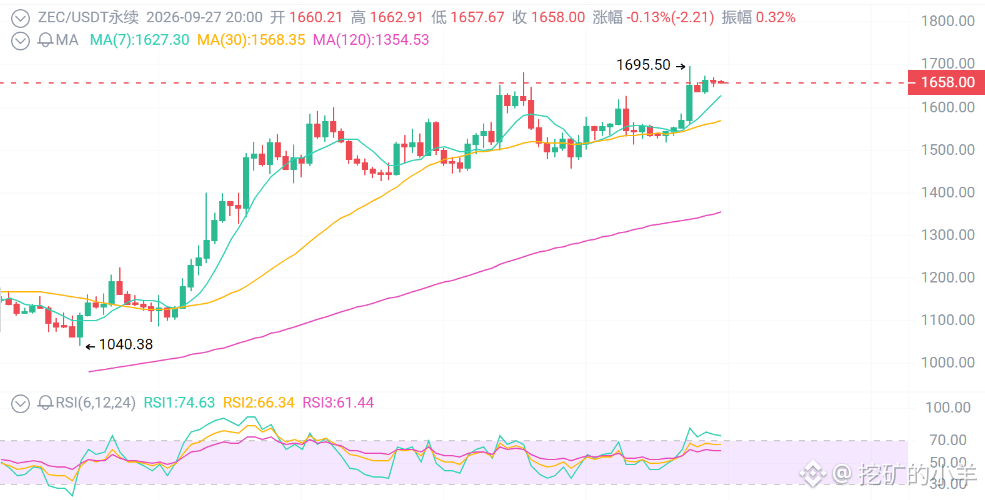
$1,658 ZEC—are you going after it?
First, look at the surface: after a massive surge, it’s been consolidating at high levels.
In 24 hours it’s up 7–8%, in 7 days it’s two-digit gains, and in 30 days it has doubled. Market cap is $28 billion, pushing into the top ten. Circulating supply is 16.88 million coins, with a hard cap of 21 million.
The price on the daily chart is far above EMA20, EMA50, and EMA200, so the trend hasn’t broken. But RSI is already 68–69—overbought. The prior high at 1680–1700 is like a wall.
First thing: ETFs are coming, but institutions won’t just floor the gas pedal forever.
Grayscale’s ZCSH has converted from a trust into a U.S. spot ETF, with AUM briefly surpassing $1 billion. 21Shares has also listed a physically backed ZEC ETP on the Euronext exchange. Privacy coins finally have a legitimate funding gateway.
Privacy coins have moved from the dark web to Wall Street—but Wall Street money isn’t here to do charity.
Second thing: the NU7 upgrade, with the mainnet target on Nov 5.
The testnet is Oct 6, final confirmation is Oct 20, and the mainnet is Nov 5. Block time is cut from 75 seconds to 25 seconds, keeping a Bitcoin-style halving, and introducing a fee lock mechanism. Holders’ voting participation is extremely high—at 25 seconds per block, approval is nearly unanimous.
The upgrade is the story; price is the emotion. Nov 5 could be a carnival—or a funeral.
Third thing: the token distribution looks clean, but the economic model is a beggar.
A hard cap of 21M, no VC unlocks, no ongoing sell pressure from any hidden pre-mine.
The shielded pool is about 29%; in early 2024 it was only 8%—4.9 million ZEC are locked in the privacy pool, liquidity is poor, effectively like natural staking.
That’s the hardest part about ZEC.
But the hard side has a soft downside: fees can hardly sustain development. The team is funded by a share of block rewards, and holders get diluted every year.
Without staking yield, holders hold purely on narrative and the price spread.
ZEC is the king of privacy—but a beggar for cash flow.
Trading strategy
For those with no position:
Wait for a pullback to 1580–1600, even better at 1530–1555. Stop loss: a valid daily close below 1470. First target 1680–1700 to take half off. Second target 1745–1760.
If it directly breaks above 1700 on heavy volume and holds—then consider chasing the breakout. Stop loss below 1640. Targets 1750/1890.
For existing long positions at lower levels:
Reduce some between 1680–1700 to lock in costs; use 1470 as the lifeline for the remainder.
For existing longs chasing at higher levels:
First priority is to reduce leverage; stop loss received below 1530.
For short-term short positions:
Only short if 1680–1700 shows long upper wicks, volume isn’t keeping up, and the 1H structure turns weaker.
Try a short in 1685–1705. Stop loss above 1725. Targets 1620 → 1580.
If you can’t hold, exit—no “holding through losses” allowed, and no turning it into a trend short.
First, look at the surface: after a massive surge, it’s been consolidating at high levels.
In 24 hours it’s up 7–8%, in 7 days it’s two-digit gains, and in 30 days it has doubled. Market cap is $28 billion, pushing into the top ten. Circulating supply is 16.88 million coins, with a hard cap of 21 million.
The price on the daily chart is far above EMA20, EMA50, and EMA200, so the trend hasn’t broken. But RSI is already 68–69—overbought. The prior high at 1680–1700 is like a wall.
First thing: ETFs are coming, but institutions won’t just floor the gas pedal forever.
Grayscale’s ZCSH has converted from a trust into a U.S. spot ETF, with AUM briefly surpassing $1 billion. 21Shares has also listed a physically backed ZEC ETP on the Euronext exchange. Privacy coins finally have a legitimate funding gateway.
Privacy coins have moved from the dark web to Wall Street—but Wall Street money isn’t here to do charity.
Second thing: the NU7 upgrade, with the mainnet target on Nov 5.
The testnet is Oct 6, final confirmation is Oct 20, and the mainnet is Nov 5. Block time is cut from 75 seconds to 25 seconds, keeping a Bitcoin-style halving, and introducing a fee lock mechanism. Holders’ voting participation is extremely high—at 25 seconds per block, approval is nearly unanimous.
The upgrade is the story; price is the emotion. Nov 5 could be a carnival—or a funeral.
Third thing: the token distribution looks clean, but the economic model is a beggar.
A hard cap of 21M, no VC unlocks, no ongoing sell pressure from any hidden pre-mine.
The shielded pool is about 29%; in early 2024 it was only 8%—4.9 million ZEC are locked in the privacy pool, liquidity is poor, effectively like natural staking.
That’s the hardest part about ZEC.
But the hard side has a soft downside: fees can hardly sustain development. The team is funded by a share of block rewards, and holders get diluted every year.
Without staking yield, holders hold purely on narrative and the price spread.
ZEC is the king of privacy—but a beggar for cash flow.
Trading strategy
For those with no position:
Wait for a pullback to 1580–1600, even better at 1530–1555. Stop loss: a valid daily close below 1470. First target 1680–1700 to take half off. Second target 1745–1760.
If it directly breaks above 1700 on heavy volume and holds—then consider chasing the breakout. Stop loss below 1640. Targets 1750/1890.
For existing long positions at lower levels:
Reduce some between 1680–1700 to lock in costs; use 1470 as the lifeline for the remainder.
For existing longs chasing at higher levels:
First priority is to reduce leverage; stop loss received below 1530.
For short-term short positions:
Only short if 1680–1700 shows long upper wicks, volume isn’t keeping up, and the 1H structure turns weaker.
Try a short in 1685–1705. Stop loss above 1725. Targets 1620 → 1580.
If you can’t hold, exit—no “holding through losses” allowed, and no turning it into a trend short.