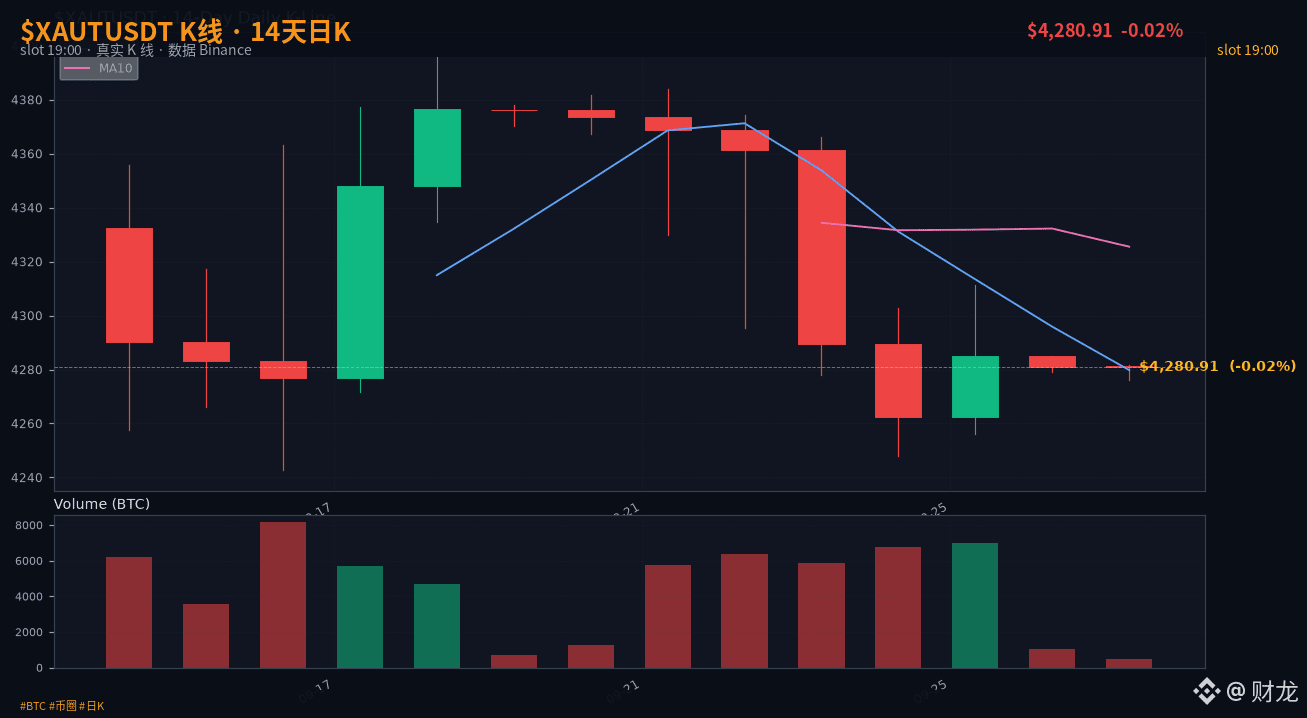

$XAUT was 4280.91 US dollars, down slightly by 0.02% over 24 hours; during the day it just hovered around the 4280 level, with an intraday high-low range of less than 5 US dollars—neither the bulls nor the bears really took the lead. $BTC in the same period stood above 84864, up 0.86% intraday. The two asset types went sideways and up respectively, but neither one collapsed.
Right now, the textbook view would suggest gold should move lower: US 10-year Treasury yields are at 5.18%, at multi-year highs; real yields are rising too, and the US dollar index DXY at 119.51 hasn’t eased. By the traditional formula, with both conditions met, gold should face downward pressure for a stretch. But an industry commentary from Sept 25 said, “Gold is breaking away from old rules.” That week, although gold ended the week slightly lower on the weekly chart, the key level at 4300 was never effectively smashed through. Wall Street is split on the next path, while retail investors on Main Street still lean bullish.
Off the chart, that line hasn’t broken. Central banks’ “long money” has been net adding since last November, without a pause in between. Data from the World Gold Council shows that, cumulatively within the year, it is already above 80 tonnes—double compared with the same period last year. In Europe and North America, global holdings are also flowing back: in August, the monthly figure of 46.7 tonnes was the biggest weekly influx in nearly ten months. With money continuing to pour in off-exchange, the on-exchange price is being supported.
As for gold: both engines—long funds off-exchange and the return of capital—haven’t been shut off. Only if gold truly breaks below 4250 should we talk about the next step. A rise above 4310 would be what signals a new leg higher.
#金价背离教科书 #央行长钱兜底 #Gold
Right now, the textbook view would suggest gold should move lower: US 10-year Treasury yields are at 5.18%, at multi-year highs; real yields are rising too, and the US dollar index DXY at 119.51 hasn’t eased. By the traditional formula, with both conditions met, gold should face downward pressure for a stretch. But an industry commentary from Sept 25 said, “Gold is breaking away from old rules.” That week, although gold ended the week slightly lower on the weekly chart, the key level at 4300 was never effectively smashed through. Wall Street is split on the next path, while retail investors on Main Street still lean bullish.
Off the chart, that line hasn’t broken. Central banks’ “long money” has been net adding since last November, without a pause in between. Data from the World Gold Council shows that, cumulatively within the year, it is already above 80 tonnes—double compared with the same period last year. In Europe and North America, global holdings are also flowing back: in August, the monthly figure of 46.7 tonnes was the biggest weekly influx in nearly ten months. With money continuing to pour in off-exchange, the on-exchange price is being supported.
As for gold: both engines—long funds off-exchange and the return of capital—haven’t been shut off. Only if gold truly breaks below 4250 should we talk about the next step. A rise above 4310 would be what signals a new leg higher.
#金价背离教科书 #央行长钱兜底 #Gold