#Hyperliquid #资金费率 Reducing the funding rate cap from 4% per hour to 0.5% sounds like the cost of all perpetual positions should drop by more than 80%. But what actually hits the cap is usually not normal market conditions. The question worth asking is: when extreme premia appear, how do the cost boundaries for both trading sides change?
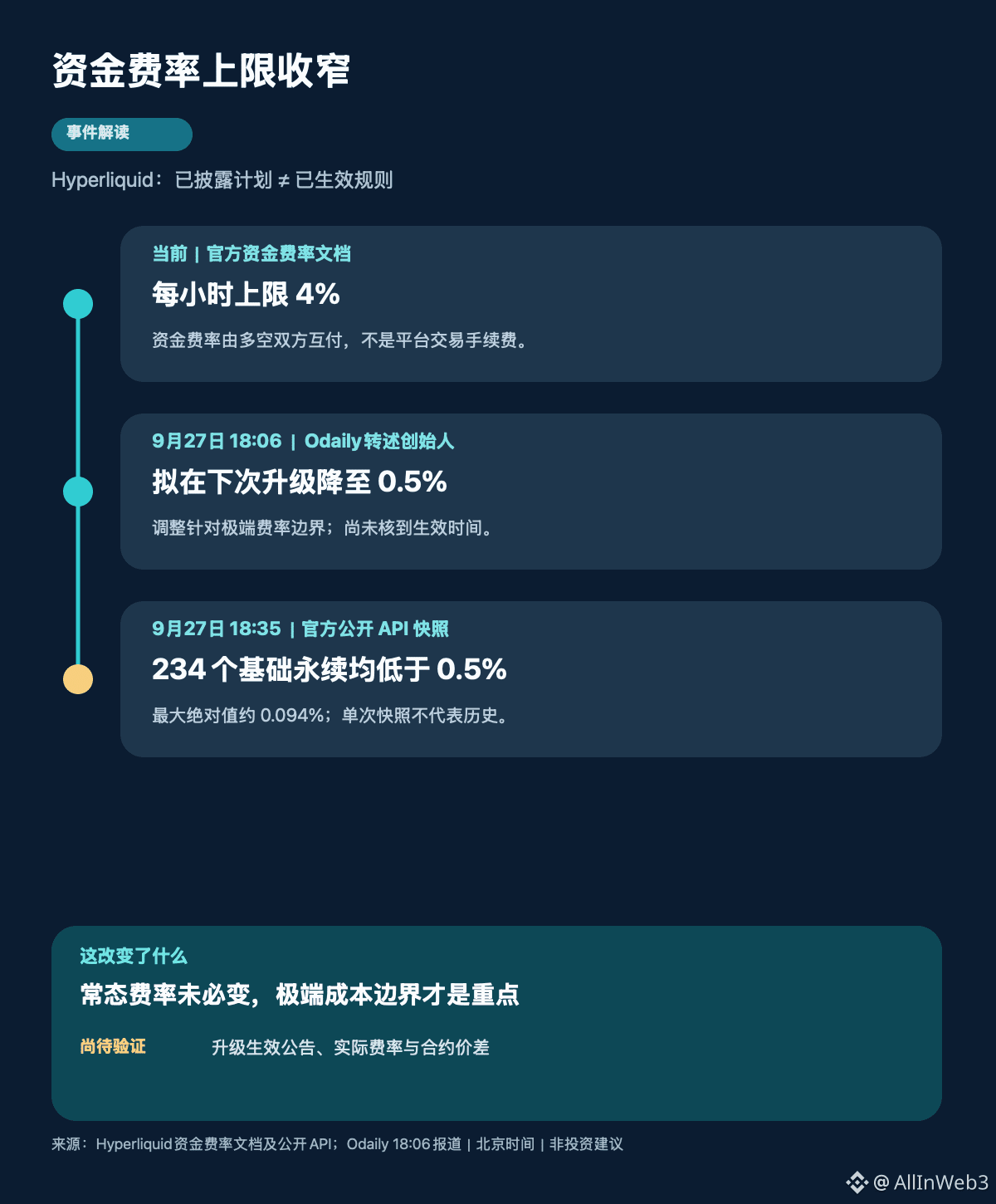
At 18:06 on September 27 (Beijing time), Odaily relayed comments from Hyperliquid founder Jeff Yan on Discord: based on user feedback, the next network upgrade is expected to adjust the funding rate cap from 4% per hour to 0.5%, and it also claims the old cap is rarely reached in actual trading. This is the plan for the next upgrade—not parameters that are already active. At that moment, Hyperliquid’s publicly available funding rate documentation still states 4% per hour; the upgrade date and whether it is truly activated will require an official announcement.
Funding rates are periodic transfers between the long and short sides of perpetual contracts, used to constrain deviations between the contract price and the spot reference price. They are not trading fees charged by the platform to either side. Suppose an open position with a notional value of $10,000 is in an extreme state where the funding rate exactly hits the cap. Under the old boundary, the hourly amount would be $400; under the new boundary, it would be $50. This example only explains the maximum boundary, and it neither means users normally pay at this funding rate nor that leveraged positions will automatically pay $350 less.
Using Hyperliquid’s public API, I captured a single snapshot of 234 basis perpetual markets at 18:35. The results show that the maximum absolute value of the funding rate was about 0.094%, and none reached the proposed 0.5% cap. This only indicates that, at that moment, the sample was far from the new boundary; it cannot prove that the cap won’t be hit in the past or won’t be hit in the future. Markets like HIP-3 are also not included in this sample. If the funding rate stays within 0.5%, merely changing the cap will have no direct impact on that period’s settlement.
My take is that this is more like resetting the risk boundary for tail scenarios, not a general fee reduction—and it also can’t be directly used to conclude higher $HYPE revenue or increased buybacks. Tightening the cap may reduce the single-period pressure on whichever side pays during extreme conditions. But when the contract price deviates significantly from the reference price, it may also weaken the ability of funding rates to drive the spread to converge. The real outcome depends on order book depth, arbitrageurs, and the liquidation mechanism.
Next, we should first wait for official confirmation of the upgrade activation time, and then compare the actual funding rates, spreads, and liquidity during extreme market conditions. If the cap is lowered and extreme spreads persist for longer, will you view it as better user protection—or as a concession to weaker price-anchoring power?
At 18:06 on September 27 (Beijing time), Odaily relayed comments from Hyperliquid founder Jeff Yan on Discord: based on user feedback, the next network upgrade is expected to adjust the funding rate cap from 4% per hour to 0.5%, and it also claims the old cap is rarely reached in actual trading. This is the plan for the next upgrade—not parameters that are already active. At that moment, Hyperliquid’s publicly available funding rate documentation still states 4% per hour; the upgrade date and whether it is truly activated will require an official announcement.
Funding rates are periodic transfers between the long and short sides of perpetual contracts, used to constrain deviations between the contract price and the spot reference price. They are not trading fees charged by the platform to either side. Suppose an open position with a notional value of $10,000 is in an extreme state where the funding rate exactly hits the cap. Under the old boundary, the hourly amount would be $400; under the new boundary, it would be $50. This example only explains the maximum boundary, and it neither means users normally pay at this funding rate nor that leveraged positions will automatically pay $350 less.
Using Hyperliquid’s public API, I captured a single snapshot of 234 basis perpetual markets at 18:35. The results show that the maximum absolute value of the funding rate was about 0.094%, and none reached the proposed 0.5% cap. This only indicates that, at that moment, the sample was far from the new boundary; it cannot prove that the cap won’t be hit in the past or won’t be hit in the future. Markets like HIP-3 are also not included in this sample. If the funding rate stays within 0.5%, merely changing the cap will have no direct impact on that period’s settlement.
My take is that this is more like resetting the risk boundary for tail scenarios, not a general fee reduction—and it also can’t be directly used to conclude higher $HYPE revenue or increased buybacks. Tightening the cap may reduce the single-period pressure on whichever side pays during extreme conditions. But when the contract price deviates significantly from the reference price, it may also weaken the ability of funding rates to drive the spread to converge. The real outcome depends on order book depth, arbitrageurs, and the liquidation mechanism.
Next, we should first wait for official confirmation of the upgrade activation time, and then compare the actual funding rates, spreads, and liquidity during extreme market conditions. If the cap is lowered and extreme spreads persist for longer, will you view it as better user protection—or as a concession to weaker price-anchoring power?