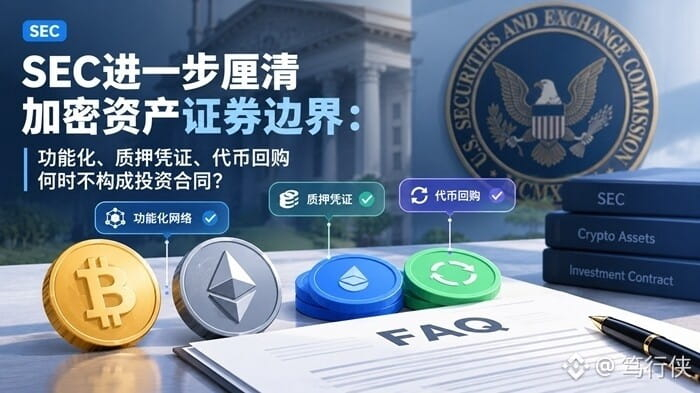
SEC issued a set of “9 Questions & 9 Answers.” One-sentence summary: whether a token is a security depends on whether it has been launched
On September 25, the U.S. SEC’s Division of Corporation Finance finally did something the industry has been waiting for years: it released 9 Q&As, spelling out in black and white when crypto assets count as securities and when they don’t.
First, a bucket of cold water
These are just employee guidance, not a rule, and they carry no legal force. But don’t underestimate it—the people who wrote these answers are the same team that reviews your listing filing. Even if courts don’t follow them, if you do the opposite, you’ll most likely be ground down to death at the filing stage.
So what’s the core? One word: functionality.
In plain language: the SEC treats “whether the network is truly running” as the master switch.
Before the network is live: even if the project team only promises development, promotes the project, and talks about buybacks or future earnings, it may constitute an “investment contract”—which is essentially selling a security;
After the network is live: maintenance, upgrades, funding development, and even announcing buybacks typically don’t count as “essential managerial efforts,” and usually don’t constitute a security.
An analogy: it’s like the difference between buying a pre-sale property (off-plan) versus an existing property. In a pre-sale, what you’re buying is “trust in the developer”—and that trust is the security. In an existing property, what you’re buying is the property itself; no matter how they market it, it’s not the sale of stock.
There are also three highly substantive criteria:
1. Tokenized staking receipts: ones that only prove ownership and prohibit misuse count as “digital tools.” Those issued by an agreement-structured liquidity-staking operator can more directly count as “digital goods”—so they don’t touch the security red line;
2. Fully decentralized networks: whatever the project team says doesn’t create a new investment contract, because nobody can control the outcome or success/failure;
3. Exchanges loosening up: simply providing a secondary market won’t automatically turn the exchange into a “promoter.”
These are the implementation details for an interpretive order from March 17. The regulator’s tone has shifted from “enforcement-style regulation” to “publishing a user manual.” This is a real positive for the staking track and already-launched projects—but there’s an exception for tokenized securities: putting something on-chain doesn’t change its nature; if it’s a security, it’s always a security.
In summary:
1. Check your holdings: for projects that are “already launched + decentralized,” policy risk drops significantly;
2. For projects still in the “promise-and-speculation” phase: buying them is effectively holding an asset that could later be retrospectively recognized as a security—pay attention to the wording the project team uses
#SEC称代币回购与网络升级不自动构成证券
On September 25, the U.S. SEC’s Division of Corporation Finance finally did something the industry has been waiting for years: it released 9 Q&As, spelling out in black and white when crypto assets count as securities and when they don’t.
First, a bucket of cold water
These are just employee guidance, not a rule, and they carry no legal force. But don’t underestimate it—the people who wrote these answers are the same team that reviews your listing filing. Even if courts don’t follow them, if you do the opposite, you’ll most likely be ground down to death at the filing stage.
So what’s the core? One word: functionality.
In plain language: the SEC treats “whether the network is truly running” as the master switch.
Before the network is live: even if the project team only promises development, promotes the project, and talks about buybacks or future earnings, it may constitute an “investment contract”—which is essentially selling a security;
After the network is live: maintenance, upgrades, funding development, and even announcing buybacks typically don’t count as “essential managerial efforts,” and usually don’t constitute a security.
An analogy: it’s like the difference between buying a pre-sale property (off-plan) versus an existing property. In a pre-sale, what you’re buying is “trust in the developer”—and that trust is the security. In an existing property, what you’re buying is the property itself; no matter how they market it, it’s not the sale of stock.
There are also three highly substantive criteria:
1. Tokenized staking receipts: ones that only prove ownership and prohibit misuse count as “digital tools.” Those issued by an agreement-structured liquidity-staking operator can more directly count as “digital goods”—so they don’t touch the security red line;
2. Fully decentralized networks: whatever the project team says doesn’t create a new investment contract, because nobody can control the outcome or success/failure;
3. Exchanges loosening up: simply providing a secondary market won’t automatically turn the exchange into a “promoter.”
These are the implementation details for an interpretive order from March 17. The regulator’s tone has shifted from “enforcement-style regulation” to “publishing a user manual.” This is a real positive for the staking track and already-launched projects—but there’s an exception for tokenized securities: putting something on-chain doesn’t change its nature; if it’s a security, it’s always a security.
In summary:
1. Check your holdings: for projects that are “already launched + decentralized,” policy risk drops significantly;
2. For projects still in the “promise-and-speculation” phase: buying them is effectively holding an asset that could later be retrospectively recognized as a security—pay attention to the wording the project team uses
#SEC称代币回购与网络升级不自动构成证券