

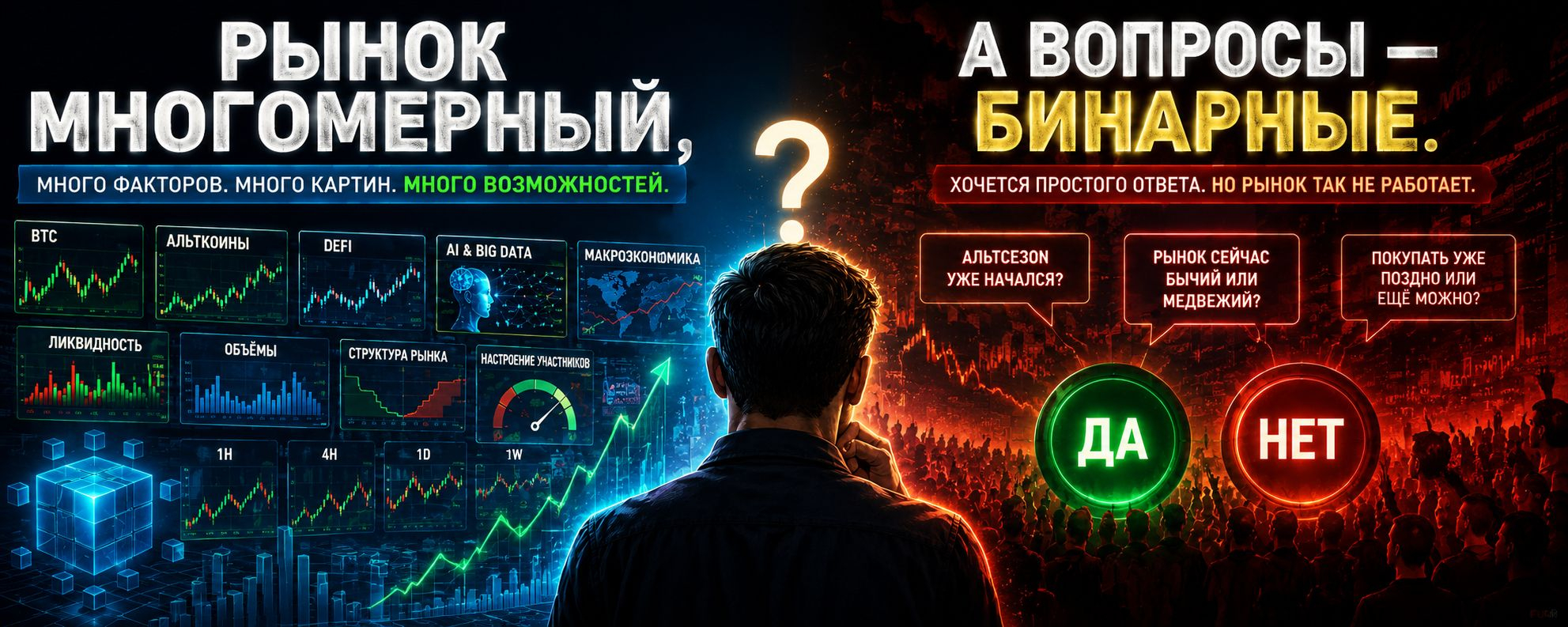

Why do we constantly try to reduce a complex market to an answer of «yes» or «no»?
«Has the altseason already started?»
«Is the market bullish or bearish right now?»
«Have the smart money already exited?»
«Is it still possible to buy, or is it already too late?»
Each of these questions sounds simple.
But the problem is that the market itself isn’t simple.
Bitcoin might be moving sideways while certain altcoins are rising.
One sector can be getting liquidity while another is losing it.
On the 1H timeframe, a move may end that looks like a normal correction on the 1D within a larger structure.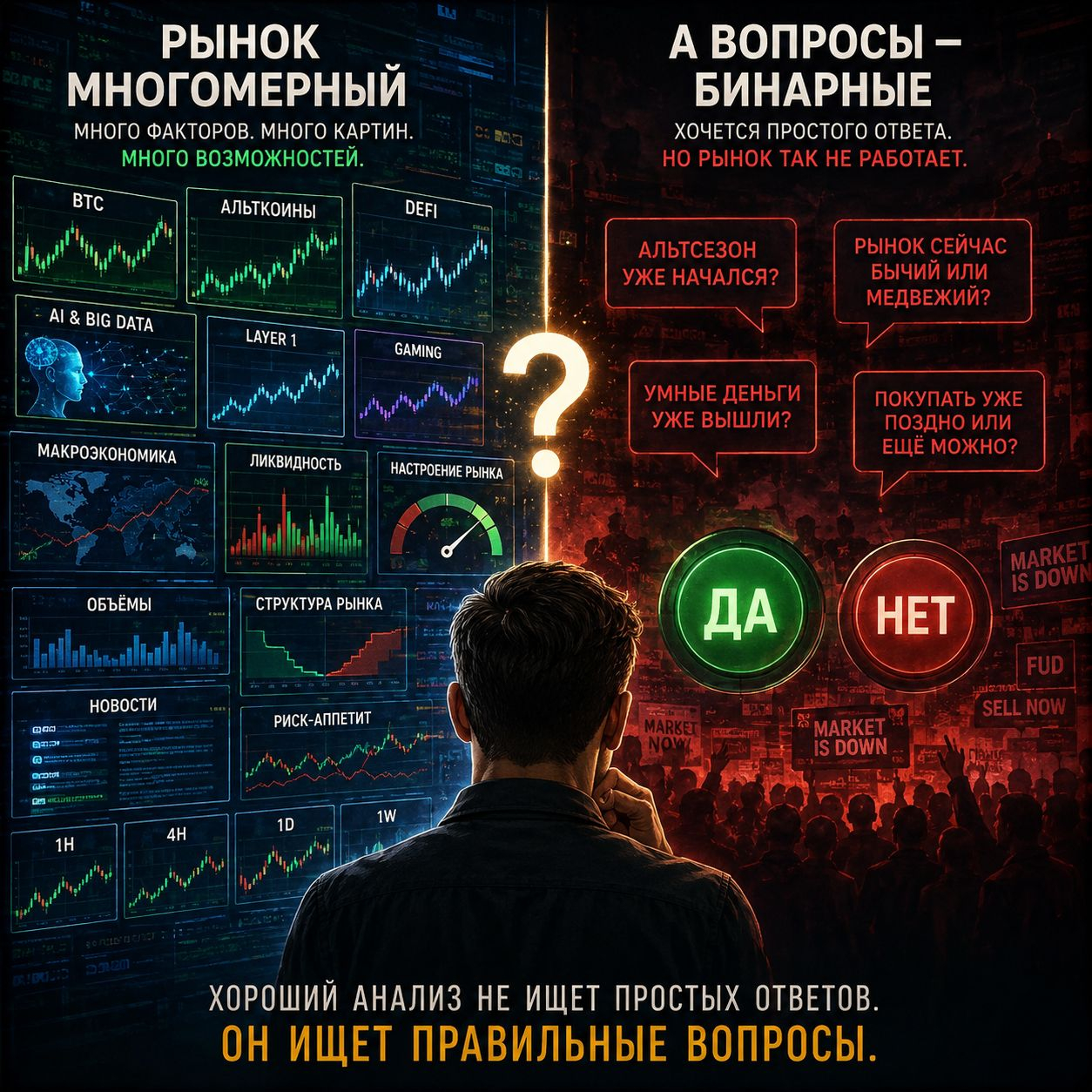
And what looks like the start of a new trend for one asset may be nothing more than a short-term spike for another.
That’s exactly why a binary question often destroys the most important element of analysis — context.
Price is only one layer.
At the same time, volumes, liquidity, market structure, the behavior of individual sectors, the sentiment of participants, and overall risk appetite all work together.
Let’s add different timeframes — and the picture becomes even more complex.
And then a news feed appears.
“The market is rising.”
“The market is falling.”
“Money is leaving.”
“A new cycle has started.”
Sounds convenient.
But the market doesn’t have to move like a single organism.
Sometimes, within the same market, several completely different pictures exist at the same time.
And here the trap of thinking appears.
We want to get one answer:
YES or NO.
And the right question often looks totally different:
“For which asset?”
“Over what horizon?”
“Compared to what?”
“What liquidity is moving right now?”
“What exactly changed in the structure?”
This isn’t an attempt to make analysis harder just for the sake of complexity.
On the contrary.
It’s a way to not lose information when reality doesn’t fit into two buttons.
Good analysis doesn’t always give a quick answer.
Sometimes its main job is to show why an answer that’s too fast was the wrong question in the first place.
And do you often catch yourself wanting the market to give you a simple “yes” or “no”?

