

易琳Ten
139 Posts

易琳Ten
交易是修行,盈利是结果,纪律是信仰。🐺📈
69 Following
20.7K+ Followers
7.3K+ Liked
Posts
All
Quotes
Videos
PINNED

PINNED


生蚝哥Oyster
·
--
BullishMay everything go well for you today,
with a good mood, good health,
and gentle treatment from the people around you.
May life bring you a little extra delight.
Hang in there—you’ll get better bit by bit~
with a good mood, good health,
and gentle treatment from the people around you.
May life bring you a little extra delight.
Hang in there—you’ll get better bit by bit~



Kaige 塏哥
·
--
30K gold badge = posting directly to get 9.99U; ordinary people = posting and waiting for an airdrop—let’s see who has the higher view count.
@小蜜蜂xmf@听澜321@Anna-汤圆@梨浅Grace@win小酒
Xiaomifeng officially launches on Sep 10👇
✅ 30K gold badge posting → 9.99U equivalent tokens; get as many as you post
✅ Regular users posting → the higher the view count, the greater the airdrop probability
If your content gets seen, Xiaomifeng rewards you—this isn’t gambling; it’s content-as-mining.
See you on Sep 10.🐝
@小蜜蜂xmf official account—join the official chat room 🔥
#meme section follow the trending topics
@小蜜蜂xmf@听澜321@Anna-汤圆@梨浅Grace@win小酒
Xiaomifeng officially launches on Sep 10👇
✅ 30K gold badge posting → 9.99U equivalent tokens; get as many as you post
✅ Regular users posting → the higher the view count, the greater the airdrop probability
If your content gets seen, Xiaomifeng rewards you—this isn’t gambling; it’s content-as-mining.
See you on Sep 10.🐝
@小蜜蜂xmf official account—join the official chat room 🔥
#meme section follow the trending topics


jimwilldoit积木
·
--
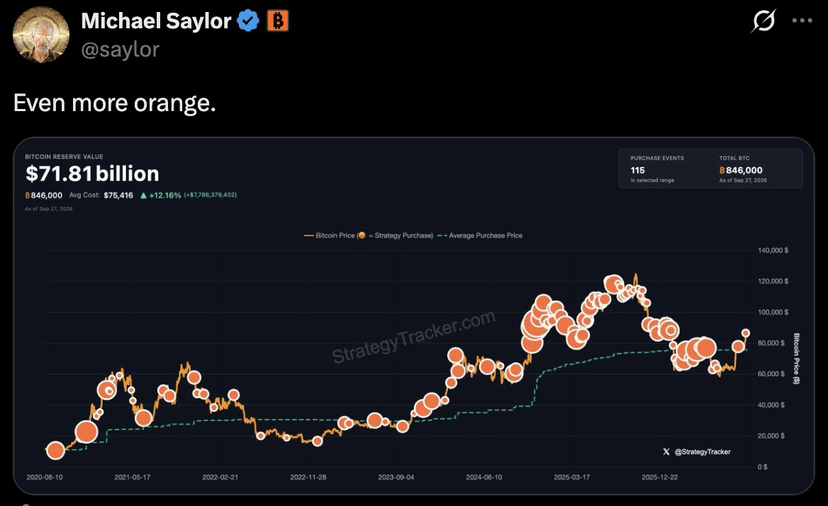
Bullish$BTC Saylor is hinting at adding more again!
With one line, “Even more orange,” the market instantly got the message.
That familiar orange-dot code is back!
Just last week, the Strategy bought 950 BTC.
Now the next tranche of accumulation may be on the way!
Michael Saylor again used “orange” to hint that Strategy might continue to accumulate BTC. This orange-dot signal has appeared multiple times in the past before Strategy released details of a new round of buys, but so far it’s only a hint—whether there was actually a purchase and how much will only be confirmed when the company makes an official disclosure.
It’s worth noting that last week Strategy bought 950 BTC at an average price of about $79,700, spending roughly $75.7 million, bringing total holdings to 846,000 BTC. Now that BTC is still consolidating at elevated levels, Saylor has started sending “orange” signals again—so naturally, the market will be watching for the next announcement.
Just after buying 950, they’re already hinting at “more orange.”
This BTC accumulation machine by Saylor may not have stopped yet!
Click the card below and go straight for it!👇
$ETH $ZEC
With one line, “Even more orange,” the market instantly got the message.
That familiar orange-dot code is back!
Just last week, the Strategy bought 950 BTC.
Now the next tranche of accumulation may be on the way!
Michael Saylor again used “orange” to hint that Strategy might continue to accumulate BTC. This orange-dot signal has appeared multiple times in the past before Strategy released details of a new round of buys, but so far it’s only a hint—whether there was actually a purchase and how much will only be confirmed when the company makes an official disclosure.
It’s worth noting that last week Strategy bought 950 BTC at an average price of about $79,700, spending roughly $75.7 million, bringing total holdings to 846,000 BTC. Now that BTC is still consolidating at elevated levels, Saylor has started sending “orange” signals again—so naturally, the market will be watching for the next announcement.
Just after buying 950, they’re already hinting at “more orange.”
This BTC accumulation machine by Saylor may not have stopped yet!
Click the card below and go straight for it!👇
$ETH $ZEC

分析师尤斯1688
·
--
comment to get your bonus.


圣克斯Lucky1688
·
--
🧧🎁🌹🧧🎁🌹
September 27 Information Quick Review:
Miner sell pressure may ease: JPMorgan analysis says that the current Bitcoin price has returned to the production cost range of around $85,000. As some miners get through the period of cost inverted pressure, overall miner selling pressure may further ease.
The Fed advances new stablecoin rules under the GENIUS Act: The Federal Reserve has officially released two highly anticipated stablecoin rule proposals in connection with the GENIUS Act. The proposals enter a 60-day public comment period. The proposals require that payment stablecoins issued by regulated banks must be backed by fully compliant 1:1 reserves (supporting U.S. Treasuries, Federal Reserve deposits, etc.), must unconditionally satisfy user redemptions within 2 business days, and must establish standardized capital charging and anti-money-laundering review standards.
U.S. stocks officially become DeFi collateral: Lending giant Aave has achieved a milestone—users can now officially deposit tokenized U.S. stocks, including seven tokenized equities such as Apple, Nvidia, and Tesla, into the platform and use them as collateral to borrow USDC.
Scale and risk-control limits: According to the initial settings from risk-control provider LlamaRisk, the loan-to-value (LTV) ratio for this batch of tokenized stocks (supported by Coinbase) is controlled between 65% and 79%. The initial USDC borrowing limit is set at $21 million—an important step toward deeper integration between TradFi (traditional finance) and DeFi.
Bitget exchange suffers a security incident: Blockchain security monitoring shows that the exchange Bitget was hacked and a large amount of XRP was transferred out (worth about $83 million). Since the XRP ledger (XRPL) native architecture does not support directly freezing assets by a single issuing party, Ripple appears powerless in responding to such cross-chain hacker transfers, sparking heated community debate over freezing and security mechanisms for assets on specific chains.
Follow me—answer 1 to take away the $SOL 红包 (red packet)!
September 27 Information Quick Review:
Miner sell pressure may ease: JPMorgan analysis says that the current Bitcoin price has returned to the production cost range of around $85,000. As some miners get through the period of cost inverted pressure, overall miner selling pressure may further ease.
The Fed advances new stablecoin rules under the GENIUS Act: The Federal Reserve has officially released two highly anticipated stablecoin rule proposals in connection with the GENIUS Act. The proposals enter a 60-day public comment period. The proposals require that payment stablecoins issued by regulated banks must be backed by fully compliant 1:1 reserves (supporting U.S. Treasuries, Federal Reserve deposits, etc.), must unconditionally satisfy user redemptions within 2 business days, and must establish standardized capital charging and anti-money-laundering review standards.
U.S. stocks officially become DeFi collateral: Lending giant Aave has achieved a milestone—users can now officially deposit tokenized U.S. stocks, including seven tokenized equities such as Apple, Nvidia, and Tesla, into the platform and use them as collateral to borrow USDC.
Scale and risk-control limits: According to the initial settings from risk-control provider LlamaRisk, the loan-to-value (LTV) ratio for this batch of tokenized stocks (supported by Coinbase) is controlled between 65% and 79%. The initial USDC borrowing limit is set at $21 million—an important step toward deeper integration between TradFi (traditional finance) and DeFi.
Bitget exchange suffers a security incident: Blockchain security monitoring shows that the exchange Bitget was hacked and a large amount of XRP was transferred out (worth about $83 million). Since the XRP ledger (XRPL) native architecture does not support directly freezing assets by a single issuing party, Ripple appears powerless in responding to such cross-chain hacker transfers, sparking heated community debate over freezing and security mechanisms for assets on specific chains.
Follow me—answer 1 to take away the $SOL 红包 (red packet)!




@520龙行天下
is speaking[LIVE] 🎙️ Improve yourself, stick to value investing, and DCA into BNB and SOL
1.9k listens

奋斗Hustle-1688
·
--
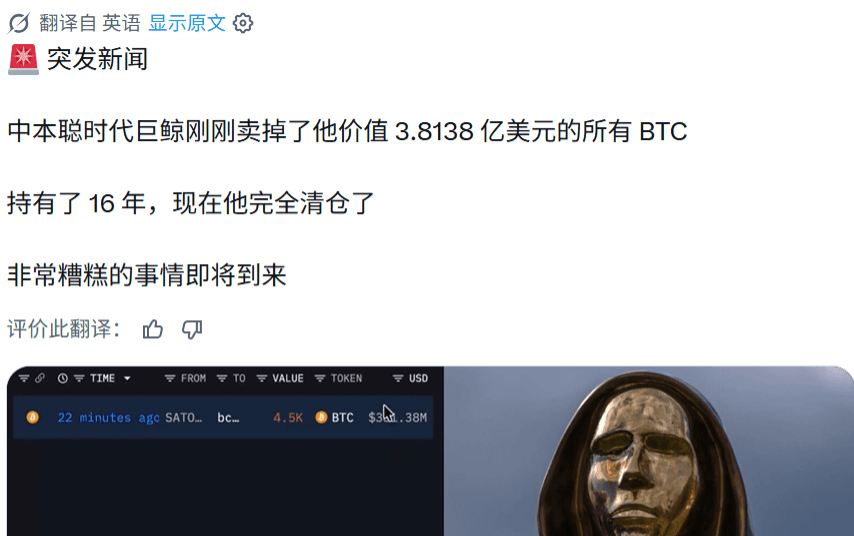
$BTC There is a big whale in the crypto world whose wallet has not moved for a full 4 years, and it suddenly woke up.
At the first move, it transferred 4,500 bitcoins, worth $380 million, and just sent them away.
No activity for 4 years, and now it suddenly moved.
What is this for? Is it preparing to make a big move??
At the first move, it transferred 4,500 bitcoins, worth $380 million, and just sent them away.
No activity for 4 years, and now it suddenly moved.
What is this for? Is it preparing to make a big move??

静心1688
·
--
🎁Follow the reply to claim a red envelope🧧🧧🧧
#Circle与Tether冻结Bitget黑客钱包
#Circle与Tether冻结Bitget黑客钱包


Fabi_4043
·
--
Be wise and persistent 🥰🎁
Like and follow 🎁🎁
$BNB
#BitgetHackerMoves$83MStolenXRP
Like and follow 🎁🎁
$BNB
#BitgetHackerMoves$83MStolenXRP


大嗯BNB
·
--
Bitget exchange announced it was hacked, with the hot wallet and warm wallet emptied; preliminary estimates place the loss at about $351.6 million, and subsequent reports raised the figure to about $387.5 million. The cold wallet was not affected. Bitget said users’ assets would be fully reimbursed.
This isn’t a small platform. Bitget is one of the global top ten derivatives exchanges. It has a complete compliance system, proof of reserves, and an insurance fund.
Then it got hit for $387 million.
I’m not questioning Bitget’s ability to handle this. They promised reimbursement, and there are historical precedents of similar cases being handled properly. I’m saying that this incident, every so often, reminds us—again in different forms—of the same thing: centralized exchanges’ hot wallets are always the highest-risk place to store assets.
“Not your keys, not your coins”—that line has been said too many times in the crypto space. It already sounds like an old cliché. But the reason it keeps becoming a cliché is because it’s always been right.
Ever since Mt. Gox in 2011, to the collapse of FTX, and every time a major exchange’s hot wallet gets emptied—the attack pattern changes, the amount changes, but the structural flaw doesn’t: users hand over the private keys to someone else for custody.
Today, BTC is trading sideways around 84,000. The total market cap is $2.98 trillion, the Fear & Greed index is 74, and overall market sentiment is stable. When the news of Bitget being hacked came out, the BTC price didn’t react much—because $387 million is a small number compared with a $2.98 trillion total market cap, and the market has enough liquidity to absorb it.
But for the users whose assets were stored in Bitget’s hot wallet, today’s experience isn’t “the market is calm.” It’s “suffering through that same waiting-for-news ordeal again.”
I’m not saying to move all coins to cold wallets—that also comes with its own risks: losing private keys, making mistakes in mnemonic phrase management, and historically the total amount of BTC lost hasn’t been less than the amount lost to hacker attacks.
What I am saying is that on September 26, this is a moment worth rethinking: how much of your assets are where, what risks correspond to those placements, and whether you can accept them.
In your view, has anyone put most of their positions on an exchange? After this Bitget hack, did you think about it again? Share your thoughts.
$BTC
#BTC
This isn’t a small platform. Bitget is one of the global top ten derivatives exchanges. It has a complete compliance system, proof of reserves, and an insurance fund.
Then it got hit for $387 million.
I’m not questioning Bitget’s ability to handle this. They promised reimbursement, and there are historical precedents of similar cases being handled properly. I’m saying that this incident, every so often, reminds us—again in different forms—of the same thing: centralized exchanges’ hot wallets are always the highest-risk place to store assets.
“Not your keys, not your coins”—that line has been said too many times in the crypto space. It already sounds like an old cliché. But the reason it keeps becoming a cliché is because it’s always been right.
Ever since Mt. Gox in 2011, to the collapse of FTX, and every time a major exchange’s hot wallet gets emptied—the attack pattern changes, the amount changes, but the structural flaw doesn’t: users hand over the private keys to someone else for custody.
Today, BTC is trading sideways around 84,000. The total market cap is $2.98 trillion, the Fear & Greed index is 74, and overall market sentiment is stable. When the news of Bitget being hacked came out, the BTC price didn’t react much—because $387 million is a small number compared with a $2.98 trillion total market cap, and the market has enough liquidity to absorb it.
But for the users whose assets were stored in Bitget’s hot wallet, today’s experience isn’t “the market is calm.” It’s “suffering through that same waiting-for-news ordeal again.”
I’m not saying to move all coins to cold wallets—that also comes with its own risks: losing private keys, making mistakes in mnemonic phrase management, and historically the total amount of BTC lost hasn’t been less than the amount lost to hacker attacks.
What I am saying is that on September 26, this is a moment worth rethinking: how much of your assets are where, what risks correspond to those placements, and whether you can accept them.
In your view, has anyone put most of their positions on an exchange? After this Bitget hack, did you think about it again? Share your thoughts.
$BTC
#BTC


E L E X A
·
--
🚨 IT’S LIVE 🚨
Watching is simple… but winners take action 👀
🎁 Want FREE $USDT?
💬 Comment 888
❤️ Like
🔁 Share
➕ Follow
⏳ Don’t miss your chance — spots are limited!
Drop 888 below and join now 🚀
#Crypto #USDT #Giveaway
Watching is simple… but winners take action 👀
🎁 Want FREE $USDT?
💬 Comment 888
❤️ Like
🔁 Share
➕ Follow
⏳ Don’t miss your chance — spots are limited!
Drop 888 below and join now 🚀
#Crypto #USDT #Giveaway


king Gulfam
·
--
#Binancefutuuretrading
@CXMT_@AAVE_@龙虾/USDT
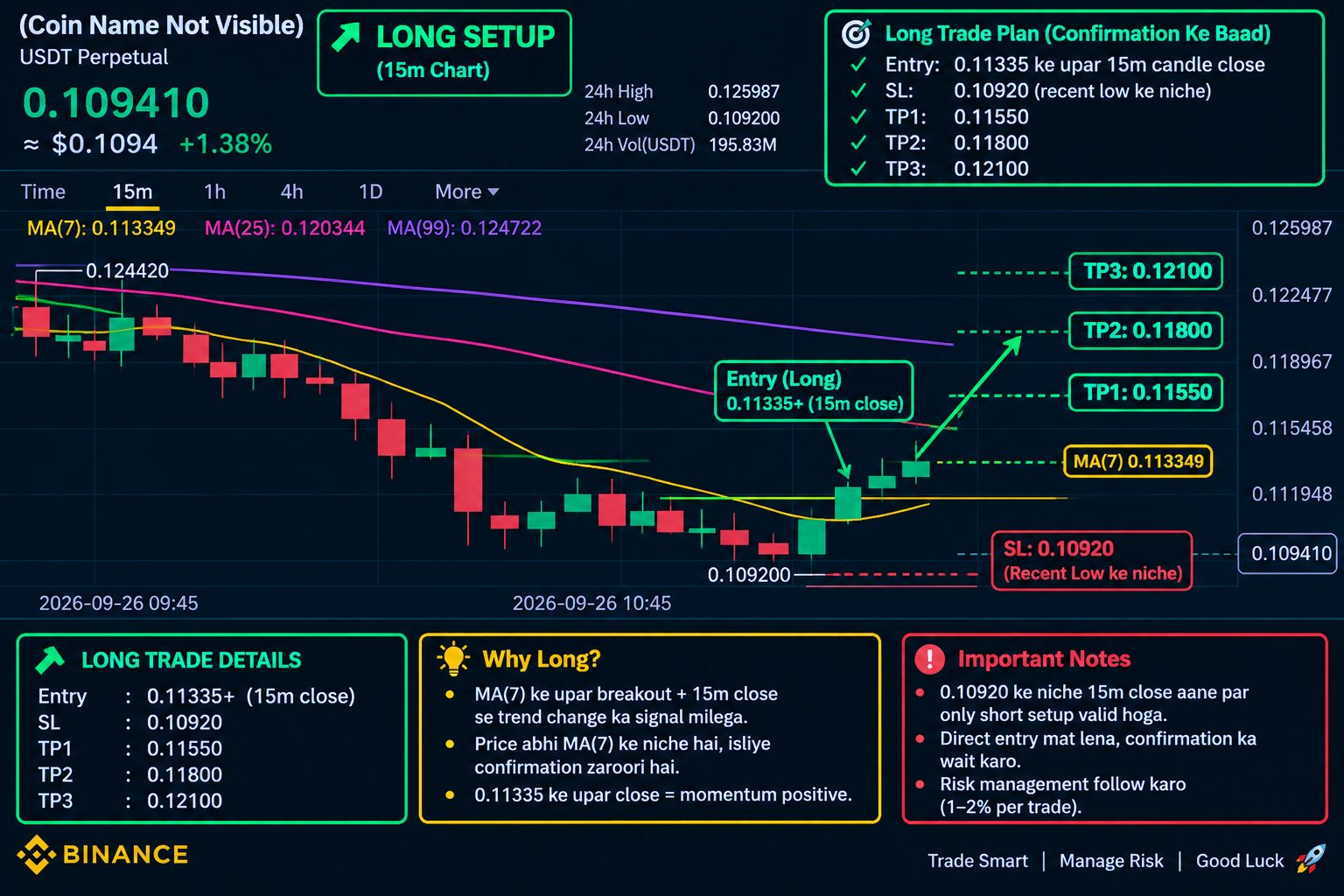
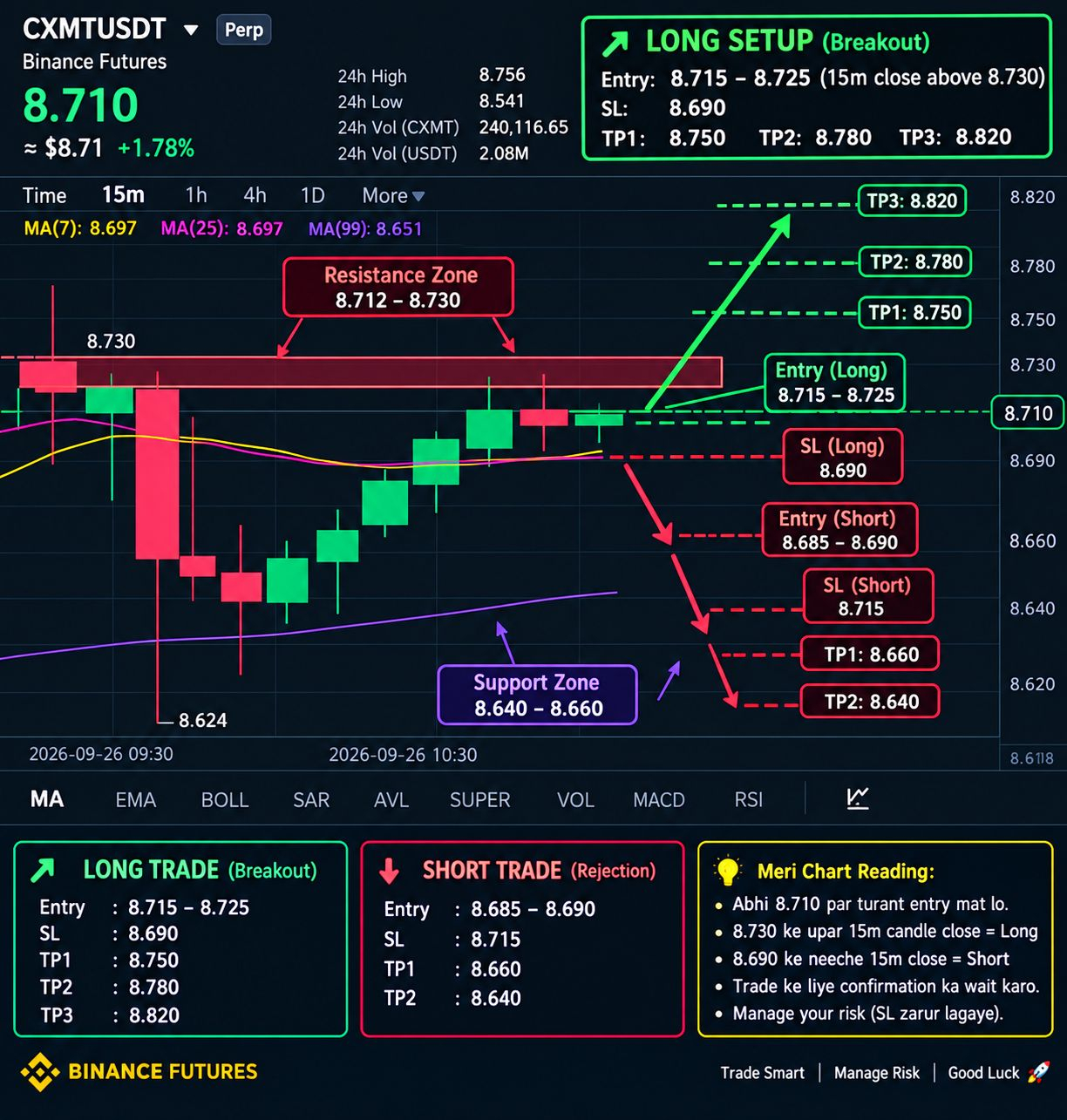
$CXMT
📈 LONG setup — after confirmation
Entry: above 8.715–8.725 with a 15m candle close
SL: 8.690
TP1: 8.750
TP2: 8.780
TP3: 8.820
📉 SHORT setup — if resistance rejects
If strong rejection comes from 8.712–8.730 and price closes below 8.690 on a 15m timeframe:
Entry: 8.685–8.690
SL: 8.715
TP1: 8.660
TP2: 8.640
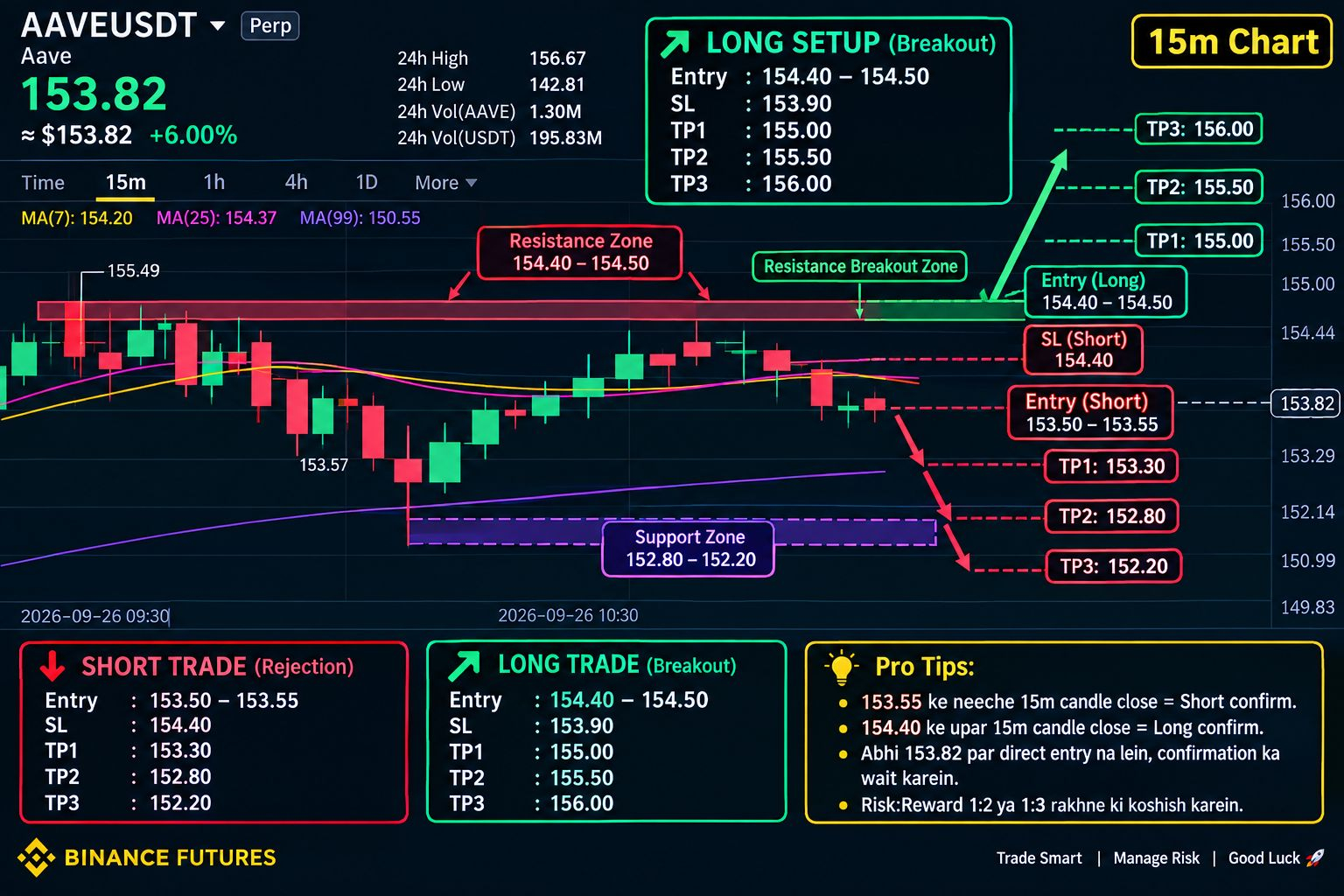
$AAVE
📉 SHORT setup
If a 15m candle closes below 153.55, then:
Entry: 153.50–153.55
SL: 154.40
TP1: 153.30
TP2: 152.80
TP3: 152.20
📈 LONG setup
For the long, first get confirmation of a 15m candle close above 154.40:
Entry: 154.40–154.50
SL: 153.90
TP1: 155.00
TP2: 155.50
TP3: 156.00
$龙虾
📈 LONG SETUP — 15M Chart
Current Price: 0.109410
Long Entry: after a 15-minute candle close above 0.11335
Stop Loss (SL): 0.10920
TP1: 0.11550
TP2: 0.11800
TP3: 0.12100
📉 SHORT setup — after confirmation
If a 15m candle closes below 0.10920, then:
Entry: 0.1090–0.1092
SL: 0.1120
TP1: 0.1070
TP2: 0.1050
TP3: 0.1025
👉🏻 YOU CAN TRY IT'S 🤞🏻
@CXMT_@AAVE_@龙虾/USDT
$CXMT
📈 LONG setup — after confirmation
Entry: above 8.715–8.725 with a 15m candle close
SL: 8.690
TP1: 8.750
TP2: 8.780
TP3: 8.820
📉 SHORT setup — if resistance rejects
If strong rejection comes from 8.712–8.730 and price closes below 8.690 on a 15m timeframe:
Entry: 8.685–8.690
SL: 8.715
TP1: 8.660
TP2: 8.640
$AAVE
📉 SHORT setup
If a 15m candle closes below 153.55, then:
Entry: 153.50–153.55
SL: 154.40
TP1: 153.30
TP2: 152.80
TP3: 152.20
📈 LONG setup
For the long, first get confirmation of a 15m candle close above 154.40:
Entry: 154.40–154.50
SL: 153.90
TP1: 155.00
TP2: 155.50
TP3: 156.00
$龙虾
📈 LONG SETUP — 15M Chart
Current Price: 0.109410
Long Entry: after a 15-minute candle close above 0.11335
Stop Loss (SL): 0.10920
TP1: 0.11550
TP2: 0.11800
TP3: 0.12100
📉 SHORT setup — after confirmation
If a 15m candle closes below 0.10920, then:
Entry: 0.1090–0.1092
SL: 0.1120
TP1: 0.1070
TP2: 0.1050
TP3: 0.1025
👉🏻 YOU CAN TRY IT'S 🤞🏻

Leo - F0
·
--
Bullish🧧🧧🔥GOOD MORNING FROM DUBAİ, FAMİLY.🔥🧧🧧
I told you to buy $ZEC 💛 when it was at $30.
As I told you before, $ZEC 💛 will be 3K.💎
BTTC🔥🔥🧧🧧
#1688家族family 💚 @周周1688 #CircleMints500MUSDCOnSolana #BlackRockBuildsTokenizedPortfoliosForOndo #xrp #solana $BTC
I told you to buy $ZEC 💛 when it was at $30.
As I told you before, $ZEC 💛 will be 3K.💎
BTTC🔥🔥🧧🧧
#1688家族family 💚 @周周1688 #CircleMints500MUSDCOnSolana #BlackRockBuildsTokenizedPortfoliosForOndo #xrp #solana $BTC


BLOCK Rayne
·
--
A BIG gift 🎁 from me to our amazing community. ❤️
Claim your $DOGE reward and enjoy!
Hurry up, everyone! 🔥
Claim your $DOGE reward and enjoy!
Hurry up, everyone! 🔥


橙子Joyce
·
--
✨Orange Joyce|Live Stream Announcement✨
⏰ Time: 21:00–23:00 on September 28, 2026
📌 Topic: Analysis of US Stock Investment Strategies and Trading Operations
Highlights:
✅ The underlying logic of the US stock market and judging market style
✅ Comparison of different strategies: value investing, growth stocks, swing trading
✅ Practical ideas for position management, take-profit and stop-loss
✅ Key points and do’s/don’ts for trading risk in US stocks
Everyone is welcome to join the live chat to exchange and discuss!
Hello everyone, welcome to stream.
Today’s topic: US stock investment strategy analysis and trading practice.
We’ll discuss popular strategies, position management and risk control.
⏰ Time: 21:00–23:00 on September 28, 2026
📌 Topic: Analysis of US Stock Investment Strategies and Trading Operations
Highlights:
✅ The underlying logic of the US stock market and judging market style
✅ Comparison of different strategies: value investing, growth stocks, swing trading
✅ Practical ideas for position management, take-profit and stop-loss
✅ Key points and do’s/don’ts for trading risk in US stocks
Everyone is welcome to join the live chat to exchange and discuss!
Hello everyone, welcome to stream.
Today’s topic: US stock investment strategy analysis and trading practice.
We’ll discuss popular strategies, position management and risk control.


@周周1688
is speaking[LIVE] 🎙️ DCA BNB, mimi special AMA!
8.1k listens

路人1688luren
·
--
#SEC称回购与升级不必然使代币成证券 Many times many things are not that you make an effort and there will be results. When the gears of fate turn, it’s as if there are two invisible hands pushing you toward another direction... When one door closes, another opens... $USD1



圣克斯Lucky1688
·
--
🧧🎁🌹🧧🎁🌹
September 27 Information Quick Review:
Miner sell pressure may ease: JPMorgan analysis says that the current Bitcoin price has returned to the production cost range of around $85,000. As some miners get through the period of cost inverted pressure, overall miner selling pressure may further ease.
The Fed advances new stablecoin rules under the GENIUS Act: The Federal Reserve has officially released two highly anticipated stablecoin rule proposals in connection with the GENIUS Act. The proposals enter a 60-day public comment period. The proposals require that payment stablecoins issued by regulated banks must be backed by fully compliant 1:1 reserves (supporting U.S. Treasuries, Federal Reserve deposits, etc.), must unconditionally satisfy user redemptions within 2 business days, and must establish standardized capital charging and anti-money-laundering review standards.
U.S. stocks officially become DeFi collateral: Lending giant Aave has achieved a milestone—users can now officially deposit tokenized U.S. stocks, including seven tokenized equities such as Apple, Nvidia, and Tesla, into the platform and use them as collateral to borrow USDC.
Scale and risk-control limits: According to the initial settings from risk-control provider LlamaRisk, the loan-to-value (LTV) ratio for this batch of tokenized stocks (supported by Coinbase) is controlled between 65% and 79%. The initial USDC borrowing limit is set at $21 million—an important step toward deeper integration between TradFi (traditional finance) and DeFi.
Bitget exchange suffers a security incident: Blockchain security monitoring shows that the exchange Bitget was hacked and a large amount of XRP was transferred out (worth about $83 million). Since the XRP ledger (XRPL) native architecture does not support directly freezing assets by a single issuing party, Ripple appears powerless in responding to such cross-chain hacker transfers, sparking heated community debate over freezing and security mechanisms for assets on specific chains.
Follow me—answer 1 to take away the $SOL 红包 (red packet)!
September 27 Information Quick Review:
Miner sell pressure may ease: JPMorgan analysis says that the current Bitcoin price has returned to the production cost range of around $85,000. As some miners get through the period of cost inverted pressure, overall miner selling pressure may further ease.
The Fed advances new stablecoin rules under the GENIUS Act: The Federal Reserve has officially released two highly anticipated stablecoin rule proposals in connection with the GENIUS Act. The proposals enter a 60-day public comment period. The proposals require that payment stablecoins issued by regulated banks must be backed by fully compliant 1:1 reserves (supporting U.S. Treasuries, Federal Reserve deposits, etc.), must unconditionally satisfy user redemptions within 2 business days, and must establish standardized capital charging and anti-money-laundering review standards.
U.S. stocks officially become DeFi collateral: Lending giant Aave has achieved a milestone—users can now officially deposit tokenized U.S. stocks, including seven tokenized equities such as Apple, Nvidia, and Tesla, into the platform and use them as collateral to borrow USDC.
Scale and risk-control limits: According to the initial settings from risk-control provider LlamaRisk, the loan-to-value (LTV) ratio for this batch of tokenized stocks (supported by Coinbase) is controlled between 65% and 79%. The initial USDC borrowing limit is set at $21 million—an important step toward deeper integration between TradFi (traditional finance) and DeFi.
Bitget exchange suffers a security incident: Blockchain security monitoring shows that the exchange Bitget was hacked and a large amount of XRP was transferred out (worth about $83 million). Since the XRP ledger (XRPL) native architecture does not support directly freezing assets by a single issuing party, Ripple appears powerless in responding to such cross-chain hacker transfers, sparking heated community debate over freezing and security mechanisms for assets on specific chains.
Follow me—answer 1 to take away the $SOL 红包 (red packet)!
Log in to explore more content