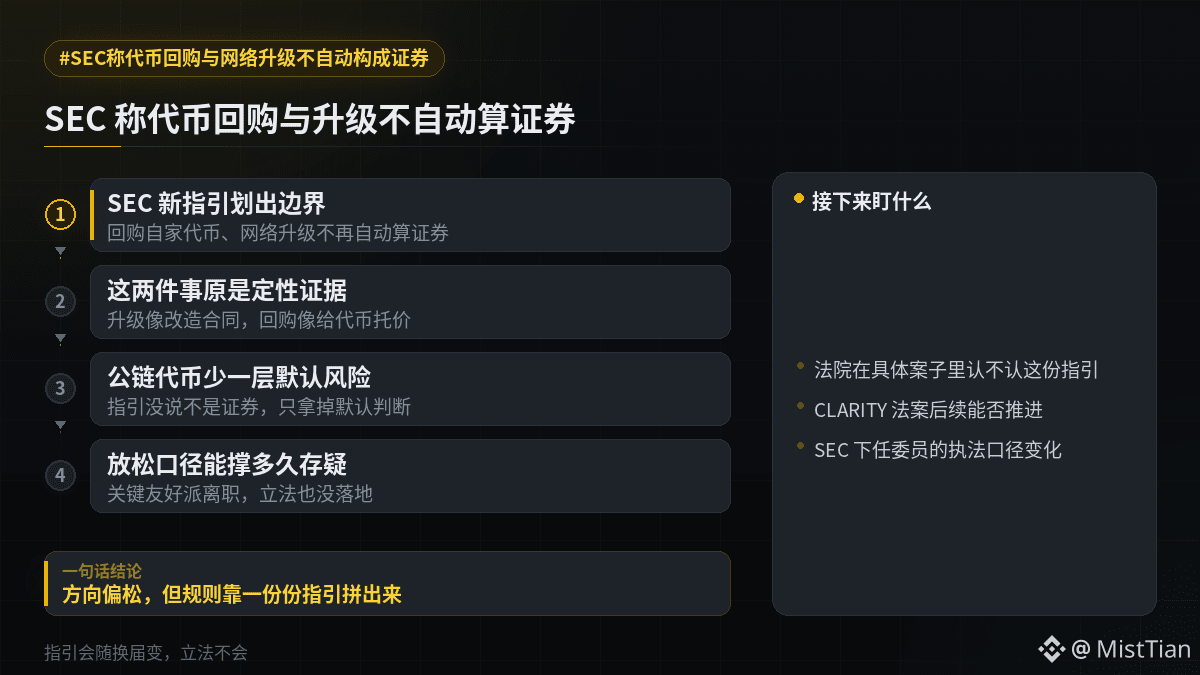
SEC issues new guidance: repurchasing one’s own tokens and doing network upgrades will not automatically be deemed securities.
These two things previously could both be treated as evidence of an “offering of securities.” A team-upgrade agreement could be suspected of modifying an investment contract; if the project team steps in to repurchase tokens, it could be suspected of propping up the token price. If the transaction is categorized this way, the costs of exchange listings, market-making, and compliance would all need to be recalculated.
For blockchain tokens like <$SOL > that are driven by upgrades, the impact is significant. The value of a blockchain relies to a large extent on ongoing protocol iterations, and repurchases are also often used to hedge selling pressure—both actions fit right into the original ambiguous zone. The guidance doesn’t say it is definitely not a security; instead, it removes the “automatic constitutes” default presumption. That gives compliance discussions and litigation an additional basis that can be cited.
Another variable is people. Hester Peirce left the SEC to teach at law school. She has long been a key vote from the “friendly camp.” With her gone, it’s a question how long this relaxed posture will continue. Meanwhile, the SEC is also pushing to loosen access to the private securities market and expand the scope of “accredited investors,” and the direction is consistent.
Next, watch two places: whether courts, in specific cases, will recognize and rely on this guidance; and whether the CLARITY Act, after this guidance was issued, failed to pass. With the market-structure legislation left in limbo, rules can only be pieced together from one guidance document at a time—guidance will change with each new administration, but legislation won’t.
#SEC says token repurchase and network upgrades do not automatically constitute securities
These two things previously could both be treated as evidence of an “offering of securities.” A team-upgrade agreement could be suspected of modifying an investment contract; if the project team steps in to repurchase tokens, it could be suspected of propping up the token price. If the transaction is categorized this way, the costs of exchange listings, market-making, and compliance would all need to be recalculated.
For blockchain tokens like <$SOL > that are driven by upgrades, the impact is significant. The value of a blockchain relies to a large extent on ongoing protocol iterations, and repurchases are also often used to hedge selling pressure—both actions fit right into the original ambiguous zone. The guidance doesn’t say it is definitely not a security; instead, it removes the “automatic constitutes” default presumption. That gives compliance discussions and litigation an additional basis that can be cited.
Another variable is people. Hester Peirce left the SEC to teach at law school. She has long been a key vote from the “friendly camp.” With her gone, it’s a question how long this relaxed posture will continue. Meanwhile, the SEC is also pushing to loosen access to the private securities market and expand the scope of “accredited investors,” and the direction is consistent.
Next, watch two places: whether courts, in specific cases, will recognize and rely on this guidance; and whether the CLARITY Act, after this guidance was issued, failed to pass. With the market-structure legislation left in limbo, rules can only be pieced together from one guidance document at a time—guidance will change with each new administration, but legislation won’t.
#SEC says token repurchase and network upgrades do not automatically constitute securities