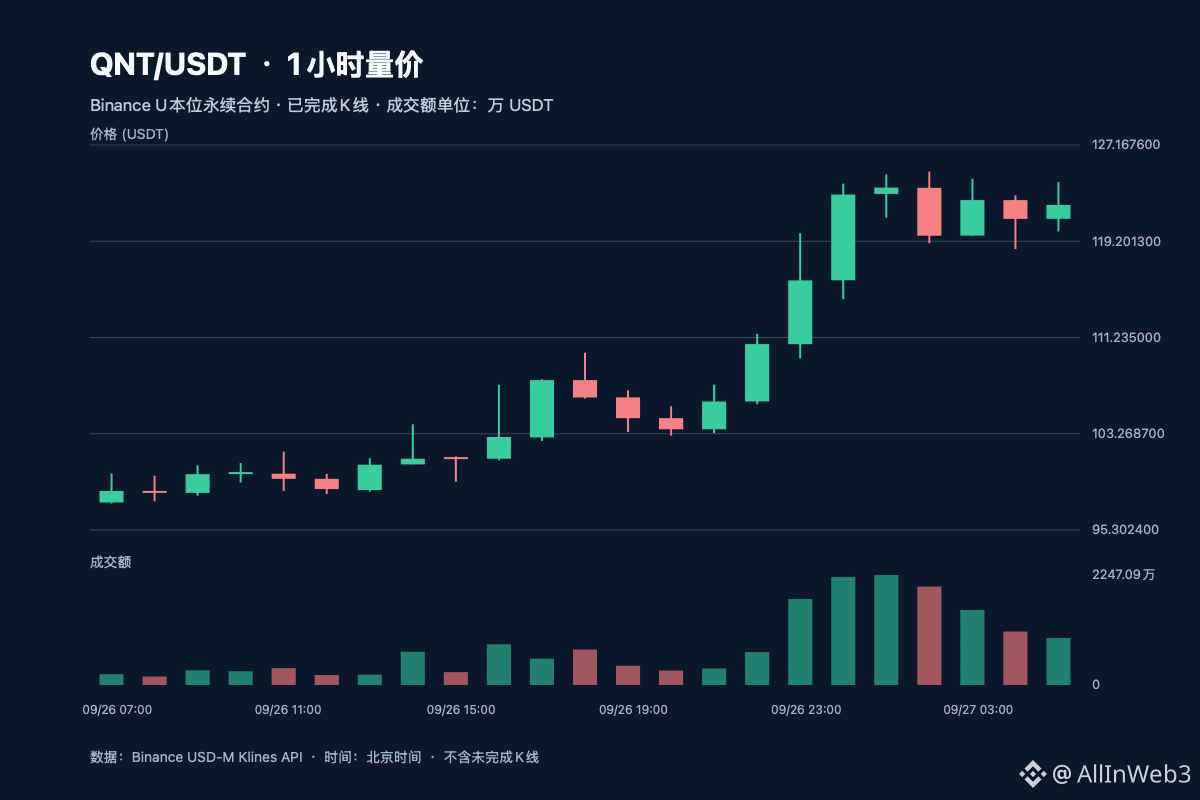
#QNT $QNT After the spike, the price stalls in place, while the open interest keeps rising. I’m inclined to wait and see—I care more about this mismatch: if new positions can’t produce sustained trading activity and new closing highs, the directional risk the market is taking on may be greater than the upside shown in the chart.
First, get the timeline right. On September 24, The Clearing House announced it would adopt Quant technology to build a tokenized deposits clearing and settlement network, with plans to open it to participating institutions only in the first half of 2027. This is a vendor selection and build plan—it can’t be written as if the network went live this morning, and it can’t be used to directly conclude that the QNT token will definitely generate revenue from it.
The market’s new change happens after the announcement. Binance QNT/USDT USDT-margined perpetuals closed at 123.07 USDT from 00:00 to 01:00. Then five consecutive full hourly candlesticks closed at 123.64, 119.66, 122.61, 121.05, and 122.21 in order. Price repeatedly ranged between about 120 and 125, without continuing the earlier one-way push higher. On the perpetuals, hourly trading volume first stayed around 22.07 million to 22.47 million USDT, then gradually fell to about 9.59 million by the final hour. The chart’s volume-backed rise and the later cooling in volume belong to two separate phases.
But positions didn’t cool off in the same way. Binance open interest, measured in QNT units, rose from about 110,600 at 01:00 to about 125,000 at 05:00—an increase of roughly 13%. This suggests the exposure of contracts that haven’t been closed is growing. You can’t tell whether the added positions are net long or net short, and you also can’t directly call it institutional buying. The global long/short ratio by accounts fell from 0.8302 at 01:00 to 0.7349 at 06:00. But that’s just the ratio of account counts—it doesn’t necessarily mean large capital positioning.
Spot is also worth comparing: Binance spot trading volume from 00:00 to 01:00 was about 2.66 million USDT, while from 05:00 to 06:00 it was about 0.80 million. The closing prices were 123.17 and 122.31, respectively. Spot didn’t provide evidence of a synchronous expansion in volume. However, a single exchange’s spot volume alone is not enough to prove that capital across the whole market has withdrawn.
My view is: this cycle has shifted from a quick surge into a “positions increasing, price waiting to be validated” phase. I’ll watch whether the next full hour can reclaim 124.97 when both spot and perpetual contract trading activity recover together. If it does, my current cautious view should be adjusted. If price breaks below 119.03 while OI remains high, the risk from crowded positions would be even more worth paying attention to. Do you think the first move will be a breakout with trade confirmation, or a withdrawal of positions ahead of any follow-through?
First, get the timeline right. On September 24, The Clearing House announced it would adopt Quant technology to build a tokenized deposits clearing and settlement network, with plans to open it to participating institutions only in the first half of 2027. This is a vendor selection and build plan—it can’t be written as if the network went live this morning, and it can’t be used to directly conclude that the QNT token will definitely generate revenue from it.
The market’s new change happens after the announcement. Binance QNT/USDT USDT-margined perpetuals closed at 123.07 USDT from 00:00 to 01:00. Then five consecutive full hourly candlesticks closed at 123.64, 119.66, 122.61, 121.05, and 122.21 in order. Price repeatedly ranged between about 120 and 125, without continuing the earlier one-way push higher. On the perpetuals, hourly trading volume first stayed around 22.07 million to 22.47 million USDT, then gradually fell to about 9.59 million by the final hour. The chart’s volume-backed rise and the later cooling in volume belong to two separate phases.
But positions didn’t cool off in the same way. Binance open interest, measured in QNT units, rose from about 110,600 at 01:00 to about 125,000 at 05:00—an increase of roughly 13%. This suggests the exposure of contracts that haven’t been closed is growing. You can’t tell whether the added positions are net long or net short, and you also can’t directly call it institutional buying. The global long/short ratio by accounts fell from 0.8302 at 01:00 to 0.7349 at 06:00. But that’s just the ratio of account counts—it doesn’t necessarily mean large capital positioning.
Spot is also worth comparing: Binance spot trading volume from 00:00 to 01:00 was about 2.66 million USDT, while from 05:00 to 06:00 it was about 0.80 million. The closing prices were 123.17 and 122.31, respectively. Spot didn’t provide evidence of a synchronous expansion in volume. However, a single exchange’s spot volume alone is not enough to prove that capital across the whole market has withdrawn.
My view is: this cycle has shifted from a quick surge into a “positions increasing, price waiting to be validated” phase. I’ll watch whether the next full hour can reclaim 124.97 when both spot and perpetual contract trading activity recover together. If it does, my current cautious view should be adjusted. If price breaks below 119.03 while OI remains high, the risk from crowded positions would be even more worth paying attention to. Do you think the first move will be a breakout with trade confirmation, or a withdrawal of positions ahead of any follow-through?