#coinmarketcap完成收购coinglass
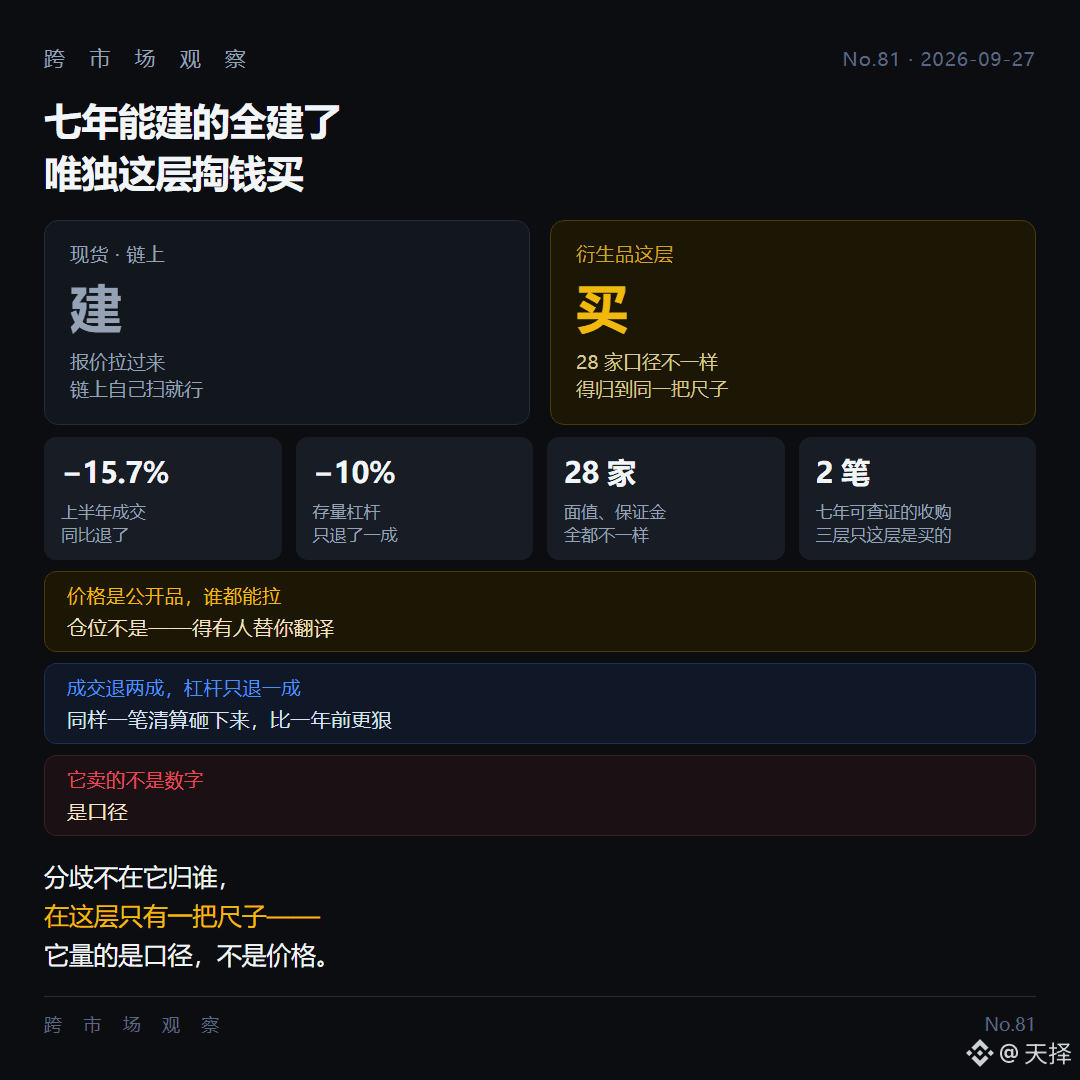
CoinMarketCap spent seven years building everything it could—spot and on-chain, all done by itself. Only for this layer, it paid to buy it outright.
▪️ On 9/25, both sides announced the deal was completed; the price was not disclosed: Coinglass covers 28 exchanges, 2,500+ assets, 5 million monthly active users, and 10,000 API clients
▪️ Why this layer is valuable: in its own semiannual report, H1 derivatives trading volume was 35.08 trillion, down 15.7% year over year, while outstanding leverage of 112.7 billion per day only shrank by 10%
▪️ Why it can only be bought: spot is about pulling quotes over; on-chain is just sweeping yourself. But clearing heatmaps require mapping contracts from 28 exchanges—whose contract values and margin-coin types differ—onto a single measuring standard, then layering leverage estimates and years of historical data
▪️ The division of labor across three layers: spot relies on the underlying data; on-chain relies on the scanning system it built in 2022; derivatives can only be bought—about 115 million people look at prices, and 5 million look at positions
The disagreement isn’t about who it belongs to. In this layer, there is only one measuring tape. When trading volume fell by 20% and leverage only fell by 10%—a single liquidation blows harder than it did a year ago. The price is a public good anyone can pull; positions are not. Converting the numbers from 28 exchanges into one unified standard has no shortcuts—you can only build it year after year. What it sells isn’t numbers, it’s methodology.
Watch three things: the exchange-coverage table, rate limits on the free interface, and that line—“no longer reporting.”
Which one will you notice first? $BTC
CoinMarketCap spent seven years building everything it could—spot and on-chain, all done by itself. Only for this layer, it paid to buy it outright.
▪️ On 9/25, both sides announced the deal was completed; the price was not disclosed: Coinglass covers 28 exchanges, 2,500+ assets, 5 million monthly active users, and 10,000 API clients
▪️ Why this layer is valuable: in its own semiannual report, H1 derivatives trading volume was 35.08 trillion, down 15.7% year over year, while outstanding leverage of 112.7 billion per day only shrank by 10%
▪️ Why it can only be bought: spot is about pulling quotes over; on-chain is just sweeping yourself. But clearing heatmaps require mapping contracts from 28 exchanges—whose contract values and margin-coin types differ—onto a single measuring standard, then layering leverage estimates and years of historical data
▪️ The division of labor across three layers: spot relies on the underlying data; on-chain relies on the scanning system it built in 2022; derivatives can only be bought—about 115 million people look at prices, and 5 million look at positions
The disagreement isn’t about who it belongs to. In this layer, there is only one measuring tape. When trading volume fell by 20% and leverage only fell by 10%—a single liquidation blows harder than it did a year ago. The price is a public good anyone can pull; positions are not. Converting the numbers from 28 exchanges into one unified standard has no shortcuts—you can only build it year after year. What it sells isn’t numbers, it’s methodology.
Watch three things: the exchange-coverage table, rate limits on the free interface, and that line—“no longer reporting.”
Which one will you notice first? $BTC