
#circletetherfreezebitgethackerwallet
The Bitget security breach is highlighting one of the key differences between stablecoins and native crypto assets: issuer-level control.
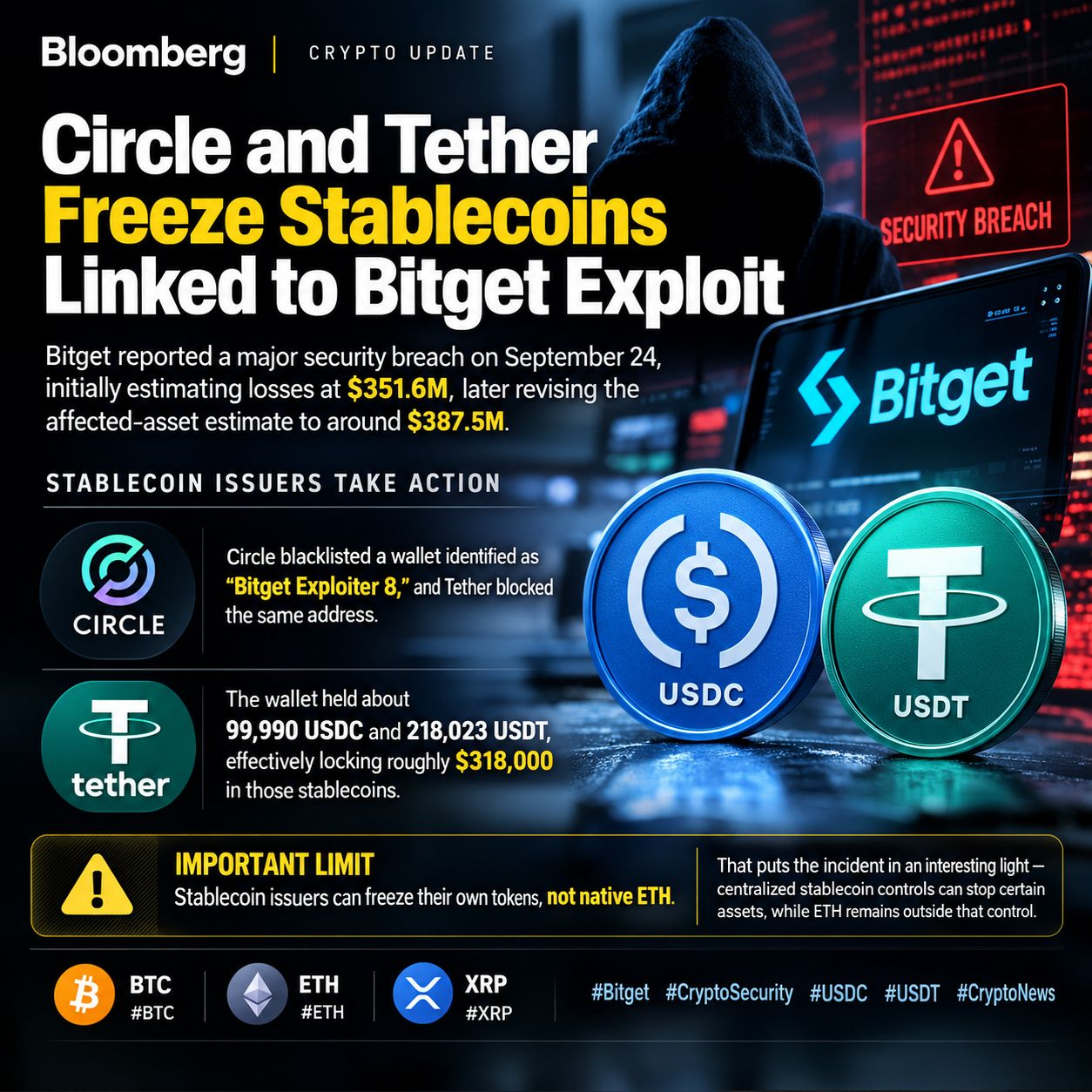
Bitget reported the exploit on September 24, initially estimating losses at $351.6 million, before revising the affected-asset estimate to around $387.5 million.
Following the incident, Circle and Tether moved to freeze stablecoins linked to one of the wallets identified in the exploit.
Circle blacklisted an address labeled “Bitget Exploiter 8,” while Tether blocked the same wallet. The address reportedly held around 99,990 USDC and 218,023 USDT, putting roughly $318,000 worth of those stablecoins under issuer control.
But there’s an important distinction here.
Circle can freeze USDC, and Tether can freeze USDT. They cannot apply the same issuer-level freeze to native ETH, because ETH is not issued or controlled by either company.
For traders, this is a useful reminder of the trade-off built into centralized stablecoins. Their issuer controls can help respond to stolen funds, but those controls don't extend across an entire blockchain or every asset involved in an exploit.
The bigger question now is how much of the affected assets can still be traced, frozen, or recovered as the investigation develops.
$BTC $ETH $XRP
#Bitget #CryptoSecurity #USDC #USDT #CryptoNews