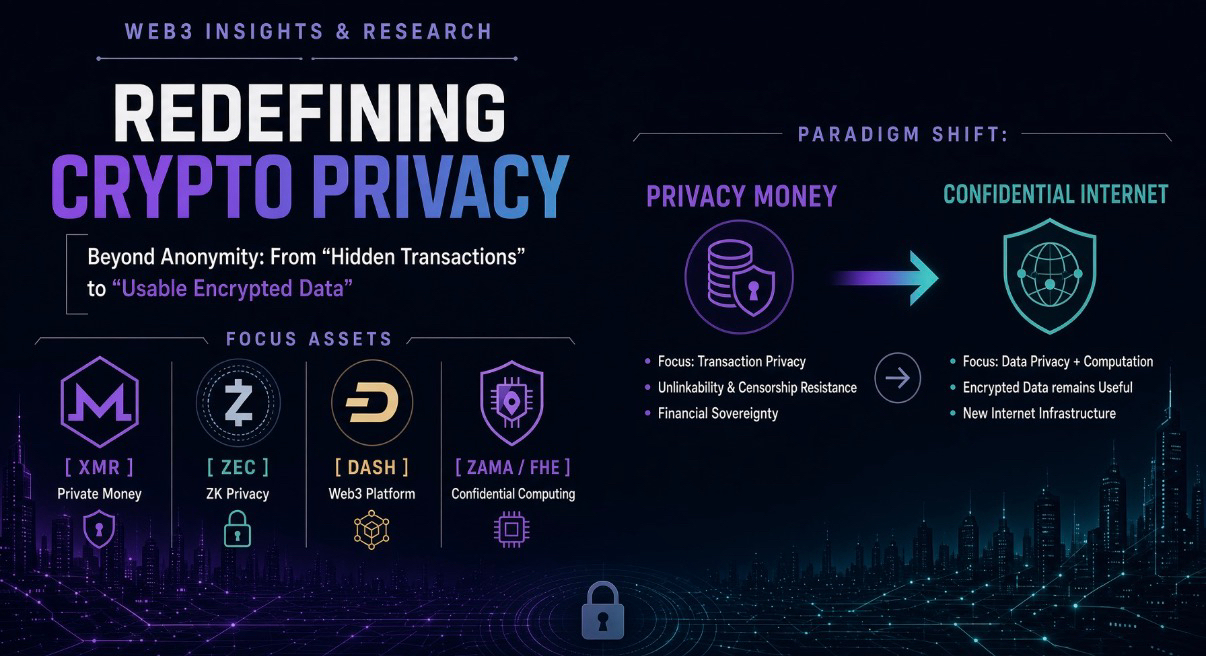

When we used to talk about privacy coins, the first thing people usually think of is: “anonymous transfers.” But if you’re still viewing XMR, ZEC, DASH, and Zama from that perspective, you may already be half a cycle behind. Because what’s truly worth noting is this: privacy is evolving from “not letting others see my transactions” to “allowing data to be used but not necessarily seen.” These two things may look like they differ by just one sentence, but behind them could be completely different markets.
First stop: XMR — truly “digital cash”
Monero’s core is actually very simple. I have money, I can spend it; but other people shouldn’t easily know how much I have, who I’m paying, or how much I paid. From the very beginning, XMR placed privacy at the core. Technologies such as Ring Signature, Stealth Address, and RingCT together form Monero’s privacy architecture. So the biggest value of XMR isn’t whether it has launched a fancy new narrative. It’s this: privacy itself is its product. Even future upgrades like FCMP++ still revolve around increasing the anonymity set and strengthening privacy. This makes XMR somewhat like the “Private Bitcoin / Digital Cash” in the cryptography world. But the issue is very real. The stronger the financial privacy, the more likely it is to run into regulatory and centralized exchange-platform limitations. So in the future, XMR may face an interesting contradiction: the more mature the technology becomes, the stronger the privacy; but the compliance environment could become more complicated.
Second stop: ZEC—from privacy coins to ZK finance
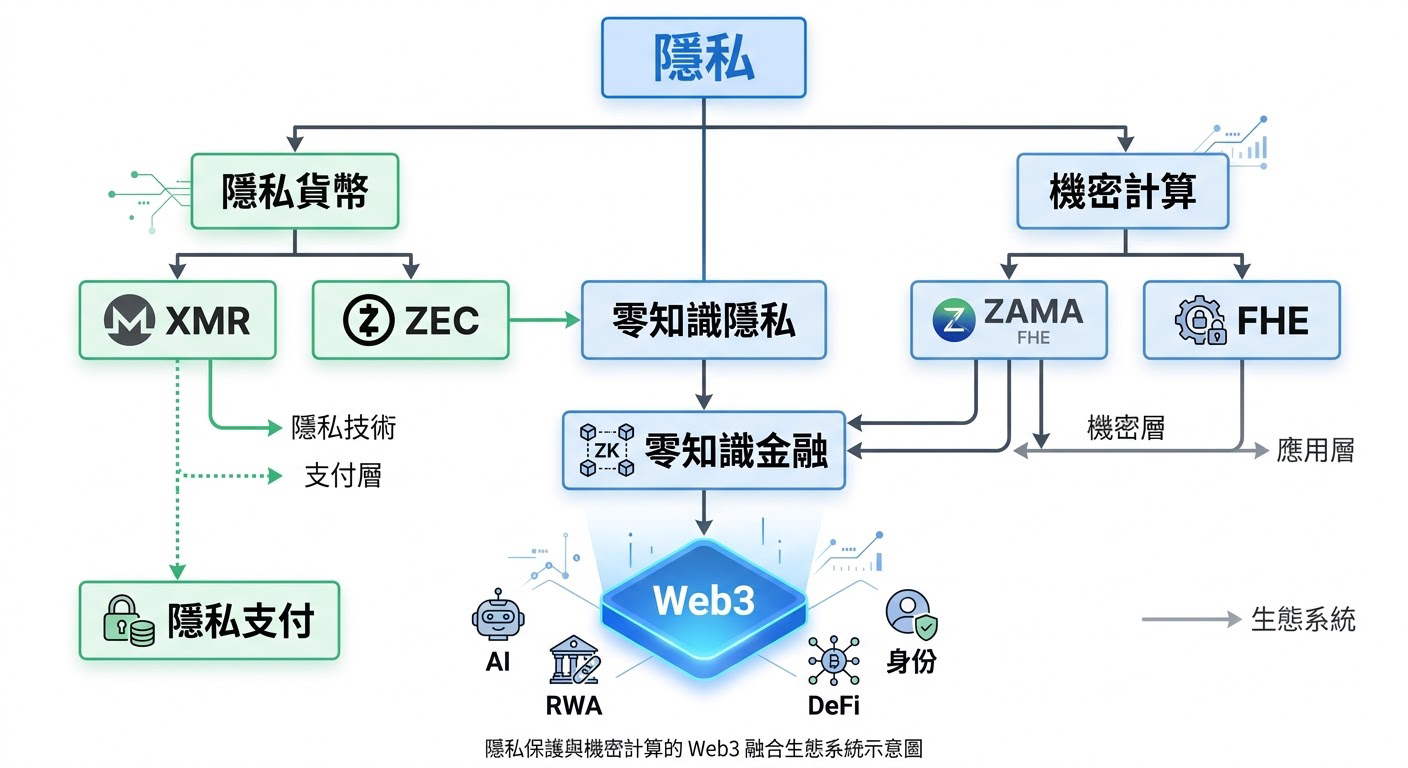
Zcash’s story is a bit different. The most valuable part is bringing Zero-Knowledge Proof into privacy transactions. Simply put: I can prove that this transaction follows the rules, but I don’t need to reveal all the transaction details to you. This concept goes far beyond “anonymous transfers.” Because ZK technology itself is entering areas like DeFi, Identity, RWA, cross-chain, private payments, and enterprise data verification, among others. Therefore, what’s truly worth watching about ZEC in the future isn’t just whether it can keep acting as a Privacy Coin. It’s whether Zcash can evolve from a Privacy Coin into Privacy Infrastructure. That may be the biggest imagination space in the next stage.
Third stop: DASH—many people may be underestimating what it’s trying to do
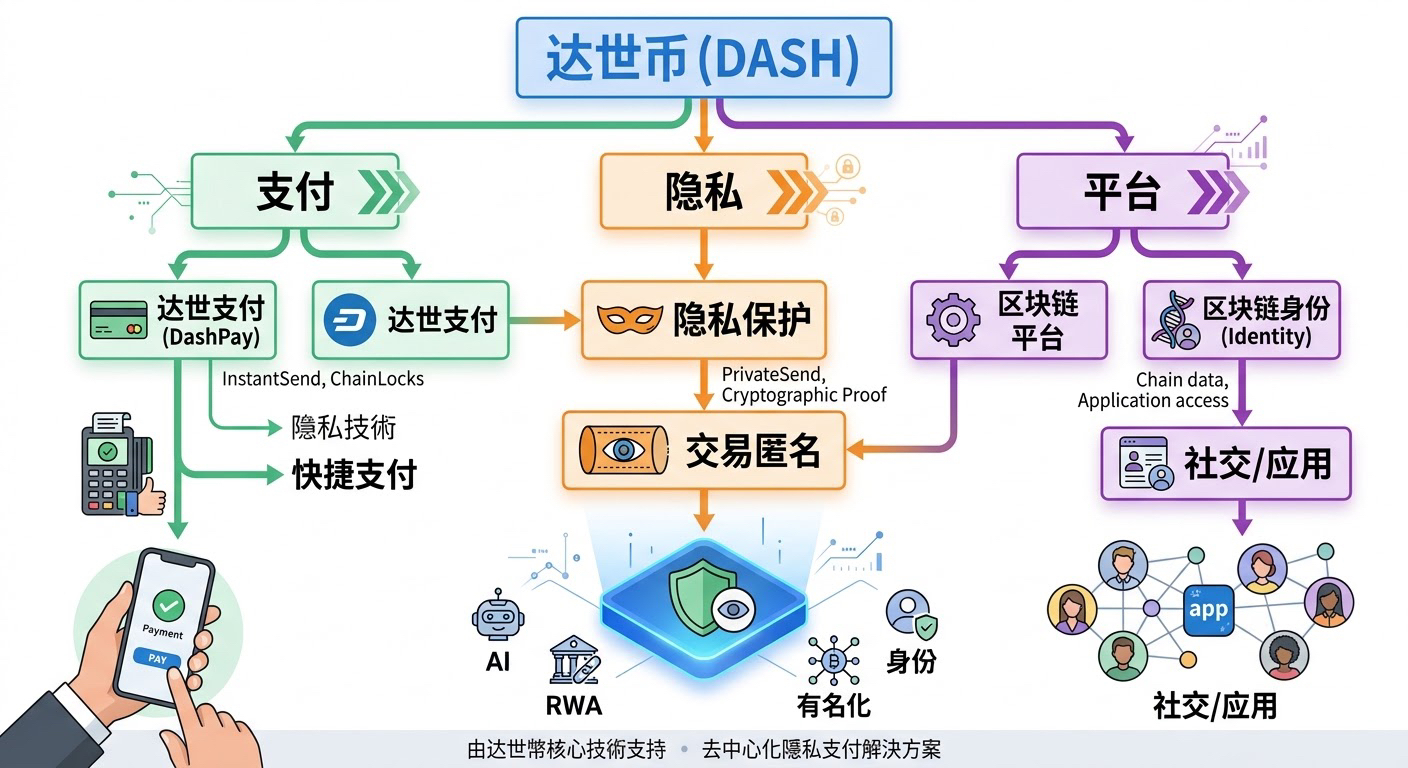
If you’re still stuck on: “DASH = an old payment coin,” then you may need to take another look at its direction of development. DASH is gradually moving toward Payment + Privacy + Identity + Platform + Web3 Application. Especially directions like Platform, DashPay, and Shielded Balance are pushing DASH to be more than just “a coin you use to transfer funds.” It’s trying to build a Web3 platform with payment, identity, social features, and privacy. This is already different from XMR and ZEC’s path. XMR is more like private digital cash; ZEC is more like ZK privacy finance; DASH is closer to privacy payments + a Web3 application platform. So DASH’s biggest challenge in the future may not be “whether it’s an old coin,” but: whether it can truly turn these infrastructures into actual users and transaction volume.
And what really made me start rethinking the “privacy” track was ZAMA.
Because ZAMA is no longer just a simple Privacy Coin. It represents a completely different direction: FHE—Fully Homomorphic Encryption, in Chinese: fully homomorphic encryption. The most interesting part of this is: data can remain encrypted, yet still be computable. This sentence is extremely important. Imagine this: you have a piece of private financial data. The traditional workflow is “data → decrypt → compute → encrypt again.” What FHE wants to do is “data stays encrypted → compute directly → get an encrypted result → only authorized people can decrypt.” In other words, the data doesn’t need to be seen, yet it can still be used. This suddenly shifts privacy from “anonymous payments” into an entirely different market.
AI × FHE: This might be one of the main reasons I want to study ZAMA. One of the biggest problems for AI in the future is: the more valuable data is, the less you can casually hand it over. Company data can’t be public. Financial data can’t be public. Personal data can’t be public. Identity data can’t be public. But AI needs a lot of data to work. So a contradiction emerges: AI wants data, but users don’t want to give it up. FHE offers a possibility: AI can process the data without necessarily needing to see the data itself. If this path really matures, Privacy may no longer be just “a niche market within encrypted coins,” and it could become part of AI Infrastructure.
RWA × FHE: Now imagine future RWAs. Banks have bonds, loans, credit data, corporate assets, customer identities, risk models—all of these on a public blockchain? Almost impossible. But if assets can be verified, transactions can be executed, models can be computed, and the data remains encrypted, then the blockchain might truly enter large financial institutions. That’s also why I believe the imagination space for FHE may be far greater than that of traditional Privacy Coins.
Four projects actually represent four different paths:
XMR → Private Money → Private digital cash
ZEC → ZK Privacy → Zero-knowledge privacy finance
DASH → Payment + Platform → Payment + Web3 applications
ZAMA → FHE → Confidential computing infrastructure
So what’s truly interesting isn’t: “Which privacy coin will pump?” It’s: what does the next generation of the internet need—“anonymity,” or “confidential computing”? These two answers might coexist.
The privacy track may be entering a second stage.
First stage (Privacy Money, represented by XMR, ZEC, DASH): the core problem is, “I don’t want others to know my transactions.”
Second stage (Confidential Internet, represented by FHE, ZK, ZAMA, Privacy Compute): the core problem becomes, “I want data to be used, but I don’t want the data itself to be seen.”
The imagination space for this market may be much larger than just anonymous payments. Because it can directly connect to AI, RWA, DeFi, Identity, enterprise data, institutional finance, medical data, and even future AI agents.
If a new wave of privacy narratives really emerges in the future, I think the market may not just hype “anonymous coins” anymore—it may start hyping a bigger concept: Confidential Internet. That is: verifiable but not public; computable but not leaking; tradable but not exposing all data. This actually closely matches what the next stage of blockchain needs. Because Web3 originally solved the “trust problem.” The next thing it may need to solve is the contradiction between “transparency and privacy.”
Finally, if you just treat XMR, ZEC, DASH, and ZAMA as four coins, it’s easy to miss the truly big direction. They’re actually like answers from four different eras:
XMR: Don’t let others know how I spend money.
ZEC: I can prove the transaction is real, but I don’t need to publish the transaction details.
DASH: I hope payment, identity, social interactions, and privacy can be combined.
ZAMA: I want data to remain encrypted, yet still be usable by AI, DeFi, RWA, and the blockchain.
So what I really want to observe isn’t the next “anonymous coin breakout.” It’s: when AI starts consuming data across the world, when RWA starts entering the financial system, when enterprises start actually using blockchains—who can make “data can be used but cannot be seen”? If this question really becomes a core requirement for Web3 in the end, then the somewhat niche XMR, ZEC, DASH, and ZAMA that we see today might just be a few early answers from different stages of the privacy era. But the real big battle may be just beginning.