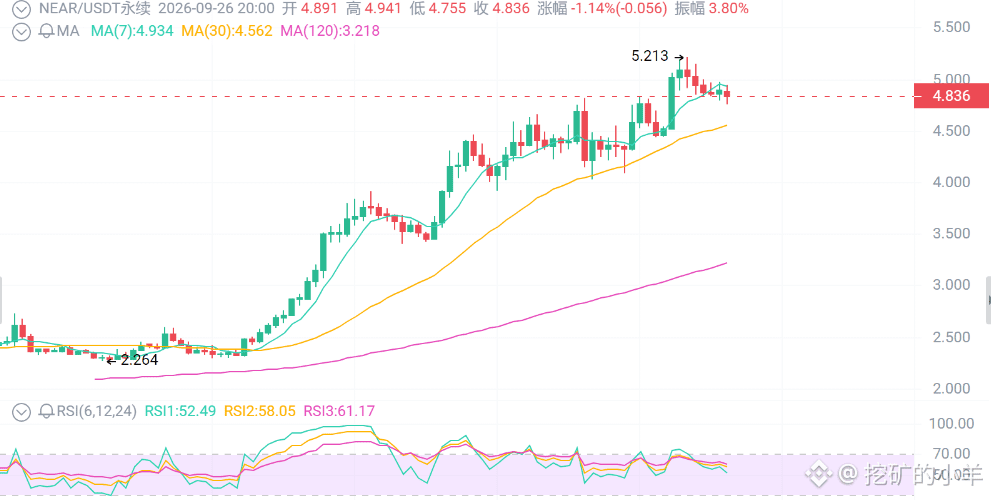
$4.8 NEAR—are you chasing it?
First, the surface: On September 24, Bitwise’s NEAR spot ETF was approved, listed on NYSE Arca under ticker NRR, with 100% backing. On the same day, Intents’ cumulative trading volume surpassed $30 billion, and in just 7 days it did $846 million. Ondo tokenized stocks came to near.com—NVIDIA, Tesla, and Apple can be bought cross-chain. Price touched $5.21, then turned around and got smashed down to $4.8. With so many positives, why is it still falling?
First thing: The ETF is bullish, but don’t treat “approval” as “opening for trading.”
The SEC’s final effectiveness and the actual first trading day haven’t been set yet. The market is currently trading expectations, not real, tangible net inflows.
Right now, even NEAR’s ETF doesn’t have a defined opening date.
Second thing: Intents is real usage, but you need to see where the fees go.
Cumulative volume: $30 billion; 7 days: $846 million; past 24 hours: $116 million.
Chain abstraction, privacy execution, confidential derivatives, AI agent settlement—NEAR is taking “the settlement layer” business.
“After the Intents fee switch, protocol revenue is used for buybacks.” Sounds great. But circulating market cap is already $6.3 billion, ranking 18—not cheap anymore.
A surge in usage is a good thing, but the price has already priced in that good news.
Third thing: The candlestick chart tells you that $4.8 isn’t “cheap”—it’s just the first stop after dropping from $5.2.
From the February low of 0.83 to 5.21, the monthly chart is up 150%+. Daily RSI once surged to 88—extremely overbought. Now it has pulled back to 52–55, cooling off the overheating, but it hasn’t reached oversold.
All moving averages are below the price by a distance—trend is still bullish. But the short-term moving averages are starting to tangle, MACD histogram bars are shrinking, and momentum is slowing.
Trading strategy
If you already hold long positions:
Cut 1/3 to 1/2 to lock in profits.
Move take-profit up to 4.35–4.5.
If it reclaims 5.05 and holds for 4 hours, add back part of the position, targeting 5.5–6.
If you’re flat and want to go long:
Buy the pullback at 4.20–4.4, looking for a low-volume selloff to stop falling, and for the 4-hour candle to reclaim the moving average.
Only after a high-volume reclaim and a firm hold above 5.05—confirm the breakout.
First stop loss: below 4.15.
For a breakout trade, place the stop below 4.85 if the retest fails.
Targets: first 5.15–5.25, second 5.80–6.1.
If you want to short / hedge:
If it rebounds to 5.05–5.20 and stalls, try a short; target 4.6 / 4.35.
Stop loss strictly above 5.28.
If the daily chart closes back above 5.10, exit the short immediately.
Scenario for the next 1–2 weeks:
Base case: 4.3–5.2 range-bound consolidation while waiting for the ETF’s opening day or a second surge in volume.
Bullish: Quickly reclaim 5.2 and push toward 6.
Bearish: Break below 4.2, retest, then resume down to 3.8–3.5 after breaking the support. Medium-term bulls are still there, but the short-term will be painful.
First, the surface: On September 24, Bitwise’s NEAR spot ETF was approved, listed on NYSE Arca under ticker NRR, with 100% backing. On the same day, Intents’ cumulative trading volume surpassed $30 billion, and in just 7 days it did $846 million. Ondo tokenized stocks came to near.com—NVIDIA, Tesla, and Apple can be bought cross-chain. Price touched $5.21, then turned around and got smashed down to $4.8. With so many positives, why is it still falling?
First thing: The ETF is bullish, but don’t treat “approval” as “opening for trading.”
The SEC’s final effectiveness and the actual first trading day haven’t been set yet. The market is currently trading expectations, not real, tangible net inflows.
Right now, even NEAR’s ETF doesn’t have a defined opening date.
Second thing: Intents is real usage, but you need to see where the fees go.
Cumulative volume: $30 billion; 7 days: $846 million; past 24 hours: $116 million.
Chain abstraction, privacy execution, confidential derivatives, AI agent settlement—NEAR is taking “the settlement layer” business.
“After the Intents fee switch, protocol revenue is used for buybacks.” Sounds great. But circulating market cap is already $6.3 billion, ranking 18—not cheap anymore.
A surge in usage is a good thing, but the price has already priced in that good news.
Third thing: The candlestick chart tells you that $4.8 isn’t “cheap”—it’s just the first stop after dropping from $5.2.
From the February low of 0.83 to 5.21, the monthly chart is up 150%+. Daily RSI once surged to 88—extremely overbought. Now it has pulled back to 52–55, cooling off the overheating, but it hasn’t reached oversold.
All moving averages are below the price by a distance—trend is still bullish. But the short-term moving averages are starting to tangle, MACD histogram bars are shrinking, and momentum is slowing.
Trading strategy
If you already hold long positions:
Cut 1/3 to 1/2 to lock in profits.
Move take-profit up to 4.35–4.5.
If it reclaims 5.05 and holds for 4 hours, add back part of the position, targeting 5.5–6.
If you’re flat and want to go long:
Buy the pullback at 4.20–4.4, looking for a low-volume selloff to stop falling, and for the 4-hour candle to reclaim the moving average.
Only after a high-volume reclaim and a firm hold above 5.05—confirm the breakout.
First stop loss: below 4.15.
For a breakout trade, place the stop below 4.85 if the retest fails.
Targets: first 5.15–5.25, second 5.80–6.1.
If you want to short / hedge:
If it rebounds to 5.05–5.20 and stalls, try a short; target 4.6 / 4.35.
Stop loss strictly above 5.28.
If the daily chart closes back above 5.10, exit the short immediately.
Scenario for the next 1–2 weeks:
Base case: 4.3–5.2 range-bound consolidation while waiting for the ETF’s opening day or a second surge in volume.
Bullish: Quickly reclaim 5.2 and push toward 6.
Bearish: Break below 4.2, retest, then resume down to 3.8–3.5 after breaking the support. Medium-term bulls are still there, but the short-term will be painful.