

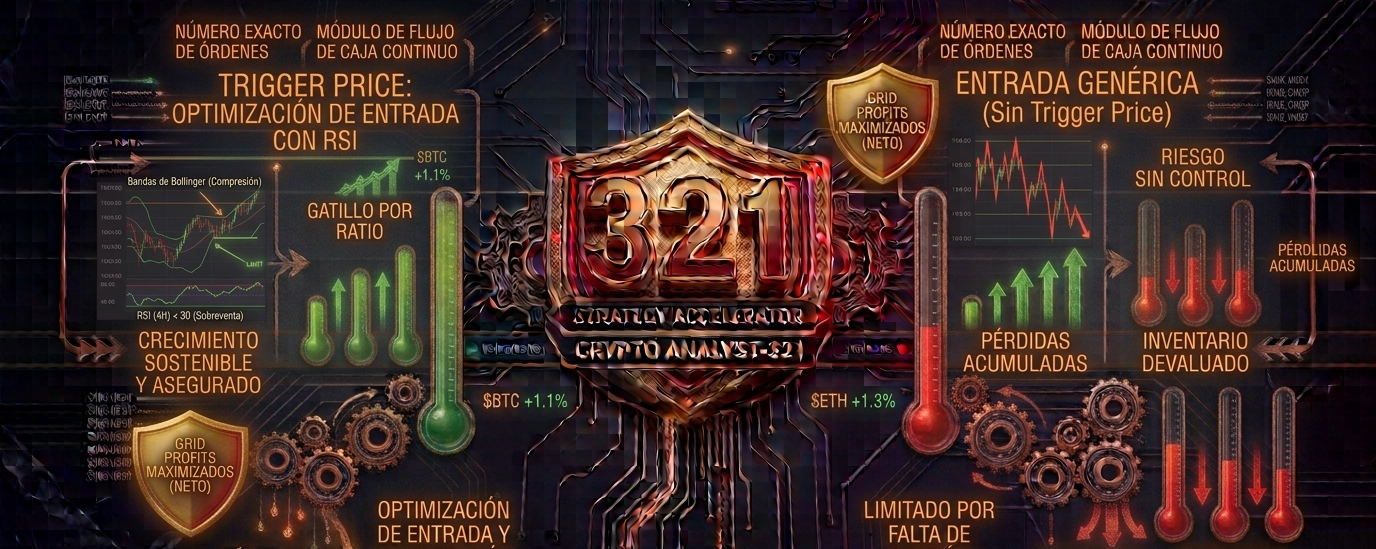

Launching a grid bot (Spot or Futures Grid) at market price without evaluating the technical starting point usually results in accumulating inventory at inflated prices or entering right before a support break.
Binance's Trigger Price function allows you to preprogram your bot to stay on standby and start operating only when the asset reaches a high-probability zone identified by technical indicators such as the RSI or the Bollinger Bands.
1. Syncing the Trigger Price with Technical Indicators
RSI Trigger (Oversold/Overbought): Set the activation price right at the level where the 1H or 4H RSI touches oversold zones (≤30) for bullish grids, avoiding starting the grid in the middle of a spent move.
Bollinger Band Trigger (Compression and Bounce): Place the Trigger Price near the lower Bollinger band on 1H charts to ensure the bot starts buying at the base of the sideways channel.
2. Benefits of Automated Conditional Entry
Zero Emotional Impact: Eliminate the temptation to enter out of FOMO when the price is in the middle of a full rally.
Margin and Inventory Optimization: The bot does not commit your capital to grid orders until the asset enters exactly the desired operating range.
Higher Risk/Reward Ratio: By starting in extreme support zones, the probability of executing quick Grid Profit closes increases exponentially.
3. Express Tactical Tip (Your setup formula)
💡 The Activation "Tip": Identify on the 4H chart the lower Bollinger band or a support level where the RSI has historically bounced. Set that exact level as your Trigger Price when creating the Spot Grid. In this way, while the market fluctuates without a clear direction, your capital remains safe in USDT until the price seeks the optimal technical level.
👉 Do you usually launch your bots at market price, or do you use conditional Activation Prices? Leave me your strategy in the comments!
If this quantitative content helps you refine your automated entries on Binance, follow me to keep discovering more tactical tools.