



Let's take a real-life example.
Imagine a farmer buys crop insurance with a simple condition:
🌾 “If rainfall during the growing season is below 50mm, the farmer receives Rs. 100,000.”
The smart contract can handle the insurance rules and payment, but there is one problem:
How does the blockchain know how much rain actually fell?
It can't simply look outside and check the weather.
That's where an oracle comes in.
🌧️ An oracle gets information from outside the blockchain and makes that information available to the smart contract.
For example:
Weather data → Chainlink → Blockchain → Smart Contract
Suppose the reported rainfall is 35mm.
The smart contract checks:
35mm < 50mm ✅
The condition is met, so the contract can execute the insurance payout.
But where does LINK come into this?
LINK is the native token of Chainlink.
In the Chainlink ecosystem, $LINK is used for things such as paying for oracle services, compensating network service providers, and supporting the network's cryptoeconomic security. Chainlink also uses $LINK in its staking system.
So, in our example, think of it like this:
🌧️ Real-world weather data
⬇️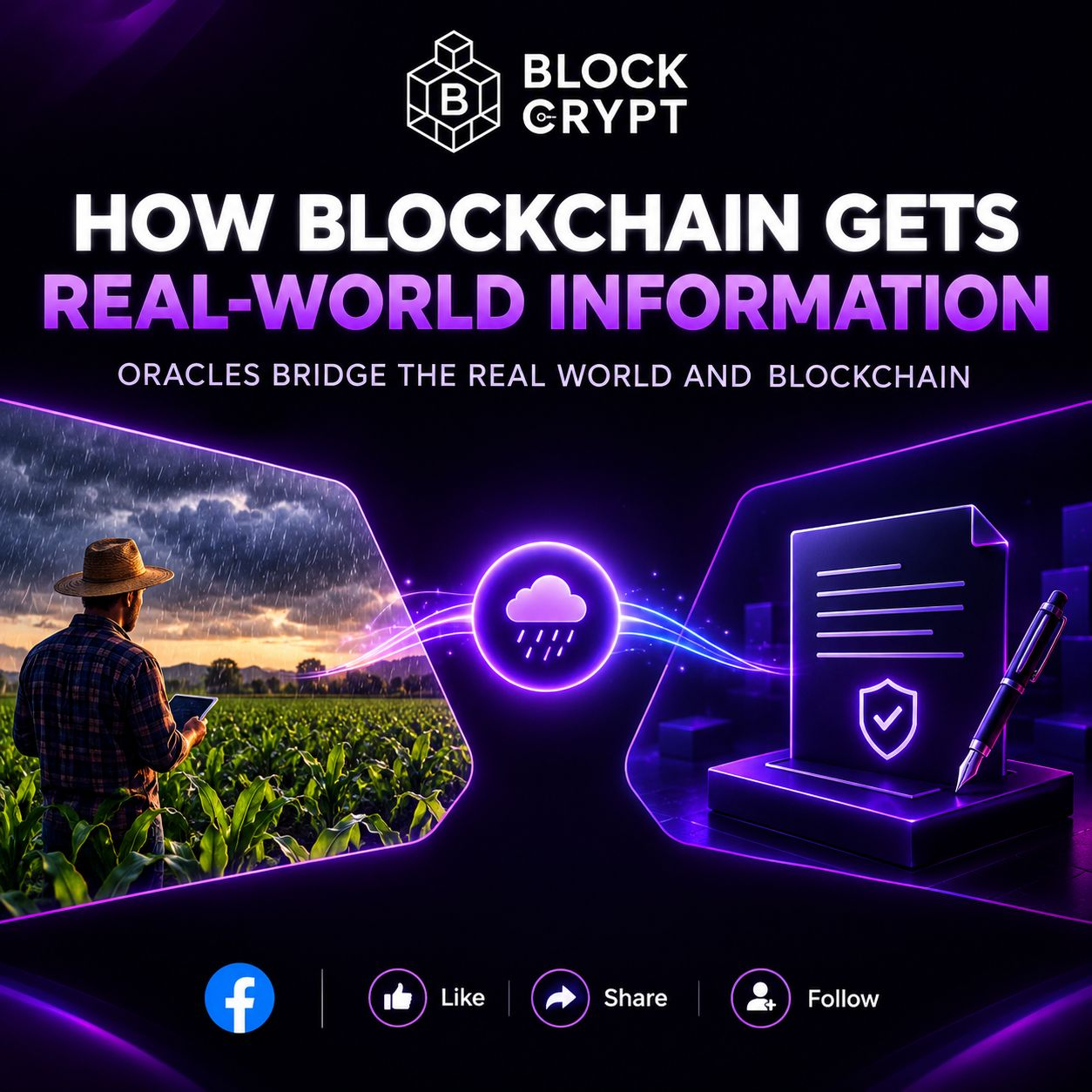
🔗 Chainlink oracle network
⬇️
💰 LINK helps support the economic system behind the oracle services
⬇️
⛓️ Blockchain receives the data
⬇️
📜 Smart contract checks the condition
⬇️
💵 Insurance payment is triggered
One important point:
The farmer doesn't necessarily have to personally buy LINK to receive the insurance payment.
Chainlink's current Payment Abstraction system can allow users to pay for Chainlink services using other assets, with those payments being converted into LINK.
📈 So does this make LINK price go up or down?
More Chainlink usage can create economic demand for LINK, because LINK is used within the network's payment and security mechanisms.
But that doesn't mean every new oracle request automatically makes LINK's market price increase.
LINK's market price is determined by the overall market — including supply and demand, investor activity, crypto-market conditions, Chainlink adoption, staking, and other factors.
For example, LINK closed around $13.93 on September 25, 2026, compared with $11.05 on September 16, according to CoinGecko's historical data. That's a recent price increase, but it should not be attributed to oracle usage alone.
So the simple idea is:
Oracle = brings outside information
Smart contract = follows the predefined rules
LINK = helps power the economic/security side of Chainlink
Other blockchain oracle projects include Pyth Network, API3, RedStone, Band Protocol and UMA.
💬 Did this example make the connection between oracles, smart contracts and LINK clearer? Share it with someone learning blockchain.
⚠️ Educational content only. Crypto prices are volatile. Do your own research before making financial decisions.