Last night I watched the on-chain data from the Bitget case into the middle of the night— the more I looked, the more surreal it felt.
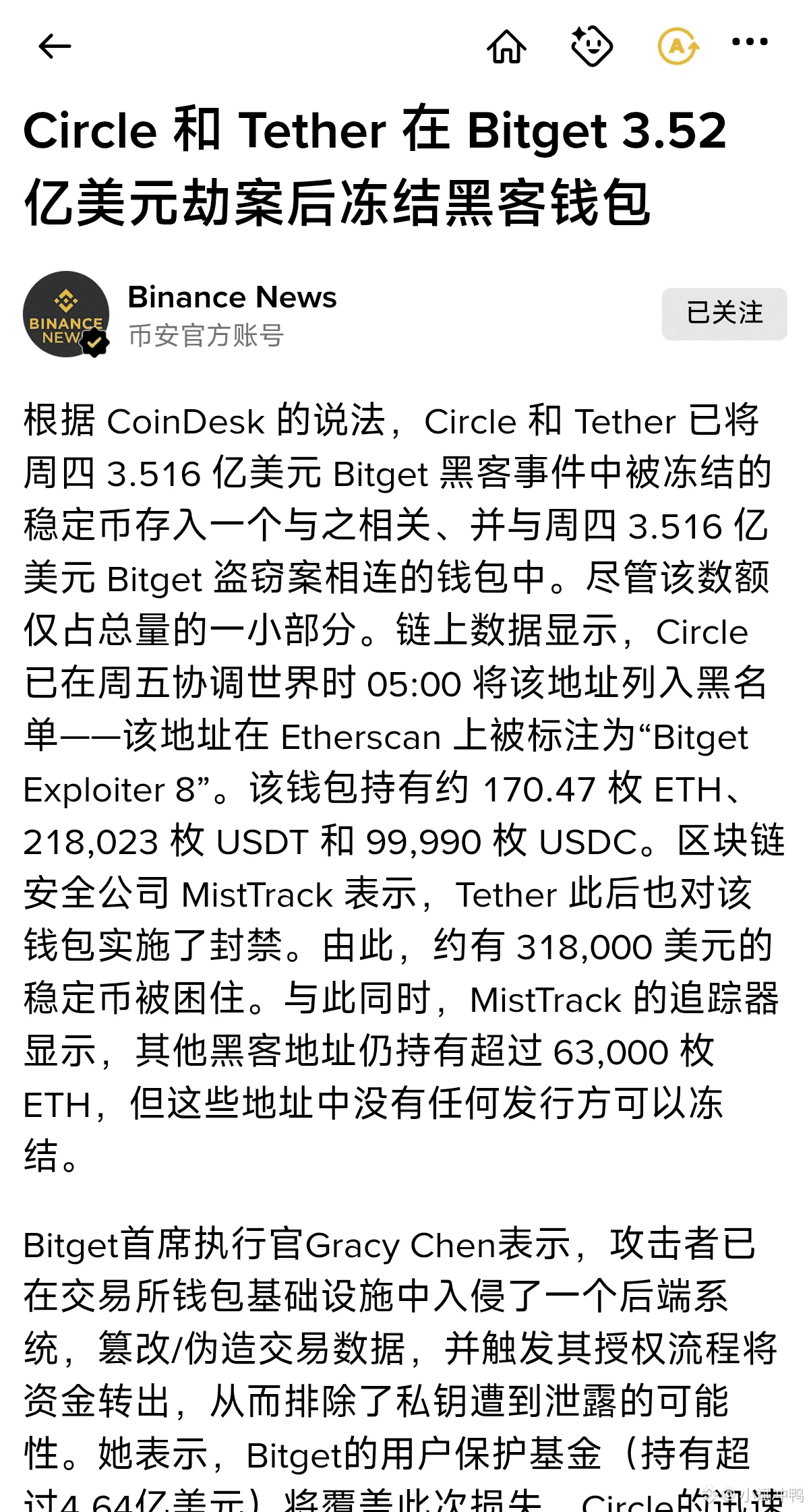
On September 25, Circle first blacklisted the hacker behind the "Bitget Exploiter 8" address, freezing 99,990 USDC; about seven hours later, Tether followed suit and froze an additional 218,023 $USDT. Combined, that’s $318,000.
Sounds satisfying? Let’s do the math: the total value of this theft has already risen from the initially reported $351.6 million to $387.5 million. Later, new transfer records were also pulled from the ZEC and TRON chains. $318,000 ÷ $387.5 million ≈ 0.08%. The robbers emptied the whole vault, and when the police stormed in, they only found three-fifty-something in his jacket pocket.
It’s the same old script. Before the freeze order was issued, the hacker had already swapped every stablecoin in his possession that could be frozen into $ETH . MistTrack’s tracker shows that more than 63,000 ETH is still sitting in other related addresses—this stuff has no issuer behind it, so neither Circle nor Tether can hit the pause button. Even more incredible: in the same frozen address, 170.47 ETH is sitting in plain sight, and it can’t be frozen or moved.
The speed is also worth pondering. Back in April, when Drift was stolen for $285 million, the attacker directly moved $232 million USDC via Circle’s own cross-chain bridge—Circle was late by a full six hours, and was dragged onto the hot search by ZachXBT. This time it’s faster, but the hacker is faster still.
In the end, what gets frozen is never just money—it’s attitude. Even Tether came out to say it has assisted in freezing more than $4.4 billion in assets historically. But if you think about it carefully, it’s still chilling: if today it can freeze a hacker’s USDT, then in theory tomorrow it can freeze yours. As for the so-called "decentralization"—when it comes to these two biggest stablecoin issuers, it’s worth putting a big question mark on that.
As for Bitget: it has promised that today (September 26) before 16:00 Beijing time, it will provide a timeline for when withdrawals will be restored. It will also cover the user protection fund with $464 million. In addition, it has set up a bounty: 5% for freezing the stolen funds; an extra 5% if the full amount is recovered. The follow-up treasure-hunt storyline will likely go on.
My position is simple: if you want the property that "no one can freeze you," just self-custody with a cold wallet; if you want the reassurance that "if something happens, someone will pay," then stay with big firms backed by a thick protection fund. These two kinds of protection are always a trade-off.
What do you think? Should this freezing power exist, or is it essentially a blade hanging over the heads of everyone holding coins? Drop your thoughts in the comments.
#Bitget #稳定币 #on-chain security
On September 25, Circle first blacklisted the hacker behind the "Bitget Exploiter 8" address, freezing 99,990 USDC; about seven hours later, Tether followed suit and froze an additional 218,023 $USDT. Combined, that’s $318,000.
Sounds satisfying? Let’s do the math: the total value of this theft has already risen from the initially reported $351.6 million to $387.5 million. Later, new transfer records were also pulled from the ZEC and TRON chains. $318,000 ÷ $387.5 million ≈ 0.08%. The robbers emptied the whole vault, and when the police stormed in, they only found three-fifty-something in his jacket pocket.
It’s the same old script. Before the freeze order was issued, the hacker had already swapped every stablecoin in his possession that could be frozen into $ETH . MistTrack’s tracker shows that more than 63,000 ETH is still sitting in other related addresses—this stuff has no issuer behind it, so neither Circle nor Tether can hit the pause button. Even more incredible: in the same frozen address, 170.47 ETH is sitting in plain sight, and it can’t be frozen or moved.
The speed is also worth pondering. Back in April, when Drift was stolen for $285 million, the attacker directly moved $232 million USDC via Circle’s own cross-chain bridge—Circle was late by a full six hours, and was dragged onto the hot search by ZachXBT. This time it’s faster, but the hacker is faster still.
In the end, what gets frozen is never just money—it’s attitude. Even Tether came out to say it has assisted in freezing more than $4.4 billion in assets historically. But if you think about it carefully, it’s still chilling: if today it can freeze a hacker’s USDT, then in theory tomorrow it can freeze yours. As for the so-called "decentralization"—when it comes to these two biggest stablecoin issuers, it’s worth putting a big question mark on that.
As for Bitget: it has promised that today (September 26) before 16:00 Beijing time, it will provide a timeline for when withdrawals will be restored. It will also cover the user protection fund with $464 million. In addition, it has set up a bounty: 5% for freezing the stolen funds; an extra 5% if the full amount is recovered. The follow-up treasure-hunt storyline will likely go on.
My position is simple: if you want the property that "no one can freeze you," just self-custody with a cold wallet; if you want the reassurance that "if something happens, someone will pay," then stay with big firms backed by a thick protection fund. These two kinds of protection are always a trade-off.
What do you think? Should this freezing power exist, or is it essentially a blade hanging over the heads of everyone holding coins? Drop your thoughts in the comments.
#Bitget #稳定币 #on-chain security