Trump rejected Iran's seven-day ceasefire proposal and told aides he expects to resume bombing after November's midterms — removing the Hormuz resolution that had been Bitcoin's primary macro tailwind this week. Morgan Stanley abandoned its bearish dollar view, now forecasting DXY at 104 by mid-2027 with two more Fed hikes (December and March) — stretching this week's dollar headwind from a trade into a multi-quarter regime. Treasury volatility (MOVE) jumped 30% to its highest since March while Bitcoin implied volatility (BVIV) sits near yearly lows at 37 — a divergence that reads as either resilience or complacency. CryptoQuant's MVRV signal marked August 20 as Bitcoin's early bull market entry at $71,255. 81% of circulating Bitcoin hasn't moved in six months.
Morgan Stanley's Dollar U-Turn Extends the Squeeze on Risk Assets Into 2027
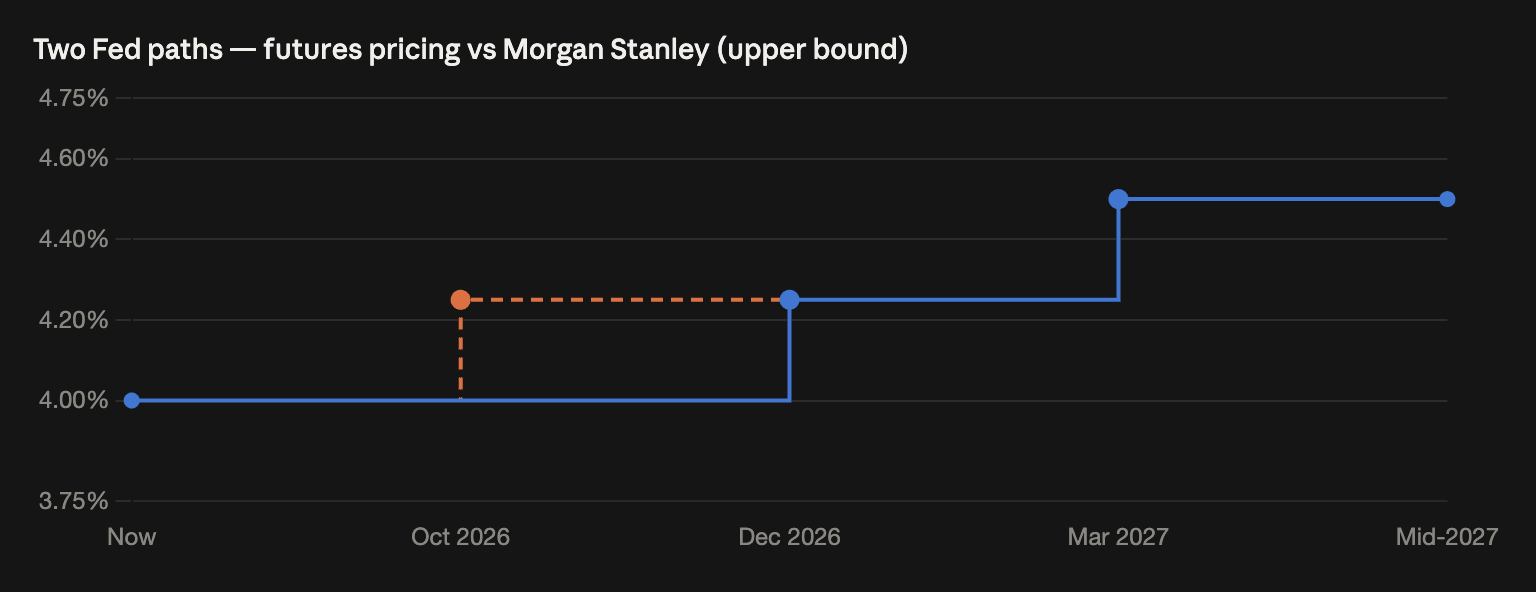
Morgan Stanley abandoned its bearish dollar view, now forecasting DXY rising from ~101 to 104 by mid-2027 and EUR/USD falling from ~$1.14 to $1.10. The bank's revised Fed path calls for hikes in December 2026 and March 2027 — more tightening than the dot plot's one remaining 2026 move, but on a slower clock than futures pricing 53%+ October odds. The distinction matters: if MS is right, October disappoints the hawks and offers a tactical reprieve while the destination ends up higher than the dot plot implies. European political risk adds a second engine — France's spring 2027 presidential election plus German and Italian election risks stack a euro risk premium on top of the US rate advantage. For crypto, a dollar march to 104 extends the two pressure channels — foreign purchasing power erosion and elevated opportunity cost — for several more quarters. The counterweights holding so far: $2.84B in six-day ETF inflows, slowing LTH distribution, and BVIV near yearly lows even as bond volatility spikes. October 2 jobs and October 14 CPI arbitrate the MS-versus-futures timing dispute.
The Bond Market Is Screaming and Bitcoin Is Not Listening — Yet
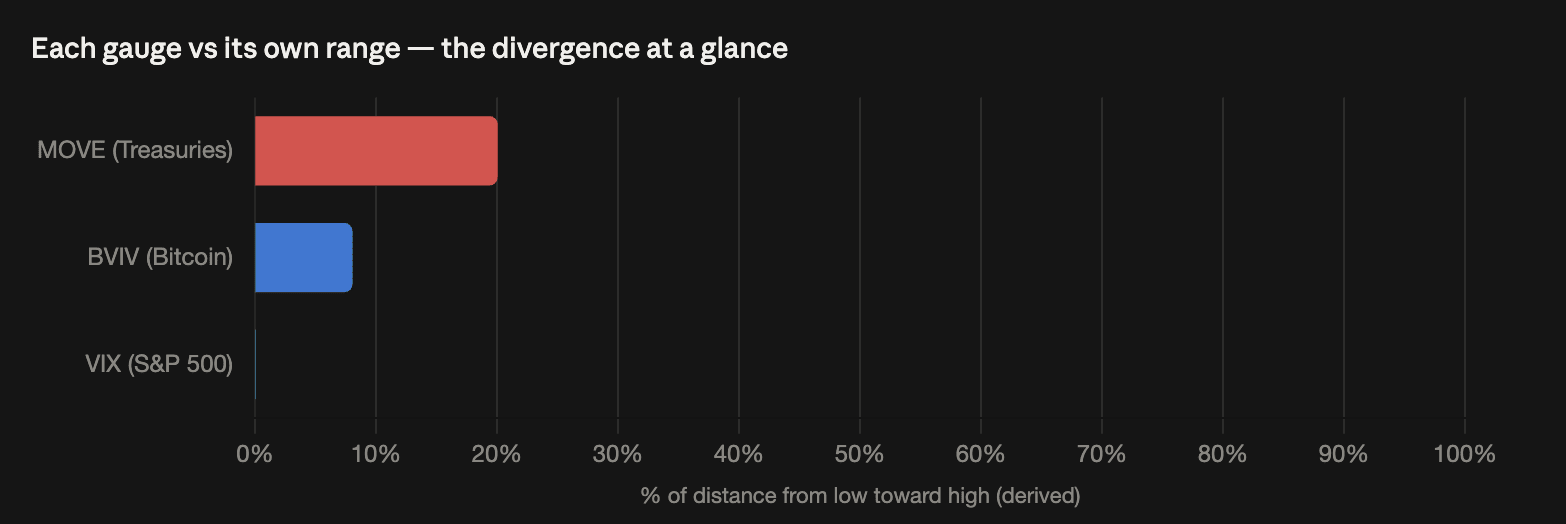
The MOVE index jumped ~30% from around 80 Tuesday to 104 Thursday — its highest since March — while BVIV sits at ~37 near its yearly floor of 35 and the VIX hovers near 14. The 20-day BVIV-MOVE correlation has turned decisively negative at -0.37: as bond volatility rose, Bitcoin's expected volatility fell. Bitcoin held ~$84,300 through the 10-year's push past 5.2%, supported by $2.84B in six-day ETF inflows. The bullish precedent: in March when MOVE last reached these levels, the S&P 500 stood near 6,350 and has since risen ~21%. The caution: BVIV at 37 means Bitcoin options are pricing very little turbulence just after a $14B Deribit expiry removed the $85,000 pin — low implied volatility is exactly what makes markets vulnerable to violent repricing if the bond warning proves right. Watch whether MOVE keeps climbing toward its March extreme of 199, whether BVIV lifts
Bitcoin Enters Early Bull Market Phase After MVRV Signal, CryptoQuant Analyst Says
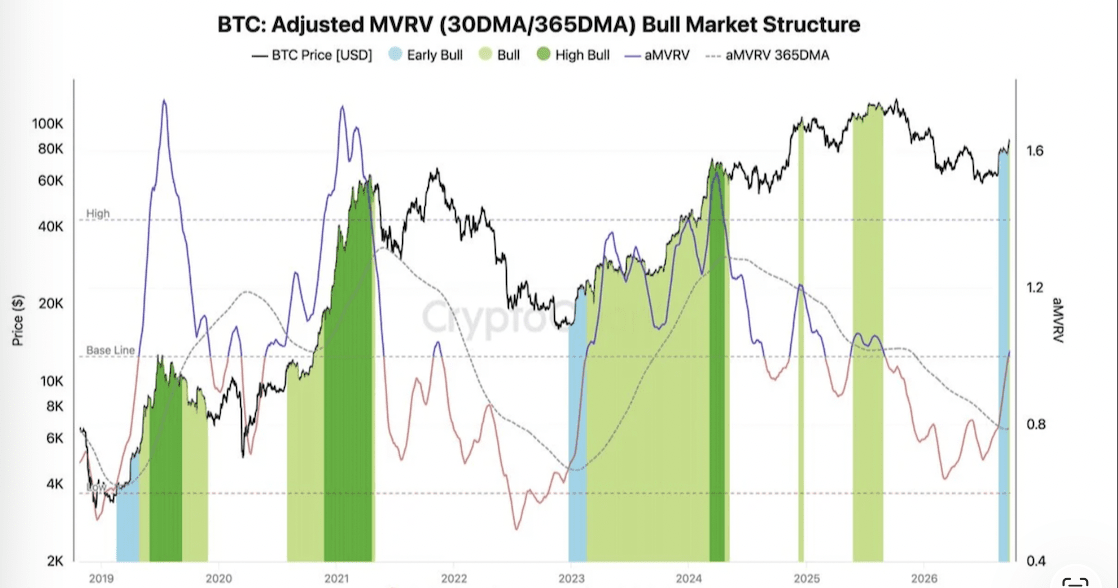
CryptoQuant's Axel Adler Jr. identified August 20 as the date Bitcoin entered an early bull market phase, based on the adjusted MVRV 30-day MA to 365-day MA ratio crossing above its 365-day moving average at a price of $71,255. The phase lasted 31 days, during which Bitcoin rose 13%. The signal is consistent with other structural reads this week: Glassnode's four-year cycle breakdown note, LTH distribution slowing 80% in three weeks, and $2.84B in six-day ETF inflows. MVRV-based signals have historically marked the transition from recovery to sustained appreciation rather than predicting a specific price target — the metric measures whether the average holder is profitable relative to historical norms, which at $71,255 entry suggested undervaluation relative to realized value.
81% of Circulating Bitcoin Has Not Moved for More Than Six Months, River Data Shows
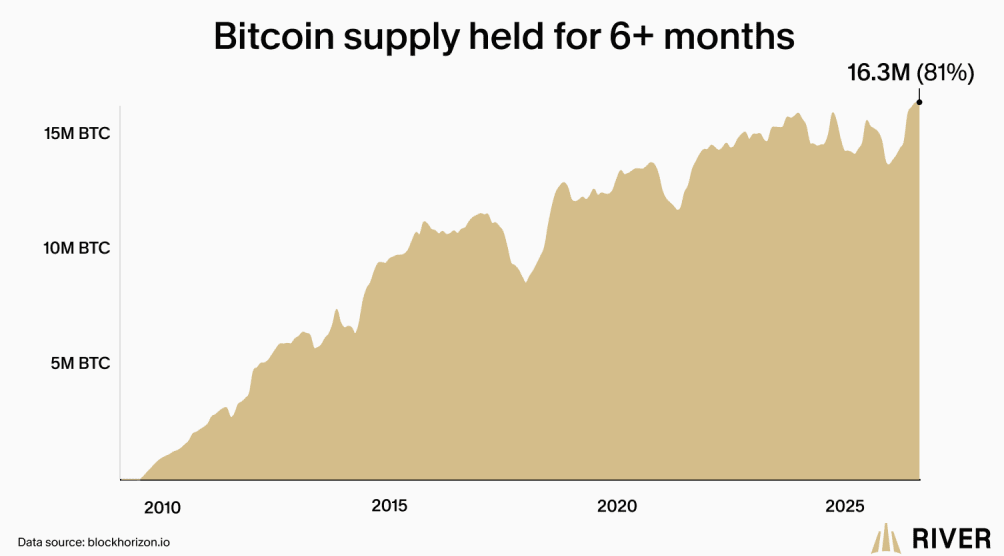
River data shows 81% of circulating Bitcoin has not been transferred in over six months — the highest illiquidity reading consistent with structural accumulation rather than active trading. The figure complements this week's LTH data: 30-day long-term holder distribution slowed from -105,900 BTC on August 30 to -21,700 BTC by September 20, with most recent sales at a loss. A market where 81% of supply is dormant and the remaining 19% is actively priced means the effective float is thin — mechanically amplifying price moves in both directions. The same dynamic that powered Monday's ~$300M/hour short liquidation squeeze also means a reversal finds less liquidity to absorb it. Bitcoin's low BVIV at 37 against this backdrop is the tension the bond market's MOVE spike is flagging.
U.S. President Donald Trump Rejects Iran's Seven-Day Ceasefire Proposal, WSJ Reports
Trump rejected Iran's proposed seven-day ceasefire and told aides he expects to resume bombing after November's midterm elections — removing the Hormuz resolution narrative that had sent WTI from $106 to $89 and supported risk assets through the week. With the ceasefire off the table until after November 3 at the earliest, the physical supply constraint returns as the base case: Saudi output at 6.238M bpd (its lowest since 1990), tanker rates above $1M/day, the East-West pipeline closed, and Bab El-Mandeb under threat. BofA's raised Brent second-half average of $95 now looks conservative against this backdrop. For Bitcoin, the oil-inflation-yields chain that capped price from February through August is back as the dominant macro regime heading into October's jobs report, CPI, and Fed decision.