
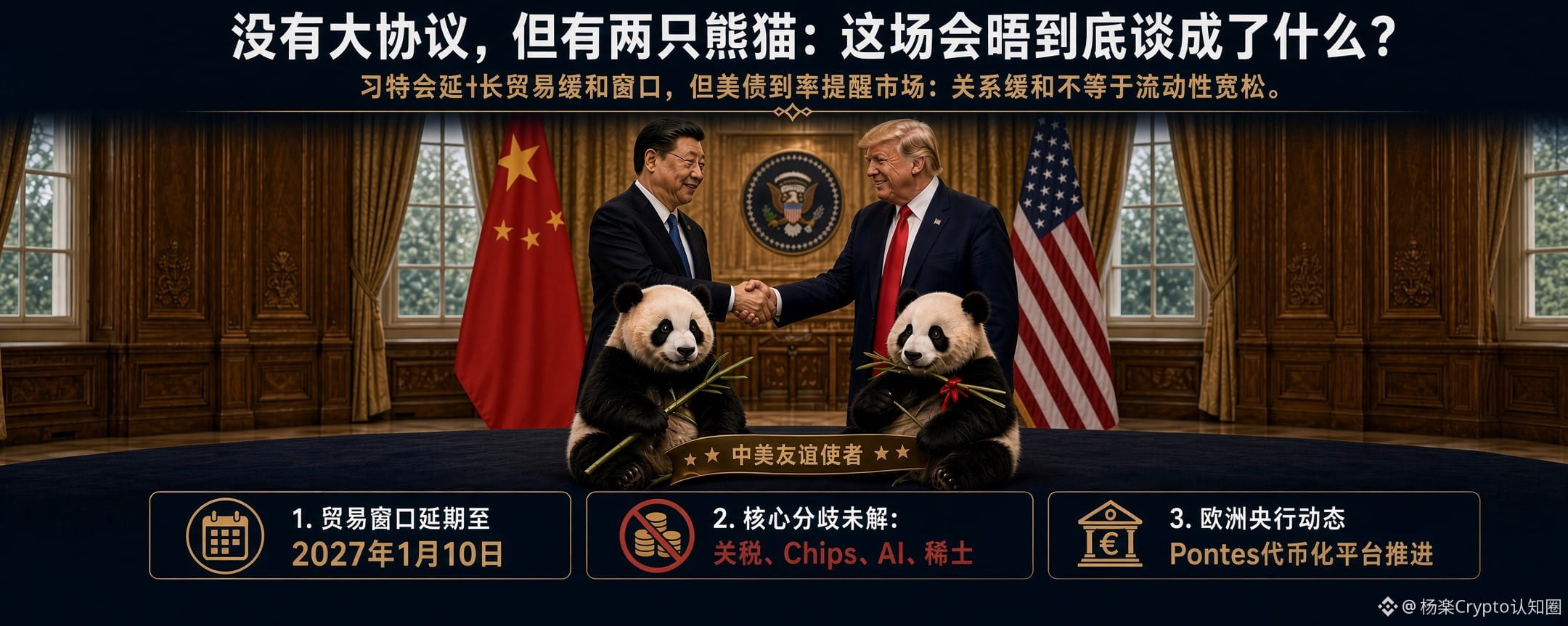

The Xi-Trump summit extended the trade de-escalation window, but U.S. Treasury yields reminded the market that easing relations does not equal liquidity loosening.
On September 24, Xi Jinping met with Donald Trump at the White House.
The outcome of this meeting is not a comprehensive big agreement, but rather to pull China-U.S. relations back onto the track of “continued talks,” after further escalation.
The two sides’ economic and trade teams reached a new joint arrangement: the trade de-escalation window was extended to January 10, 2027, and both sides confirmed their mutual support for hosting the APEC and G20 summits.
But it needs to be noted that the key words are “extension” and “arrangement,” not “problem-solving.”
Key differences still remain, including tariffs, advanced chips, competition in artificial intelligence, and rare earth supply. On AI, the two sides only agreed to continue discussions and have not yet formed substantive shared rules.
Therefore, this is more like an effort to buy time rather than a complete shift in Sino-U.S. relations.
During the meeting, China also announced it would send two giant pandas to the Atlanta Zoo, calling them messengers of Sino-U.S. friendship.
The pandas won’t change tariff and chip restrictions, but they convey an important soft signal: even with limited hard agreements, both sides still want to preserve a cooperative atmosphere and room for communication.
The market first priced in this easing expectation.
Bitcoin once climbed to around $86,000. Spot Bitcoin ETFs saw nearly $1 billion in net inflows in a single day, and for 2026, the capital flows turned from a prior net outflow of $5.8 billion to about $0.8 billion in net inflows.
Then, the yield on the 10-year U.S. Treasury note rose to its highest level since 2007, while Bitcoin dipped to around $84,000.
This shows the market is pricing two opposing logics:
Sino-U.S. relations are easing, boosting risk appetite; but high interest rates and high yields still limit the upside for risky assets.
Meanwhile, the European Central Bank has launched the Pontes tokenized finance platform and plans to invest in tokenized securities using part of its own funds. This indicates that even if the U.S. crypto bill moves slowly, traditional finance continues building the infrastructure for tokenized assets.
$This summit bought time, but it didn’t solve all the problems.
The two pandas are a mild soft signal; the trade arrangements are the mid-term variable to watch next, while U.S. Treasury yields are the most realistic constraint in the current market.
Next, the focus is on three things: whether the joint U.S.-China arrangements can be implemented, whether the 10-year U.S. Treasury yield can fall, and whether Bitcoin ETF inflows can continue.
If yields fall and capital continues to flow back, there’s a chance the Bitcoin rebound can extend; if the agreement lacks specific content and yields keep rising, the current trend is more likely just a temporary risk-appetite correction.