
In the process of confirming the bottom on the major cryptocurrency level and laying out the main uptrend, concentrating in a single point often faces extremely high risk of being the “late buyer” at the high end. By adopting a “grid/stepwise staged limit orders + strong risk control and fault tolerance rate” model, the mathematical probability can be converted into long-term trading advantages. According to the latest BTC accumulation strategy publicly shared by an analyst, it demonstrates a highly rigorous multi-tier isolated-leverage game logic.
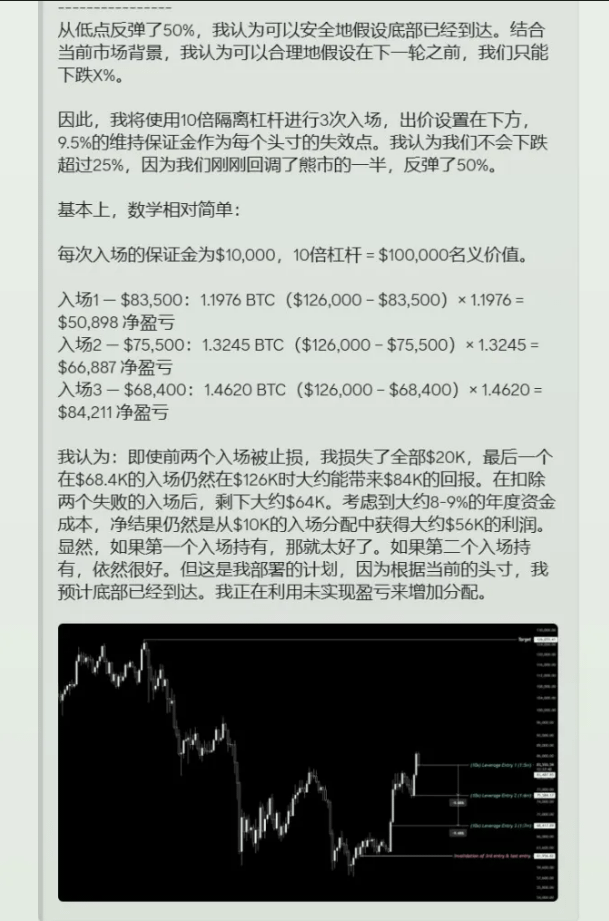
The analyst assumes that the BTC bottom has formed and designs a plan to place staged orders at three key support levels of $83,500, $75,500, and $68,400, with a unified target set at $126,000.
Key takeaways from trading and risk-control post-mortems:
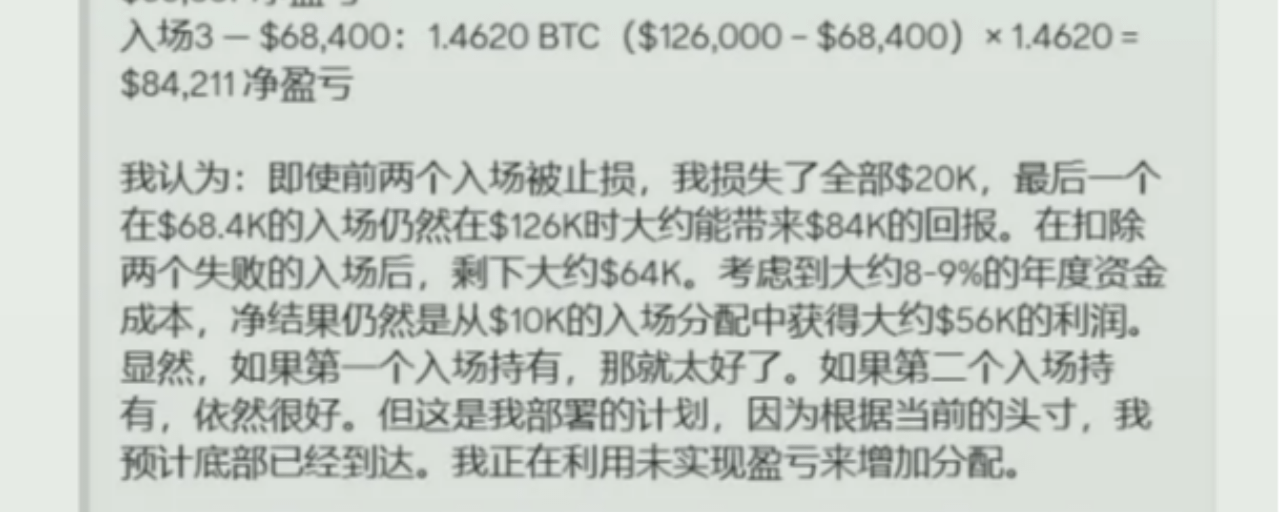
Mathematical solution to prevent trial-and-error costs: Allocate a $10,000 margin for each entry (10x isolated leverage, $100k notional value). Even if the first two entries ($83.5K / $75.5K) fully trigger stop-loss losses of $20,000, as long as the third extreme limit order ($68,400) gets filled and lifts the position to $126K, the profit of $84,211 from a single trade can completely cover the initial losses.
Net certainty after deducting funding fees: After deducting the losses from the first two trial-and-error attempts (-$20k) and the annual capital cost of the long-position holdings of about 8%-9% (incurring about -$8k), the final account still remains net profitable by approximately $56,000.
Isolate leverage to isolate risk: Use isolated margin instead of cross margin to ensure that each single sweep only risks the specified $10,000 margin, completely eliminating the risk of chain liquidations.
When doing large-cycle bottom-fishing on Bitcoin, would you rather, like this model, use batch-by-batch staggered isolated limit orders to increase tolerance, or prefer to wait for an exact signal and then go all-in with a one-time right-side position? Feel free to discuss in the comments.