

易琳Ten
125 Posts

易琳Ten
交易是修行,盈利是结果,纪律是信仰。🐺📈
70 Following
20.8K+ Followers
7.5K+ Liked
Posts
All
Quotes
Videos
PINNED
PINNED
易琳Ten
·
--
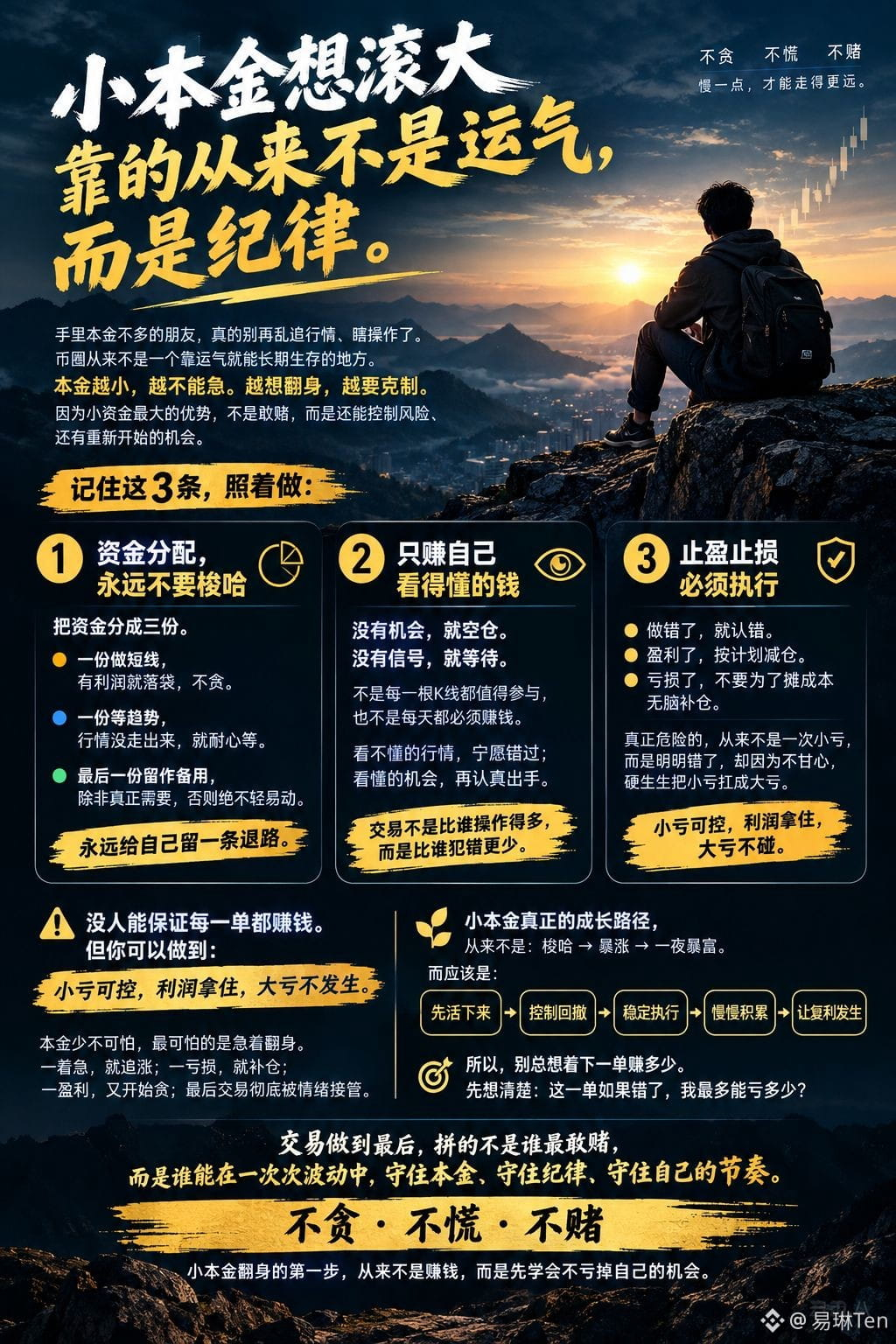
To grow the principal, you don’t rely on luck—you rely on discipline
If you don’t have much capital, really stop chasing charts blindly and making random trades.
The crypto market has never been a place where you can survive long-term by luck alone.
The smaller your principal, the less you can afford to be anxious.
The more you want to turn things around, the more you must restrain yourself.
Because the biggest advantage of small capital isn’t that you’re bold enough to gamble—it’s that you can control risk and still have a chance to start over.
Remember these 3 rules:
① Capital allocation—never go all-in
Divide your capital into three parts.
One part for short-term trades: when you have profit, take it off the table—don’t get greedy to the very end;
One part for waiting for trends: if the market hasn’t moved in your expected direction, be patient and wait;
The last part as a reserve: unless it’s truly necessary, never touch it lightly.
Always leave yourself a way to retreat.
② Only make money from what you can understand
If there’s no opportunity, stay in cash.
If there’s no signal, wait.
Not every candlestick is worth participating in,
And you don’t have to make money every day.
If you don’t understand the market, it’s better to miss it;
Only after you understand the opportunity should you act seriously.
Trading isn’t about who makes more moves—it’s about who makes fewer mistakes.
③ Take-profit and stop-loss must be executed
If you’re wrong, admit it.
If you’re in profit, reduce your position according to the plan.
If you’re at a loss, don’t mindlessly add just to average down.
The real danger has never been a single small loss.
It’s when you’re clearly wrong, but because you’re unwilling to accept it, you stubbornly turn a small loss into a big one.
No one can guarantee that every trade will be profitable.
But you can do this:
Keep small losses under control, hold onto profits, and never touch big losses.
Having a small principal isn’t scary.
What’s truly terrifying is trying to turn things around in a rush.
When you’re anxious, you chase the surge.
When you have a loss, you add.
When you get a win, you start getting greedy again.
In the end, your trading is completely taken over by emotions.
The real growth path for small capital has never been:
All-in → a sudden surge → a fortune overnight.
It should be:
First survive → control drawdowns → execute steadily → accumulate slowly → let compounding work.
So don’t always think about how much you’ll make on the next trade.
First ask yourself:
If this trade is wrong, what’s the maximum I can afford to lose?
In the end, trading isn’t about who’s most willing to gamble.
It’s about who can, through repeated fluctuations, keep their principal, keep their discipline, and keep their own rhythm.
Don’t be greedy. Don’t panic. Don’t gamble.
The first step in turning around with a small principal has never been making money—it’s learning how not to lose your chance first.
If you don’t have much capital, really stop chasing charts blindly and making random trades.
The crypto market has never been a place where you can survive long-term by luck alone.
The smaller your principal, the less you can afford to be anxious.
The more you want to turn things around, the more you must restrain yourself.
Because the biggest advantage of small capital isn’t that you’re bold enough to gamble—it’s that you can control risk and still have a chance to start over.
Remember these 3 rules:
① Capital allocation—never go all-in
Divide your capital into three parts.
One part for short-term trades: when you have profit, take it off the table—don’t get greedy to the very end;
One part for waiting for trends: if the market hasn’t moved in your expected direction, be patient and wait;
The last part as a reserve: unless it’s truly necessary, never touch it lightly.
Always leave yourself a way to retreat.
② Only make money from what you can understand
If there’s no opportunity, stay in cash.
If there’s no signal, wait.
Not every candlestick is worth participating in,
And you don’t have to make money every day.
If you don’t understand the market, it’s better to miss it;
Only after you understand the opportunity should you act seriously.
Trading isn’t about who makes more moves—it’s about who makes fewer mistakes.
③ Take-profit and stop-loss must be executed
If you’re wrong, admit it.
If you’re in profit, reduce your position according to the plan.
If you’re at a loss, don’t mindlessly add just to average down.
The real danger has never been a single small loss.
It’s when you’re clearly wrong, but because you’re unwilling to accept it, you stubbornly turn a small loss into a big one.
No one can guarantee that every trade will be profitable.
But you can do this:
Keep small losses under control, hold onto profits, and never touch big losses.
Having a small principal isn’t scary.
What’s truly terrifying is trying to turn things around in a rush.
When you’re anxious, you chase the surge.
When you have a loss, you add.
When you get a win, you start getting greedy again.
In the end, your trading is completely taken over by emotions.
The real growth path for small capital has never been:
All-in → a sudden surge → a fortune overnight.
It should be:
First survive → control drawdowns → execute steadily → accumulate slowly → let compounding work.
So don’t always think about how much you’ll make on the next trade.
First ask yourself:
If this trade is wrong, what’s the maximum I can afford to lose?
In the end, trading isn’t about who’s most willing to gamble.
It’s about who can, through repeated fluctuations, keep their principal, keep their discipline, and keep their own rhythm.
Don’t be greedy. Don’t panic. Don’t gamble.
The first step in turning around with a small principal has never been making money—it’s learning how not to lose your chance first.

易琳Ten
·
--
Once a centralized exchange suffers a massive crypto theft, it is not only the hackers who are truly being put on trial, but also the platform’s security systems and information transparency. Academic research indicates that CEXs naturally carry custody risks, information asymmetry, and principal–agent problems, and that relying on “proof of reserves” alone cannot cover internal governance and key security.
Of course, we should not conclude “self-sabotage” based solely on the fact that funds were stolen. In reality, the FBI and blockchain security organizations have indeed, on multiple occasions, attributed major crypto theft incidents to hackers linked to North Korea.
So what users should really ask is not “who’s to blame,” but: where is the evidence? Where are the security mechanisms? Where did the money go?
Of course, we should not conclude “self-sabotage” based solely on the fact that funds were stolen. In reality, the FBI and blockchain security organizations have indeed, on multiple occasions, attributed major crypto theft incidents to hackers linked to North Korea.
So what users should really ask is not “who’s to blame,” but: where is the evidence? Where are the security mechanisms? Where did the money go?


BLOCK Rayne
·
--
A BIG gift 🎁 from me to our amazing community. ❤️
Claim your $DOGE reward and enjoy!
Hurry up, everyone! 🔥
Claim your $DOGE reward and enjoy!
Hurry up, everyone! 🔥


熙熙xixi
·
--
At will 🌸🌸
#AI stocks keep rising—what other investment opportunities are there?
#AI stocks keep rising—what other investment opportunities are there?


白鲨观点马来西亚
·
--
I know, a lot of people feel uncomfortable today.
It’s not that you lost money—it’s that you missed the move.
A few days ago, when it was dropping, you told yourself, “Wait a bit—there will be another dip.” “Buy only when it drops below 70,000.” “Once it stabilizes, I’ll decide.” So what happened? You waited and waited, and then a big bullish candle came—straight from 76,000 to 81,000. In two days, it jumped nearly 10%.
Then you started to feel bad.
“I wish I had bought at the recent low.”
“I was ready to place the order, but I hesitated.”
“Can I still get in now? What if I’m chasing and it keeps going up?”
“Wait for a pullback… but what if it never pulls back and keeps climbing?”
I totally understand that feeling.
Missing the trade is painful—sometimes it’s not any lighter than losing money. Losing money is at least, “I did it, and I was wrong.” Missing it is, “I clearly saw the opportunity, but I didn’t catch it.” That kind of regret and resentment is even more tormenting than losing money.
But I want to tell you the truth: missing the trade isn’t your fault.
No one can buy at the absolute bottom, and no one can sell at the absolute top. Those who say they “nailed the exact bottom” are either lucky or just bragging. If you check their past records, you’ll definitely find countless times they also bought their “bottom” in the middle of the mountain.
Trading isn’t an exam—you don’t have to get every question right. You just need to grab the opportunities you understand, and make the money that’s within your ability. What you miss, let it be missed. There’s nothing that big about it.
In the crypto market, opportunities are never in short supply.
If you miss this rebound today,
next month there may be another wave,
and next year there could be even bigger行情.
As long as you’re still in the market,
as long as you still have “ammunition,”
you’ll always have a chance.
What’s the worst part? It’s when you lose your composure after missing the trade, and you feel forced to chase in to “make up the loss.” Then you end up buying at the top, getting trapped in the position, and it becomes a loop: cutting loss, regret, chasing again, trapped again… a vicious cycle.
So what should you do if you miss the trade?
Two words: Accept.
Accept that you missed it.
Accept that others made money and you didn’t.
Accept that the market won’t follow your script.
Then quietly wait for the next opportunity.
You can’t make all the money,
but if you’re impatient,
you can lose it all.
#BinanceSquare #BTC #交易心态 #踏空 #Tradingers’ daily life
It’s not that you lost money—it’s that you missed the move.
A few days ago, when it was dropping, you told yourself, “Wait a bit—there will be another dip.” “Buy only when it drops below 70,000.” “Once it stabilizes, I’ll decide.” So what happened? You waited and waited, and then a big bullish candle came—straight from 76,000 to 81,000. In two days, it jumped nearly 10%.
Then you started to feel bad.
“I wish I had bought at the recent low.”
“I was ready to place the order, but I hesitated.”
“Can I still get in now? What if I’m chasing and it keeps going up?”
“Wait for a pullback… but what if it never pulls back and keeps climbing?”
I totally understand that feeling.
Missing the trade is painful—sometimes it’s not any lighter than losing money. Losing money is at least, “I did it, and I was wrong.” Missing it is, “I clearly saw the opportunity, but I didn’t catch it.” That kind of regret and resentment is even more tormenting than losing money.
But I want to tell you the truth: missing the trade isn’t your fault.
No one can buy at the absolute bottom, and no one can sell at the absolute top. Those who say they “nailed the exact bottom” are either lucky or just bragging. If you check their past records, you’ll definitely find countless times they also bought their “bottom” in the middle of the mountain.
Trading isn’t an exam—you don’t have to get every question right. You just need to grab the opportunities you understand, and make the money that’s within your ability. What you miss, let it be missed. There’s nothing that big about it.
In the crypto market, opportunities are never in short supply.
If you miss this rebound today,
next month there may be another wave,
and next year there could be even bigger行情.
As long as you’re still in the market,
as long as you still have “ammunition,”
you’ll always have a chance.
What’s the worst part? It’s when you lose your composure after missing the trade, and you feel forced to chase in to “make up the loss.” Then you end up buying at the top, getting trapped in the position, and it becomes a loop: cutting loss, regret, chasing again, trapped again… a vicious cycle.
So what should you do if you miss the trade?
Two words: Accept.
Accept that you missed it.
Accept that others made money and you didn’t.
Accept that the market won’t follow your script.
Then quietly wait for the next opportunity.
You can’t make all the money,
but if you’re impatient,
you can lose it all.
#BinanceSquare #BTC #交易心态 #踏空 #Tradingers’ daily life



晚风Vesper_1688
·
--
🌞Walk in the sunlight, rush toward the road ahead🍃
Through ups and downs, keep hold of your true heart📈
Even if the journey is winding with bumps and jolts✨
Stay true to your初心, never stop moving💎
Time will eventually witness every persistence💛
#交易心理
#Circle与Tether冻结Bitget黑客钱包
#1688家族family
Through ups and downs, keep hold of your true heart📈
Even if the journey is winding with bumps and jolts✨
Stay true to your初心, never stop moving💎
Time will eventually witness every persistence💛
#交易心理
#Circle与Tether冻结Bitget黑客钱包
#1688家族family

慢就是快Mike8
·
--
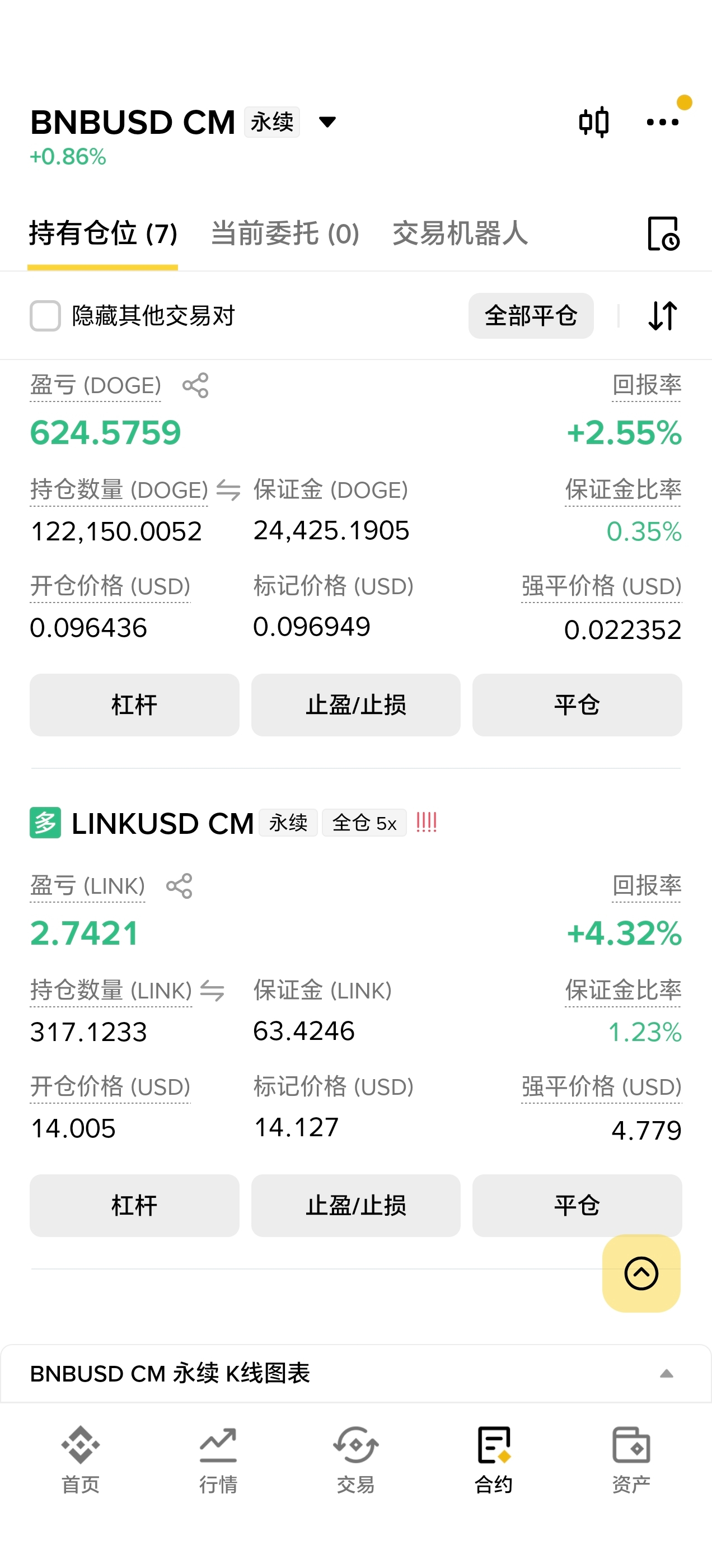
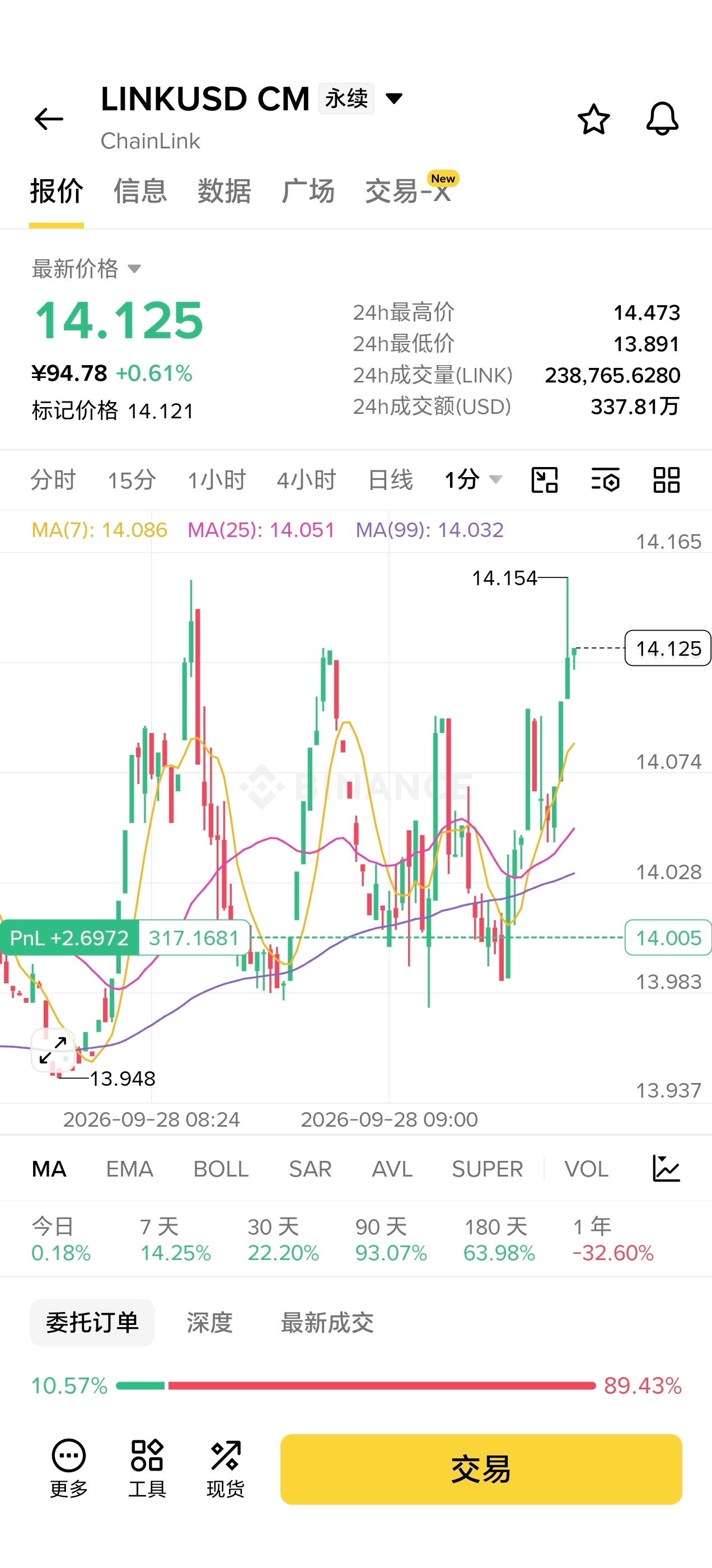
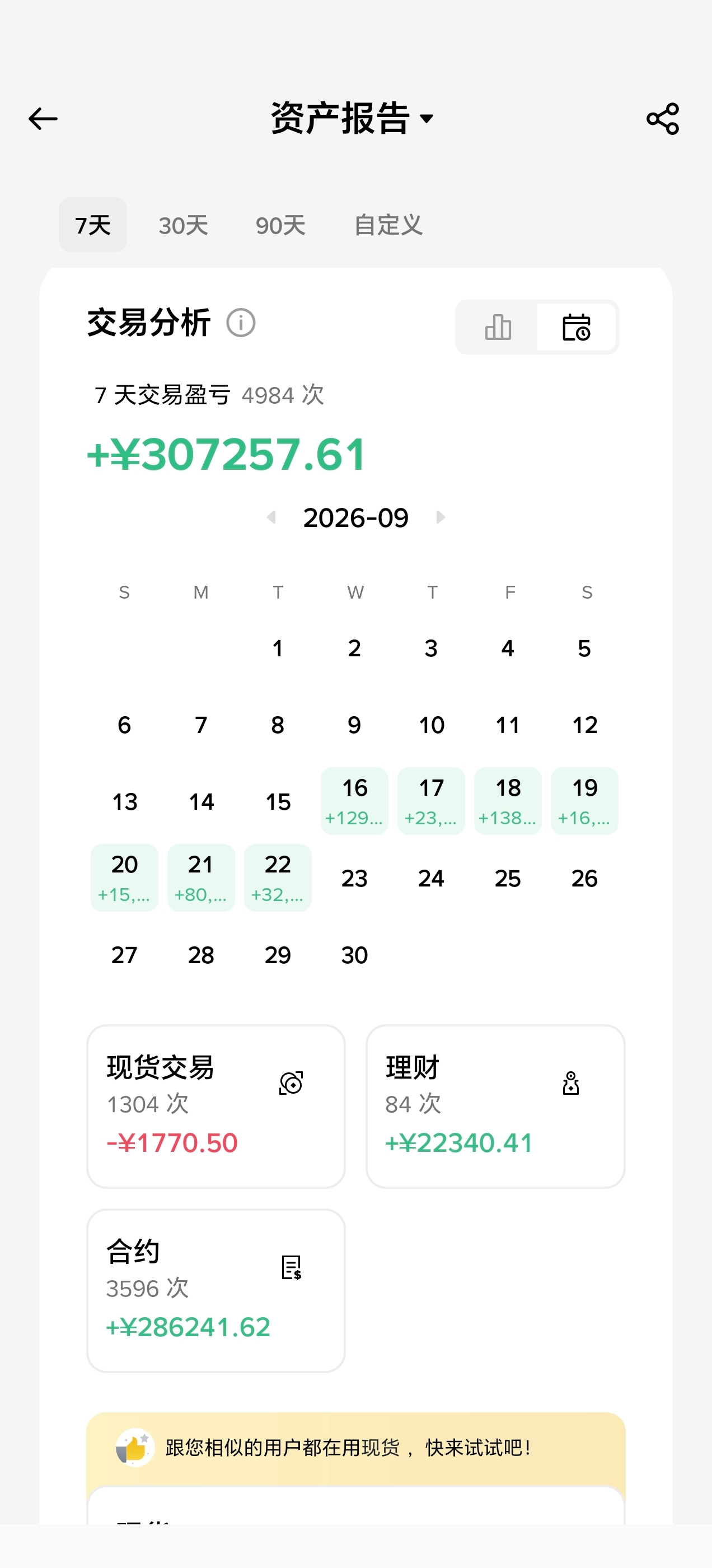
$LINK The economy is getting worse and worse, and there are very few opportunities to make money anymore. This may be the last super bull market we can seize. Carpe diem—cherish it as it comes!!!

幸运雨Rain
·
--
☁️With an original heart,迎接新旅程🍃
Fluctuations in the market are all part of cultivation📈
Do not let short-term rises and falls disturb your mind✨
Hold fast to your beliefs and endure the磨练💛
Time never fails those who keep standing firm💎
#Circle与Tether冻结Bitget黑客钱包
Fluctuations in the market are all part of cultivation📈
Do not let short-term rises and falls disturb your mind✨
Hold fast to your beliefs and endure the磨练💛
Time never fails those who keep standing firm💎
#Circle与Tether冻结Bitget黑客钱包


静姐168
·
--
Brother Sun let go of what he could not obtain in his youth; but people who crave to show off can never let go.
Sun let go of what he could not obtain in his youth, yet those who crave pretense never will.
Sun let go of what he could not obtain in his youth, yet those who crave pretense never will.


静心1688
·
--
🎉Follow, like, comment to claim a red envelope🧧🧧🧧
#狗狗币ETF创上市来最大周流入
#Bitget黑客转移8300万美元被盗XRP
#狗狗币ETF创上市来最大周流入
#Bitget黑客转移8300万美元被盗XRP


乘风Sunshine
·
--
《China-U.S. Summit Meets and Reaches Eight Key Outcomes—What Could This Mean for the Crypto Market?》
1️⃣ “Building a constructive, stable China-U.S. strategic relationship based on respect, fairness, and equality”
The easing of geopolitical conflicts could give global risk appetite some breathing room. As a global liquidity asset, BTC is most sensitive to this kind of macro risk shift.
2️⃣ “Mutually support one another in doing a good job hosting APEC and the G20”
Major global economies will continue to maintain high-level communication, meaning there is still room to coordinate international financial rules. Future regulation of crypto assets also cannot develop outside the G20 framework.
3️⃣ “Iran should fulfill its commitment not to develop nuclear weapons; no country or entity may charge transit fees for international waterways”
Risks related to the Middle East and energy transportation directly affect inflation, the U.S. dollar, and U.S. Treasuries. If energy prices swing sharply, changes in Federal Reserve rate expectations could lead BTC to be repriced as well.
4️⃣ “Recalling that China and the United States are wartime allies in World War II, and fighting side by side to win the war”
This is a historical narrative, but for markets, the more important part is the signal of “avoiding escalation out of control.”
5️⃣ “Reaching a mutually equivalent ‘$30 billion’ arrangement to lower tariffs”
As trade friction cools, global trade and liquidity expectations may improve. In recent years, whenever tariffs were upgraded, it became a key variable for risk assets—so BTC naturally also can’t be completely insulated.
6️⃣ “Coooperation between China and the U.S. anti-drug enforcement agencies has achieved visible results”
This point is actually very practical for the crypto world: strengthened cross-border law enforcement cooperation may further reinforce compliance requirements for stablecoins, exchanges, and on-chain capital flows in the future.
7️⃣ “Establishing a China-U.S. dialogue on artificial intelligence”
AI and Crypto are forming a new overlap area: AI agents, on-chain payments, automated execution of smart contracts, DePIN, and more. For China and the U.S. to begin building AI risk communication mechanisms is, in itself, a signal worth long-term attention.
8️⃣ “The U.S. side welcomes China’s lending of a pair of giant pandas to the Atlanta Zoo”
Pandas may seem to have nothing to do with the crypto space, but what they represent is the restoration of people-to-people communication.
Summary:
What the crypto market should truly pay attention to from this summit is not any single item that directly benefits BTC, but three keywords:
Geopolitical risk ↓
Trade uncertainty ↓
AI and financial regulatory cooperation ↑
1️⃣ “Building a constructive, stable China-U.S. strategic relationship based on respect, fairness, and equality”
The easing of geopolitical conflicts could give global risk appetite some breathing room. As a global liquidity asset, BTC is most sensitive to this kind of macro risk shift.
2️⃣ “Mutually support one another in doing a good job hosting APEC and the G20”
Major global economies will continue to maintain high-level communication, meaning there is still room to coordinate international financial rules. Future regulation of crypto assets also cannot develop outside the G20 framework.
3️⃣ “Iran should fulfill its commitment not to develop nuclear weapons; no country or entity may charge transit fees for international waterways”
Risks related to the Middle East and energy transportation directly affect inflation, the U.S. dollar, and U.S. Treasuries. If energy prices swing sharply, changes in Federal Reserve rate expectations could lead BTC to be repriced as well.
4️⃣ “Recalling that China and the United States are wartime allies in World War II, and fighting side by side to win the war”
This is a historical narrative, but for markets, the more important part is the signal of “avoiding escalation out of control.”
5️⃣ “Reaching a mutually equivalent ‘$30 billion’ arrangement to lower tariffs”
As trade friction cools, global trade and liquidity expectations may improve. In recent years, whenever tariffs were upgraded, it became a key variable for risk assets—so BTC naturally also can’t be completely insulated.
6️⃣ “Coooperation between China and the U.S. anti-drug enforcement agencies has achieved visible results”
This point is actually very practical for the crypto world: strengthened cross-border law enforcement cooperation may further reinforce compliance requirements for stablecoins, exchanges, and on-chain capital flows in the future.
7️⃣ “Establishing a China-U.S. dialogue on artificial intelligence”
AI and Crypto are forming a new overlap area: AI agents, on-chain payments, automated execution of smart contracts, DePIN, and more. For China and the U.S. to begin building AI risk communication mechanisms is, in itself, a signal worth long-term attention.
8️⃣ “The U.S. side welcomes China’s lending of a pair of giant pandas to the Atlanta Zoo”
Pandas may seem to have nothing to do with the crypto space, but what they represent is the restoration of people-to-people communication.
Summary:
What the crypto market should truly pay attention to from this summit is not any single item that directly benefits BTC, but three keywords:
Geopolitical risk ↓
Trade uncertainty ↓
AI and financial regulatory cooperation ↑

慢就是快Mike8
·
--
$LINK The economy is getting worse and worse, and there are very few opportunities to make money anymore. This may be the last super bull market we can seize. Carpe diem—cherish it as it comes!!!

兰汐kyL
·
--
$ETH China-US Reach Eight-Point Consensus—Many Crypto Friends Haven’t Realized This Yet. This Is a Major Piece of News That Can Affect the Market!
With the macro environment easing, market risk-aversion sentiment is cooling down directly, and investors’ risk appetite will gradually rise. What everyone feared before was that tensions would keep dragging on, making capital afraid to enter and causing the overall market to keep grinding at the bottom. Now that this news has landed, it’s a positive signal for the crypto market. 💥
But please don’t let your head get hot and rush in with a full position. In market moves driven by news like this, many are short-term, pulse-like rallies—after a run-up, it’s easy for profit-taking to slam the brakes and trigger a pullback. Seasoned players know this: news-driven momentum usually doesn’t last long, and you can’t treat it as a signal that a full bull market is starting. 💥
Bitcoin and altcoins will likely diverge. BTC will first help lift the overall market, driving a rebound; smaller coins may look like they’re pumping hard, but when they retrace, they can drop just as violently. For execution, the suggestion is to participate with a light position—don’t chase. If you already hold positions, you can use the rebound to reduce some of the high-level trapped positions and set up proper take-profit. 💥
Remember: news is only a catalyst. What truly determines the bigger trend is still the Fed’s policy. Even if good news comes out, it doesn’t mean the market will rise in one direction forever—the board can flip at any time. In the crypto world, risk always comes first. Protect your principal, and only then will you have a chance to catch the next wave of opportunities 💥#Circle与Tether冻结Bitget黑客钱包 #中美达成300亿美元关税削减共识 #
With the macro environment easing, market risk-aversion sentiment is cooling down directly, and investors’ risk appetite will gradually rise. What everyone feared before was that tensions would keep dragging on, making capital afraid to enter and causing the overall market to keep grinding at the bottom. Now that this news has landed, it’s a positive signal for the crypto market. 💥
But please don’t let your head get hot and rush in with a full position. In market moves driven by news like this, many are short-term, pulse-like rallies—after a run-up, it’s easy for profit-taking to slam the brakes and trigger a pullback. Seasoned players know this: news-driven momentum usually doesn’t last long, and you can’t treat it as a signal that a full bull market is starting. 💥
Bitcoin and altcoins will likely diverge. BTC will first help lift the overall market, driving a rebound; smaller coins may look like they’re pumping hard, but when they retrace, they can drop just as violently. For execution, the suggestion is to participate with a light position—don’t chase. If you already hold positions, you can use the rebound to reduce some of the high-level trapped positions and set up proper take-profit. 💥
Remember: news is only a catalyst. What truly determines the bigger trend is still the Fed’s policy. Even if good news comes out, it doesn’t mean the market will rise in one direction forever—the board can flip at any time. In the crypto world, risk always comes first. Protect your principal, and only then will you have a chance to catch the next wave of opportunities 💥#Circle与Tether冻结Bitget黑客钱包 #中美达成300亿美元关税削减共识 #

钞机八蛋
·
--
Good morning, family and friends! We’re still on the way!


幸运雨Rain
·
--
☁️With an original heart,迎接新旅程🍃
Fluctuations in the market are all part of cultivation📈
Do not let short-term rises and falls disturb your mind✨
Hold fast to your beliefs and endure the磨练💛
Time never fails those who keep standing firm💎
#Circle与Tether冻结Bitget黑客钱包
Fluctuations in the market are all part of cultivation📈
Do not let short-term rises and falls disturb your mind✨
Hold fast to your beliefs and endure the磨练💛
Time never fails those who keep standing firm💎
#Circle与Tether冻结Bitget黑客钱包
灼见Cryptosighted
·
--
🚨 A subtle change that’s easy to overlook is happening:
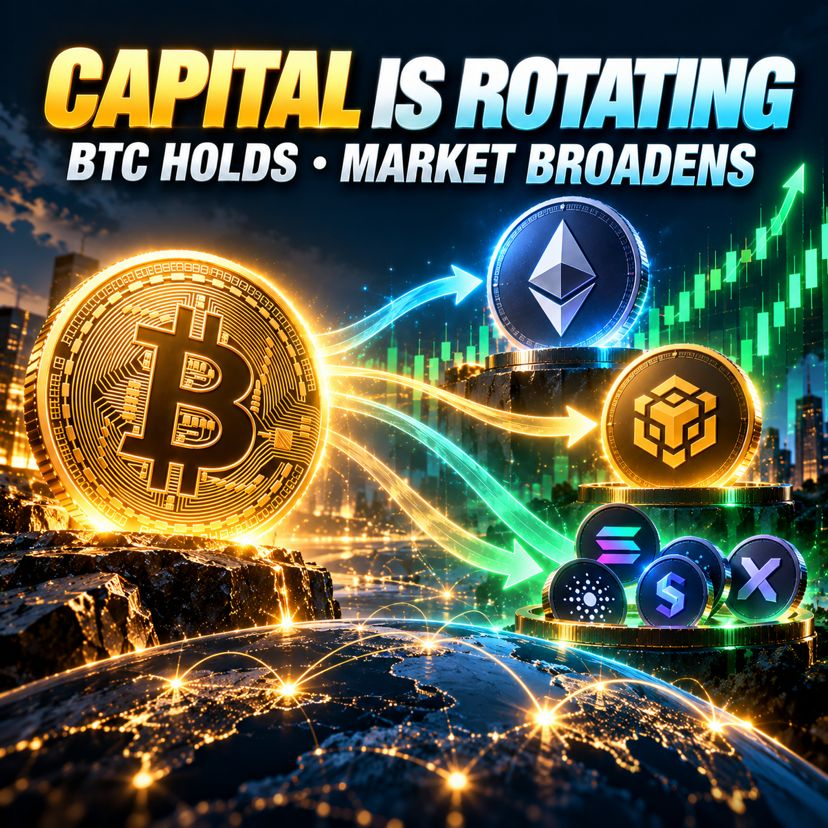
BTC is still stable, but capital is no longer focused only on BTC.
This quarter, BTC has been strong, and ETH has even more “elasticity.” Over the weekend, the number of rising coins also began to exceed the number of falling ones.
This is usually a signal worth watching when the market enters its next phase:
🟠 BTC keeps the market stable
🔵 ETH starts to amplify its volatility
🟢 More altcoins begin to rotate
💰 Capital shifts from “single-point bets” to looking for opportunities
The real key isn’t how much any one altcoin suddenly pumps.
It’s whether the breadth of the market’s gains can continue to expand.
If BTC holds steady, and ETH, BNB, and more assets keep strengthening, the rotation of capital may not be over yet.
But if BTC breaks down, the high elasticity of altcoins could quickly turn into high volatility.
Who are you backing for the next leg?
🟠 BTC / 🔵 ETH / 🟡 BNB / 🟢 ALTS
#BTC #ETH #BNB
BTC is still stable, but capital is no longer focused only on BTC.
This quarter, BTC has been strong, and ETH has even more “elasticity.” Over the weekend, the number of rising coins also began to exceed the number of falling ones.
This is usually a signal worth watching when the market enters its next phase:
🟠 BTC keeps the market stable
🔵 ETH starts to amplify its volatility
🟢 More altcoins begin to rotate
💰 Capital shifts from “single-point bets” to looking for opportunities
The real key isn’t how much any one altcoin suddenly pumps.
It’s whether the breadth of the market’s gains can continue to expand.
If BTC holds steady, and ETH, BNB, and more assets keep strengthening, the rotation of capital may not be over yet.
But if BTC breaks down, the high elasticity of altcoins could quickly turn into high volatility.
Who are you backing for the next leg?
🟠 BTC / 🔵 ETH / 🟡 BNB / 🟢 ALTS
#BTC #ETH #BNB

Log in to explore more content