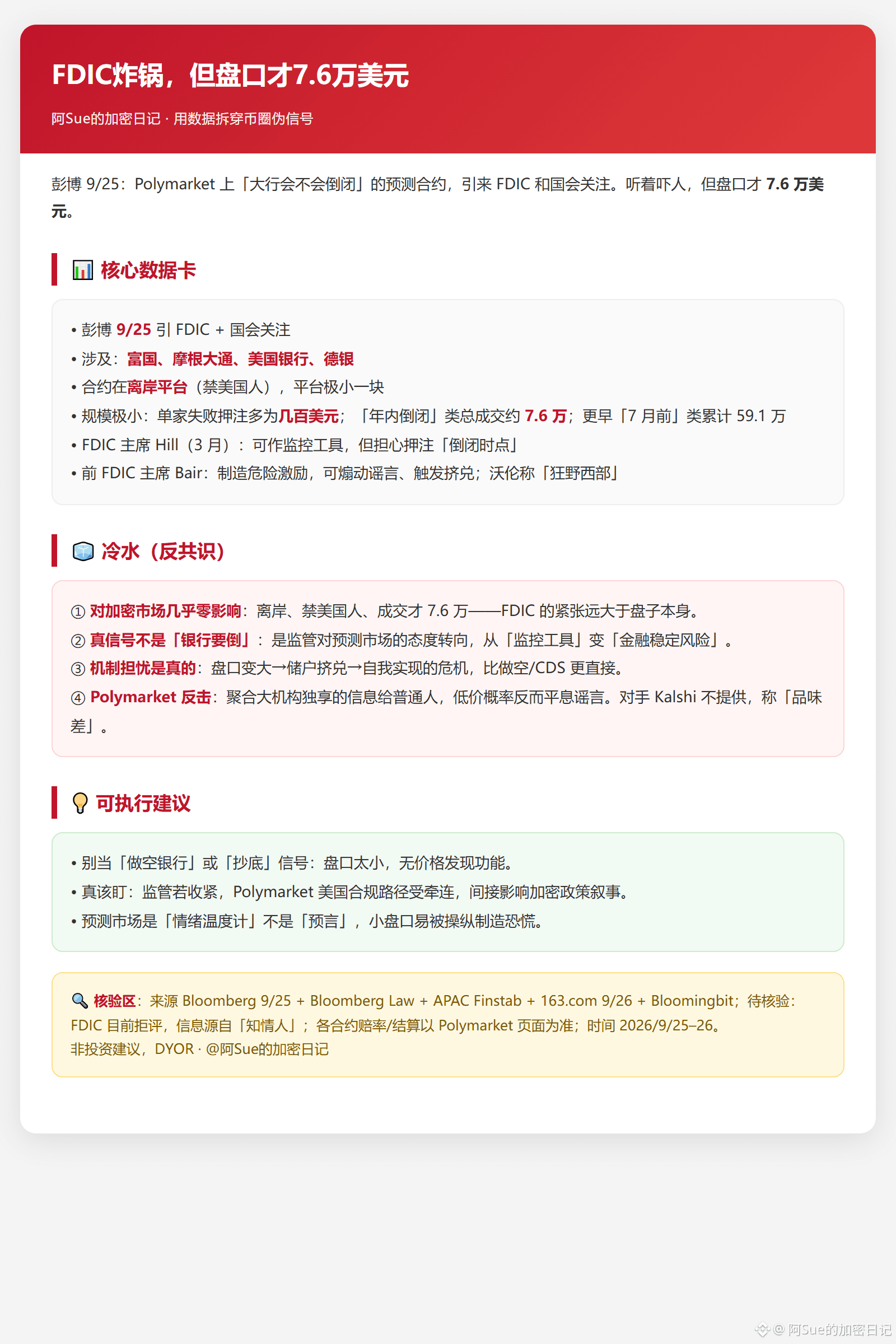
#polymarket银行倒闭押注引fdic关注 FDIC炸锅,但盘口才7.6万美元
Subheading: Bets on Polymarket—“Will big banks go bust?”—drew U.S. regulatory scrutiny. But the market itself is so small it’s basically ignorable.
📊 Data Card
Bloomberg 9/25: Contracts tied to Polymarket’s “Will big banks go bust?” prediction drew attention from the FDIC and Congress, involving banks: Wells Fargo, JPMorgan, Bank of America, and Deutsche Bank. The contracts are traded on Polymarket’s offshore platform (banned for Americans), and are only a tiny fraction of the platform’s overall size: failed bets are typically just a few hundred dollars each, while some (Deutsche Bank, and Wooris/Wells Fargo) are in the thousands. Total trading volume for “within the year goes bust” contracts is about $76,000; earlier “goes bust within before July” contracts total $591,000.
FDIC Chair Travis Hill (privately in March): Prediction markets can serve as a monitoring tool, but he worries about people betting on the “bank going bust time.”
FDIC Chair Sheila Bair: Such contracts create dangerous incentives and could be used to stir rumors and trigger runs.
Sen. Warren: Says it’s “the Wild West,” involving insider manipulation.
🧊 Cold Water (against the consensus)
Nearly no impact on the crypto market: the contracts are offshore, barred to Americans, and have only $76,000 in trading volume—the FDIC’s worry is far bigger than the market’s actual size. The real signal isn’t “banks are about to fail,” but a shift in regulators’ stance toward prediction markets—from “monitoring tools” to “financial stability risks.” The mechanism concern is very real: if the odds on a particular bank collapsing get bigger, depositors may see it and run—creating a self-fulfilling liquidity crisis. It’s more direct than shorting stocks or CDS.
Polymarket’s rebuttal: Prediction markets aggregate information that “only big institutions have” and give it to ordinary people; a low-priced probability can actually calm rumors.
Rival Kalshi (CFTC-regulated) doesn’t offer such contracts, calling it “bad taste.” Polymarket’s U.S.-compliant platform also doesn’t provide them.
✅ Actionable Recommendations
Don’t treat this as a signal to “short banks” or “buy the dip”: the odds are too small and there’s no real price-discovery function. The real thing worth watching: if regulators tighten prediction markets, Polymarket’s U.S. expansion/compliance pathway will be affected—indirectly influencing the crypto policy narrative.
For ordinary people: Prediction markets are a “mood thermometer,” not a prophecy. Small odds are easy to manipulate and can manufacture panic.
Subheading: Bets on Polymarket—“Will big banks go bust?”—drew U.S. regulatory scrutiny. But the market itself is so small it’s basically ignorable.
📊 Data Card
Bloomberg 9/25: Contracts tied to Polymarket’s “Will big banks go bust?” prediction drew attention from the FDIC and Congress, involving banks: Wells Fargo, JPMorgan, Bank of America, and Deutsche Bank. The contracts are traded on Polymarket’s offshore platform (banned for Americans), and are only a tiny fraction of the platform’s overall size: failed bets are typically just a few hundred dollars each, while some (Deutsche Bank, and Wooris/Wells Fargo) are in the thousands. Total trading volume for “within the year goes bust” contracts is about $76,000; earlier “goes bust within before July” contracts total $591,000.
FDIC Chair Travis Hill (privately in March): Prediction markets can serve as a monitoring tool, but he worries about people betting on the “bank going bust time.”
FDIC Chair Sheila Bair: Such contracts create dangerous incentives and could be used to stir rumors and trigger runs.
Sen. Warren: Says it’s “the Wild West,” involving insider manipulation.
🧊 Cold Water (against the consensus)
Nearly no impact on the crypto market: the contracts are offshore, barred to Americans, and have only $76,000 in trading volume—the FDIC’s worry is far bigger than the market’s actual size. The real signal isn’t “banks are about to fail,” but a shift in regulators’ stance toward prediction markets—from “monitoring tools” to “financial stability risks.” The mechanism concern is very real: if the odds on a particular bank collapsing get bigger, depositors may see it and run—creating a self-fulfilling liquidity crisis. It’s more direct than shorting stocks or CDS.
Polymarket’s rebuttal: Prediction markets aggregate information that “only big institutions have” and give it to ordinary people; a low-priced probability can actually calm rumors.
Rival Kalshi (CFTC-regulated) doesn’t offer such contracts, calling it “bad taste.” Polymarket’s U.S.-compliant platform also doesn’t provide them.
✅ Actionable Recommendations
Don’t treat this as a signal to “short banks” or “buy the dip”: the odds are too small and there’s no real price-discovery function. The real thing worth watching: if regulators tighten prediction markets, Polymarket’s U.S. expansion/compliance pathway will be affected—indirectly influencing the crypto policy narrative.
For ordinary people: Prediction markets are a “mood thermometer,” not a prophecy. Small odds are easy to manipulate and can manufacture panic.