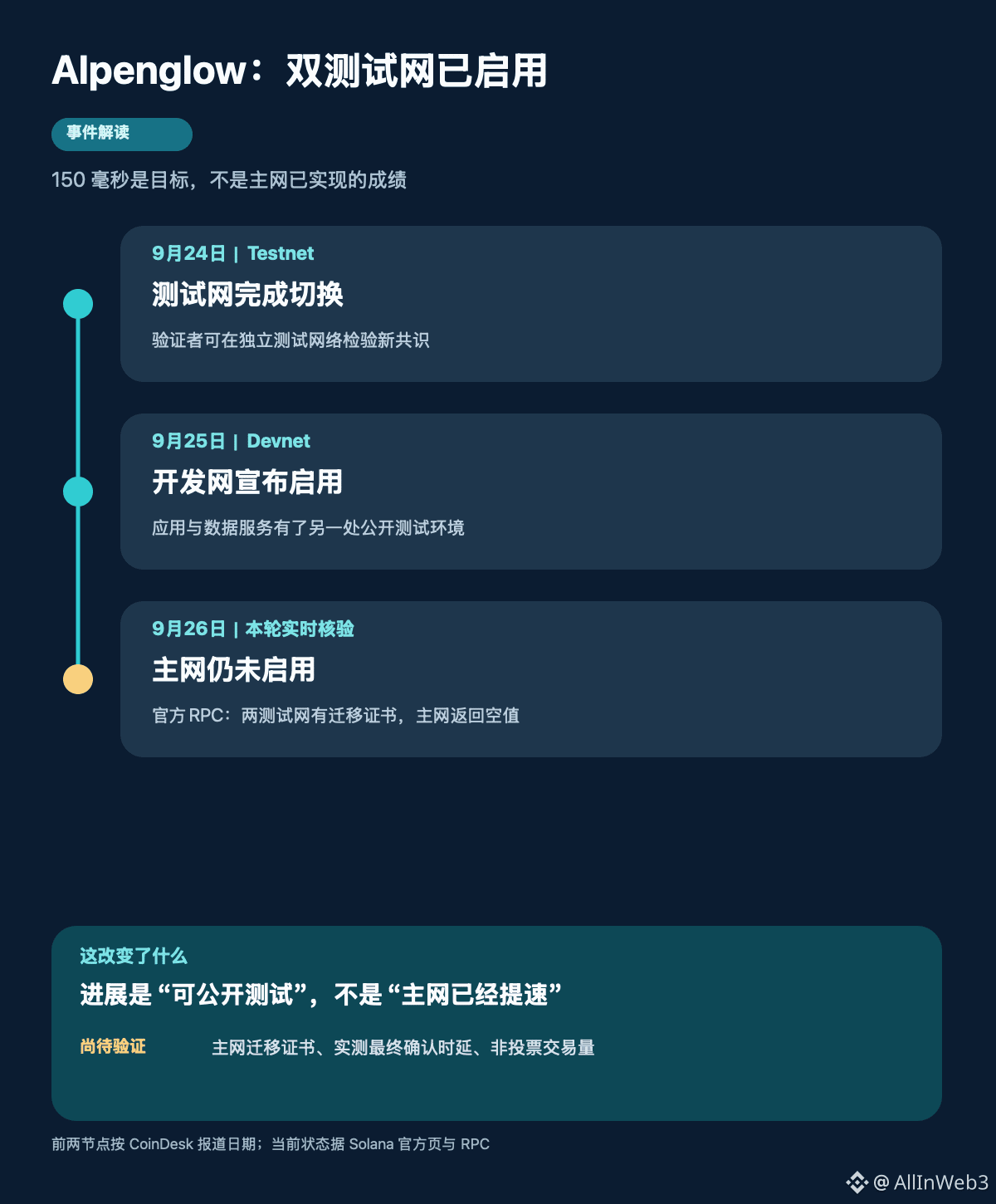
#Solana升级 Alpenglow has indeed taken one step forward. But the easiest place to misread today is this: it has already been running in two public test environments, which does not mean the Solana mainnet has already achieved 150-millisecond finality. What I care about is whether the test results can be safely and reliably carried over to real transaction environments—not whether we write the target speed into the price expectations for <$SOL >.
The timeline is clear. According to updates verified by CoinDesk, the 9/24 Testnet migration was completed; on 9/25, the core software team, Anza, announced that Devnet had also been switched over. By the afternoon of 9/26, when I checked Solana’s official RPC migration-certificate interface, both Testnet and Devnet returned certificates, while Mainnet returned an empty value. Solana’s official upgrade page also lists the first two as enabled, with the mainnet not yet enabled. Having two test environments allows validators, wallets, and data services to check compatibility—that’s meaningful progress, but it is not a mainnet switch confirmation receipt.
So where, exactly, does this upgrade speed things up? Alpenglow changes the way validators reach final consensus: the goal is to reduce a transaction’s “irreversible” waiting time from roughly 12.8 seconds to about 150 milliseconds. It doesn’t mean every block’s generation interval is cut to 150 milliseconds, nor does it mean exchanges will complete internal risk controls or process deposits within 150 milliseconds. The official documentation frames 150 milliseconds as a target; whether it can be consistently achieved under real mainnet load still has no verified measurement.
Another easy-to-overlook change is the data metric. The new mechanism moves validator votes out of the blocks; the vote transactions that previously counted toward total transaction counts will disappear. If some dashboards’ total TPS suddenly drops in the future, you can’t directly conclude that user activity has collapsed. You should first separate and examine non-vote transactions, actual paid usage, and network stability. That is more decision-relevant than fixating on a pretty speed number.
As for tokens, the upgrade changes consensus but does not directly change execution, transaction formats, or the fee mechanism. Faster final confirmation may improve payment and trading experience, but for it to translate into ongoing demand for <$SOL >, we still need to see whether the applications that go live on mainnet truly bring more paid activity. The three verifiable things to check next are: whether a mainnet migration certificate appears; the final confirmation time under real load; and user transactions and fees after removing vote traffic. Source: Solana’s official upgrade page and three-net RPCs; dates of progress per CoinDesk, status verification as of 14:34 Beijing time on 9/26. #SOL