#sec称回购与升级不必然使代币成证券 But what’s “approved” is what’s already live—not a sales pitch.
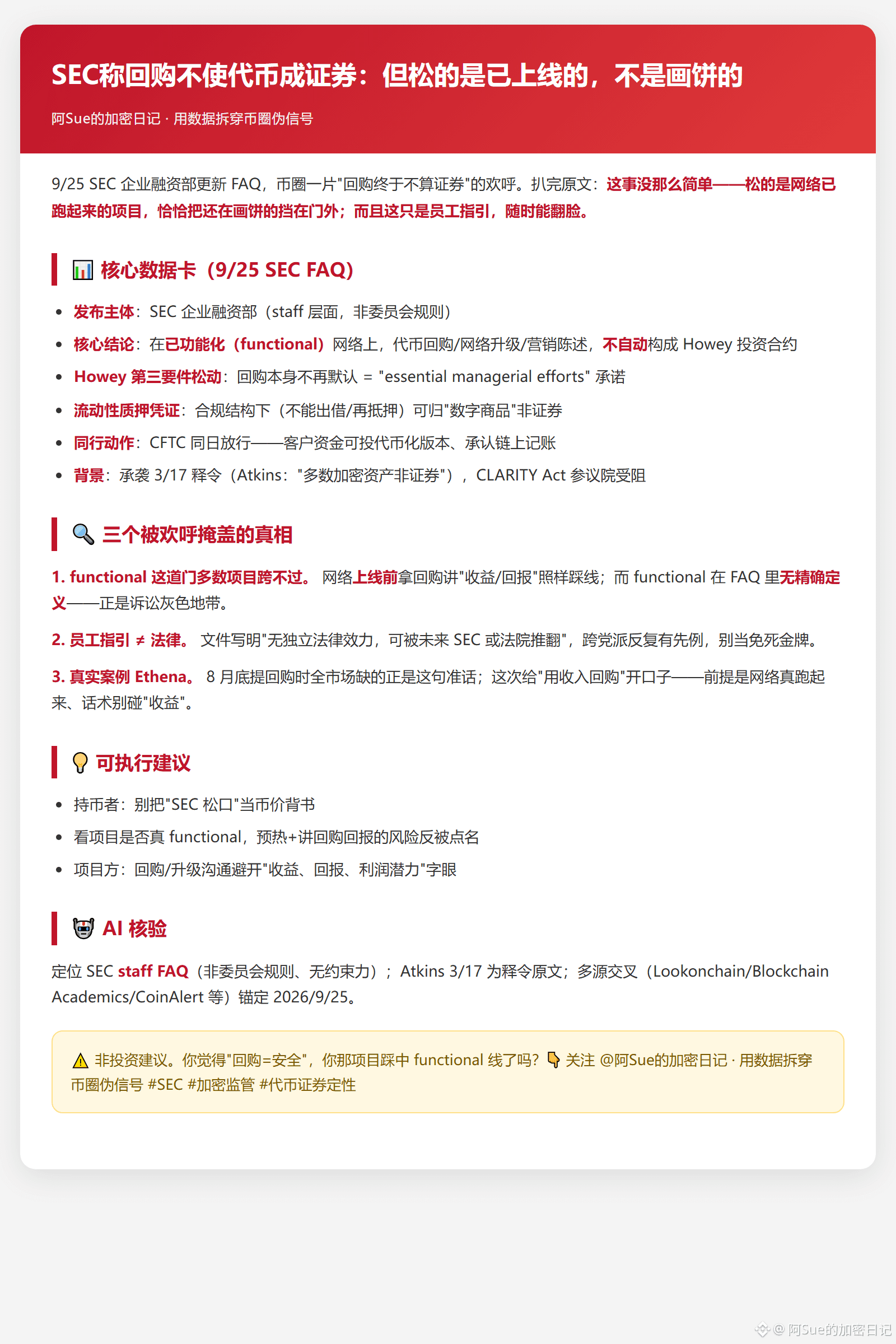
On 9/25, the SEC’s Corporate Finance Division updated its FAQ, and the crypto world erupted with cheers of “buybacks no longer count as securities.” After digging through the original text, the conclusion is: it’s not that simple.
📊 Core facts
On a **functional** network, token buybacks, network upgrades, and marketing statements do not automatically constitute an investment contract under Howey. Howey’s third requirement—“the critical managerial efforts”—is no longer deemed to be triggered by buybacks that default to liquidity-staking derivative (LST) instruments, in a compliant structure (the issuer cannot lend/re-pledge). So it can be characterized as a **“digital commodity” rather than a security**.
On the same day, the CFTC also granted clearance: client funds may be invested in “tokenized versions of approved assets.”
Clarifying on-chain accounting context: it inherits the 3/17 release (Atkins: “Most crypto assets are not securities”). The CLARITY Act was blocked in the Senate.
🔍 Three truths hidden by the celebration
Most projects can’t get past the “functional” door. If you’re touting buybacks “for yield/returns” before the network is live, you’re still crossing the line. And the “functional” FAQ doesn’t precisely define it—this is exactly the kind of lawsuit gray zone where employee guidance ≠ law. The documents state that they “have no independent legal effect and may be overturned by future SEC action or court decisions.” There are bipartisan precedents—don’t treat this as a get-out-of-jail-free card.
Real case in point: Ethena. When it proposed buybacks at the end of August, the entire market was missing precisely that kind of explicit assurance. This time, it essentially opens a structural loophole for “buybacks funded by revenue”—but only if the network truly runs and the messaging avoids words touching “yield,” “returns,” etc.
💡 Recommendation
For token holders: Don’t treat “the SEC loosening up” as a stamp of approval for the token price or as proof that a project is truly functional. If the project is still in hype mode and talks about buyback returns, it’s the risk that gets called out.
For project teams: In communications about buybacks/upgrades, avoid wording like “yield,” “returns,” and “profit potential.”
⚠️ Not investment advice. If you think “buybacks = safe,” has your project actually crossed the functional line?
On 9/25, the SEC’s Corporate Finance Division updated its FAQ, and the crypto world erupted with cheers of “buybacks no longer count as securities.” After digging through the original text, the conclusion is: it’s not that simple.
📊 Core facts
On a **functional** network, token buybacks, network upgrades, and marketing statements do not automatically constitute an investment contract under Howey. Howey’s third requirement—“the critical managerial efforts”—is no longer deemed to be triggered by buybacks that default to liquidity-staking derivative (LST) instruments, in a compliant structure (the issuer cannot lend/re-pledge). So it can be characterized as a **“digital commodity” rather than a security**.
On the same day, the CFTC also granted clearance: client funds may be invested in “tokenized versions of approved assets.”
Clarifying on-chain accounting context: it inherits the 3/17 release (Atkins: “Most crypto assets are not securities”). The CLARITY Act was blocked in the Senate.
🔍 Three truths hidden by the celebration
Most projects can’t get past the “functional” door. If you’re touting buybacks “for yield/returns” before the network is live, you’re still crossing the line. And the “functional” FAQ doesn’t precisely define it—this is exactly the kind of lawsuit gray zone where employee guidance ≠ law. The documents state that they “have no independent legal effect and may be overturned by future SEC action or court decisions.” There are bipartisan precedents—don’t treat this as a get-out-of-jail-free card.
Real case in point: Ethena. When it proposed buybacks at the end of August, the entire market was missing precisely that kind of explicit assurance. This time, it essentially opens a structural loophole for “buybacks funded by revenue”—but only if the network truly runs and the messaging avoids words touching “yield,” “returns,” etc.
💡 Recommendation
For token holders: Don’t treat “the SEC loosening up” as a stamp of approval for the token price or as proof that a project is truly functional. If the project is still in hype mode and talks about buyback returns, it’s the risk that gets called out.
For project teams: In communications about buybacks/upgrades, avoid wording like “yield,” “returns,” and “profit potential.”
⚠️ Not investment advice. If you think “buybacks = safe,” has your project actually crossed the functional line?