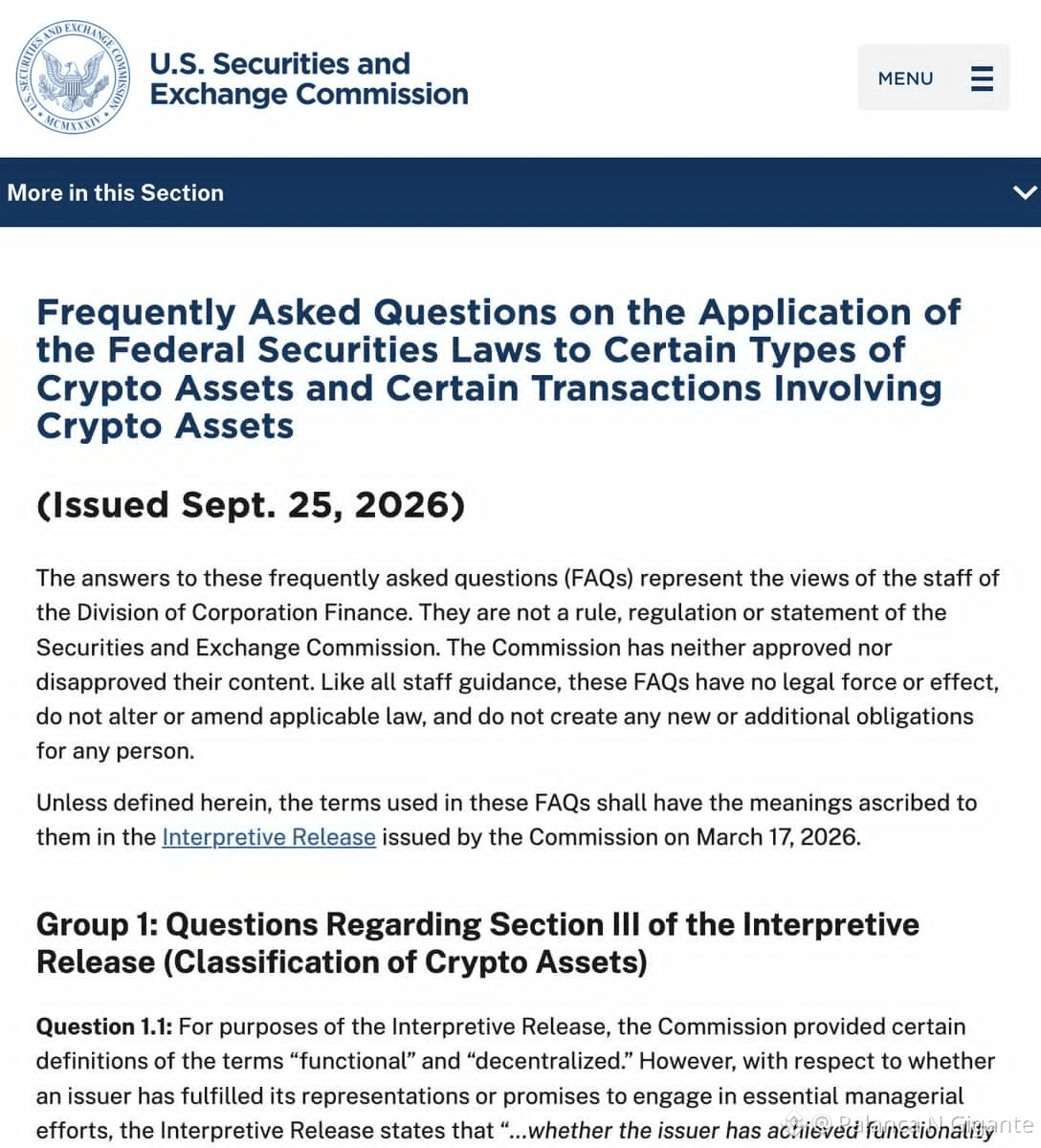
🚨TODAY: The SEC has just released NEW Frequently Asked Questions about cryptoassets, clarifying how securities laws apply to certain tokens and transactions.
KEY POINTS:
- A token and the investment contract used to sell it are not necessarily the same thing. A token may later exist as a non-securities cryptoasset.
- Functionality and decentralization depend, in part, on what the issuer promised to buyers.
- Staking receipt tokens are not automatically securities. Some may qualify as digital instruments or digital commodities.
- A true “crypto receipt” represents only ownership of the underlying asset. The issuer cannot lend it, pledge it, or mortgage it again.
- Marketing the utility or future resources of a network, by itself, does not necessarily create an investment contract.
- Developers can continue to maintain and update a functional network without those efforts necessarily satisfying the Howey test.
- In a decentralized network with no central controller, the issuer’s statements are less likely to create a new investment contract.
- Token repurchases are not automatically considered securities unless they are tied to earnings or returns promised before the network is operational.
- Broker-dealers that offer secondary trading are not automatically considered promoters.
Overall, the SEC’s new FAQs are focusing more on what the token really represents, how functional and decentralized the network is, who controls it, and what was promised to buyers.
It’s important to note that these are FAQs issued by the SEC’s Division of Corporate Finance team, and are NOT new SEC rules.
$QI $PHA $ARK
#SEC
KEY POINTS:
- A token and the investment contract used to sell it are not necessarily the same thing. A token may later exist as a non-securities cryptoasset.
- Functionality and decentralization depend, in part, on what the issuer promised to buyers.
- Staking receipt tokens are not automatically securities. Some may qualify as digital instruments or digital commodities.
- A true “crypto receipt” represents only ownership of the underlying asset. The issuer cannot lend it, pledge it, or mortgage it again.
- Marketing the utility or future resources of a network, by itself, does not necessarily create an investment contract.
- Developers can continue to maintain and update a functional network without those efforts necessarily satisfying the Howey test.
- In a decentralized network with no central controller, the issuer’s statements are less likely to create a new investment contract.
- Token repurchases are not automatically considered securities unless they are tied to earnings or returns promised before the network is operational.
- Broker-dealers that offer secondary trading are not automatically considered promoters.
Overall, the SEC’s new FAQs are focusing more on what the token really represents, how functional and decentralized the network is, who controls it, and what was promised to buyers.
It’s important to note that these are FAQs issued by the SEC’s Division of Corporate Finance team, and are NOT new SEC rules.
$QI $PHA $ARK
#SEC