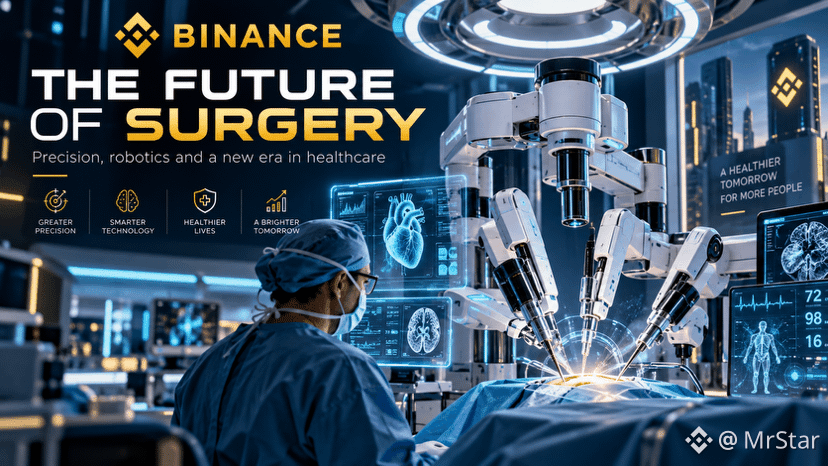

The operating room of the future may look very different from the one we know today.
Some surgeries are already limited by something very human: the precision of our hands.
Microsurgery can involve blood vessels and nerves smaller than 1 millimeter. Even the best surgeons still face natural tremor, fatigue and restricted movement in deep or difficult areas of the body. New robotic microsurgery systems are being developed to reduce those limitations through motion scaling and tremor filtration. Recent clinical research shows that these systems can already improve precision in extremely delicate procedures.
Now imagine what happens when #Robotics becomes smaller, more precise and combined with artificial intelligence.
The first major step will probably not be robots replacing surgeons.
It will be robots helping surgeons see more clearly, recognize anatomy, detect possible errors and perform movements that are difficult for the human hand. Current research suggests AI assisted surgical systems could improve perception and intraoperative guidance while keeping the surgeon in control.
Further ahead we may see microrobots operating inside parts of the body that are extremely difficult to reach today. Researchers are already studying autonomous robotic surgery and microrobotic surgery as long term directions.
For crypto there is also an interesting connection.
Projects such as $BIO are building blockchain based infrastructure around biotechnology research and decentralized scientific funding. That does not make $BIO a robotic surgery token. But it represents another part of the same future where medical research, funding and technology become more connected.
#Biotech
My view is simple:
The next revolution in healthcare may not come from one new medicine. It may come from giving doctors capabilities the human body never had before.
Will you trust a surgeon using an #AI assisted robot for a procedure that could not be performed safely by hand?
I think I will not :) This makes me so scared.
Some surgeries are already limited by something very human: the precision of our hands.
Microsurgery can involve blood vessels and nerves smaller than 1 millimeter. Even the best surgeons still face natural tremor, fatigue and restricted movement in deep or difficult areas of the body. New robotic microsurgery systems are being developed to reduce those limitations through motion scaling and tremor filtration. Recent clinical research shows that these systems can already improve precision in extremely delicate procedures.
Now imagine what happens when #Robotics becomes smaller, more precise and combined with artificial intelligence.
The first major step will probably not be robots replacing surgeons.
It will be robots helping surgeons see more clearly, recognize anatomy, detect possible errors and perform movements that are difficult for the human hand. Current research suggests AI assisted surgical systems could improve perception and intraoperative guidance while keeping the surgeon in control.
Further ahead we may see microrobots operating inside parts of the body that are extremely difficult to reach today. Researchers are already studying autonomous robotic surgery and microrobotic surgery as long term directions.
For crypto there is also an interesting connection.
Projects such as $BIO are building blockchain based infrastructure around biotechnology research and decentralized scientific funding. That does not make $BIO a robotic surgery token. But it represents another part of the same future where medical research, funding and technology become more connected.
#Biotech
My view is simple:
The next revolution in healthcare may not come from one new medicine. It may come from giving doctors capabilities the human body never had before.
Will you trust a surgeon using an #AI assisted robot for a procedure that could not be performed safely by hand?
I think I will not :) This makes me so scared.