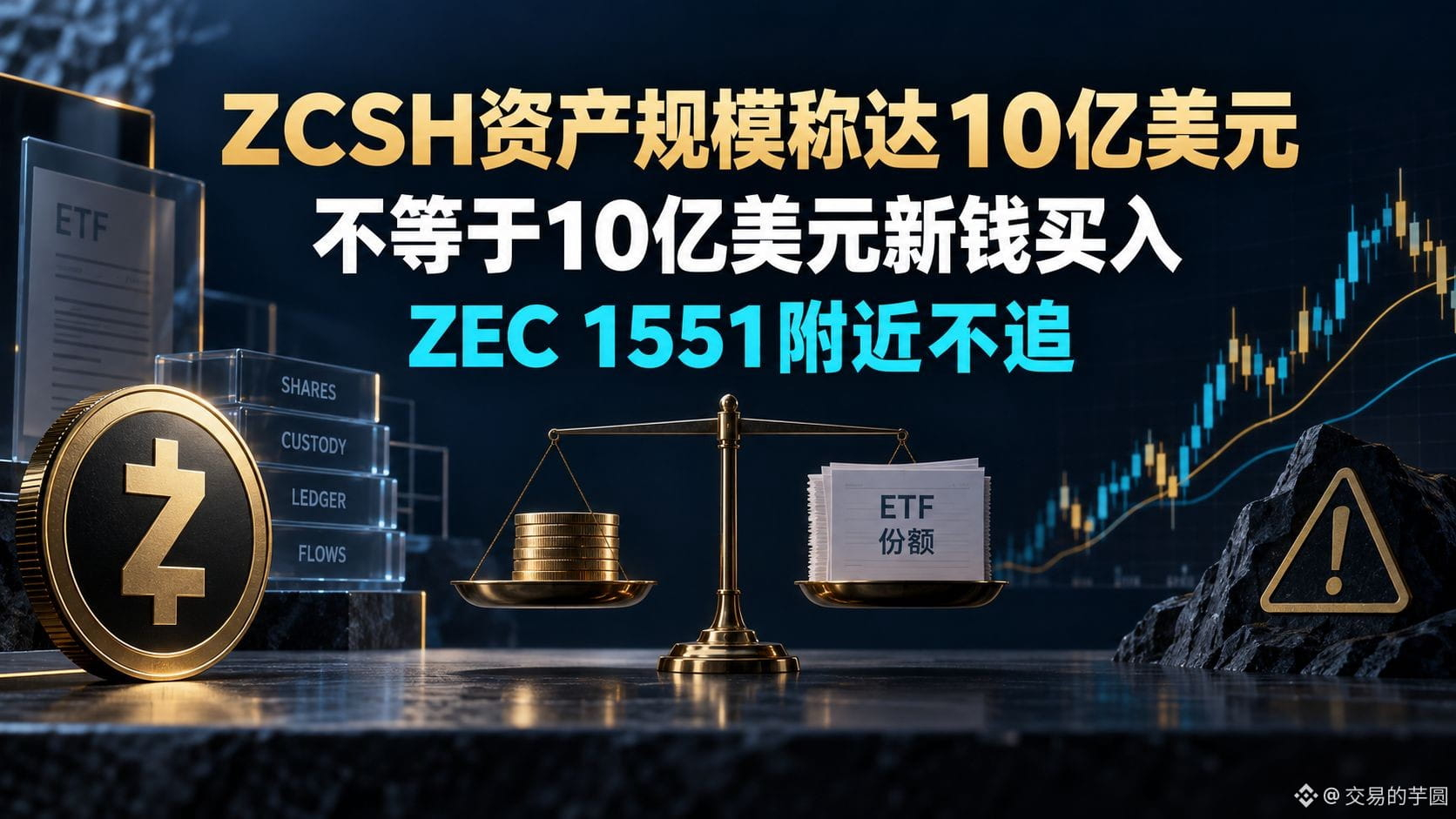
ZCSH asset size reportedly reaches $1B|Not $1B of new money buying|ZEC around 1551, I’m not chasing
My take: This trending topic is worth watching, but you can’t directly translate the fund’s assets under management into same-day spot buy orders. Binance Square is discussing #GrayscaleZcashETFHits$1BNetAssets. Grayscale’s official account says its ZCSH has $1B in assets under management; that’s the scale metric disclosed by the issuer. It is not real-time fund flow independently audited by me, and it is certainly not “$1B flowing in today.” ZCSH originally came from the conversion of an older Zcash trust, and the account already holds ZEC. The fund’s asset value will rise as ZEC’s price increases, so the increase in new shares and the repricing must be separated. Mixing the two easily leads to overestimating marginal buying demand.
Another key transaction must be accounted for clearly. On September 8, ZCSH filed an 8-K with the US SEC confirming that related party DCG exchanged 85,705.32563297 ZEC, via an authorized participant, for approximately $100 million worth of fund shares. This is an in-kind exchange for shares, not sweeping $100 million in cash into the public spot market on the same day. If posts call it direct external cash inflow, I won’t simply accept that at face value. On September 18, another 8-K disclosed a 1-for-3 structure change: record date September 28, allocation September 29, and the split-and-trade after September 30. Shares triple, and net value per share drops by roughly one-third. That doesn’t magically create assets or demand. Institutional product expansion may indeed improve ZEC’s investable channels, but it can’t guarantee a sustained short-term uptrend.
How has the market reacted? When I wrote this, KuCoin’s ZEC/USDT was around $1550.6; over the past 24 hours the high was $1624.8 and the low $1515.2, with price already pulling back from the high. This range suggests that attention and volatility both increased; you can’t claim that every candlestick is ETF buying just based on the fund’s headline. Next, I’m watching two things: whether the issuer’s subsequent asset and share data can verify that the scale continues, and whether ZEC can regain and hold above 1625. If it breaks below 1515 and the fund data is revised, the bullish case based on that thesis gets invalidated. The Bitget incident is still under investigation; if the exchange’s deposits/withdrawals aren’t smooth, I’ll also raise my liquidity discount requirement and won’t frame platform risk as a “Zcash chain malfunction.”
If I were trading myself: I’m not entering at the moment. I would only plan a small spot long position after predefined conditions are met, without leverage. I’ll wait until ZEC closes two consecutive complete 15-minute candles above 1625, then retests 1605—1625 without breaking it, and confirm that the platform’s ZEC deposits/withdrawals are functioning normally. Only then would I build a position using at most 0.2% of total capital. If conditions aren’t triggered, I stay at 0 exposure. If I enter and the price reaches 1670, I’ll cut the position in half; at 1710 I’ll close any remaining shares. If it falls to 1585, I’ll cut the position in half first; if it touches 1560, I’ll fully stop out and close the position. If, before entry, price breaks below 1515, I’ll cancel the whole plan and recheck the fund share details and the market situation. Separating scale, actual inflows, and execution conditions matters more than chasing a “nice round number.”
#GrayscaleZcashETFHits$1BNetAssets #ZEC
The above is only my personal market observation and does not constitute investment advice.
My take: This trending topic is worth watching, but you can’t directly translate the fund’s assets under management into same-day spot buy orders. Binance Square is discussing #GrayscaleZcashETFHits$1BNetAssets. Grayscale’s official account says its ZCSH has $1B in assets under management; that’s the scale metric disclosed by the issuer. It is not real-time fund flow independently audited by me, and it is certainly not “$1B flowing in today.” ZCSH originally came from the conversion of an older Zcash trust, and the account already holds ZEC. The fund’s asset value will rise as ZEC’s price increases, so the increase in new shares and the repricing must be separated. Mixing the two easily leads to overestimating marginal buying demand.
Another key transaction must be accounted for clearly. On September 8, ZCSH filed an 8-K with the US SEC confirming that related party DCG exchanged 85,705.32563297 ZEC, via an authorized participant, for approximately $100 million worth of fund shares. This is an in-kind exchange for shares, not sweeping $100 million in cash into the public spot market on the same day. If posts call it direct external cash inflow, I won’t simply accept that at face value. On September 18, another 8-K disclosed a 1-for-3 structure change: record date September 28, allocation September 29, and the split-and-trade after September 30. Shares triple, and net value per share drops by roughly one-third. That doesn’t magically create assets or demand. Institutional product expansion may indeed improve ZEC’s investable channels, but it can’t guarantee a sustained short-term uptrend.
How has the market reacted? When I wrote this, KuCoin’s ZEC/USDT was around $1550.6; over the past 24 hours the high was $1624.8 and the low $1515.2, with price already pulling back from the high. This range suggests that attention and volatility both increased; you can’t claim that every candlestick is ETF buying just based on the fund’s headline. Next, I’m watching two things: whether the issuer’s subsequent asset and share data can verify that the scale continues, and whether ZEC can regain and hold above 1625. If it breaks below 1515 and the fund data is revised, the bullish case based on that thesis gets invalidated. The Bitget incident is still under investigation; if the exchange’s deposits/withdrawals aren’t smooth, I’ll also raise my liquidity discount requirement and won’t frame platform risk as a “Zcash chain malfunction.”
If I were trading myself: I’m not entering at the moment. I would only plan a small spot long position after predefined conditions are met, without leverage. I’ll wait until ZEC closes two consecutive complete 15-minute candles above 1625, then retests 1605—1625 without breaking it, and confirm that the platform’s ZEC deposits/withdrawals are functioning normally. Only then would I build a position using at most 0.2% of total capital. If conditions aren’t triggered, I stay at 0 exposure. If I enter and the price reaches 1670, I’ll cut the position in half; at 1710 I’ll close any remaining shares. If it falls to 1585, I’ll cut the position in half first; if it touches 1560, I’ll fully stop out and close the position. If, before entry, price breaks below 1515, I’ll cancel the whole plan and recheck the fund share details and the market situation. Separating scale, actual inflows, and execution conditions matters more than chasing a “nice round number.”
#GrayscaleZcashETFHits$1BNetAssets #ZEC
The above is only my personal market observation and does not constitute investment advice.