

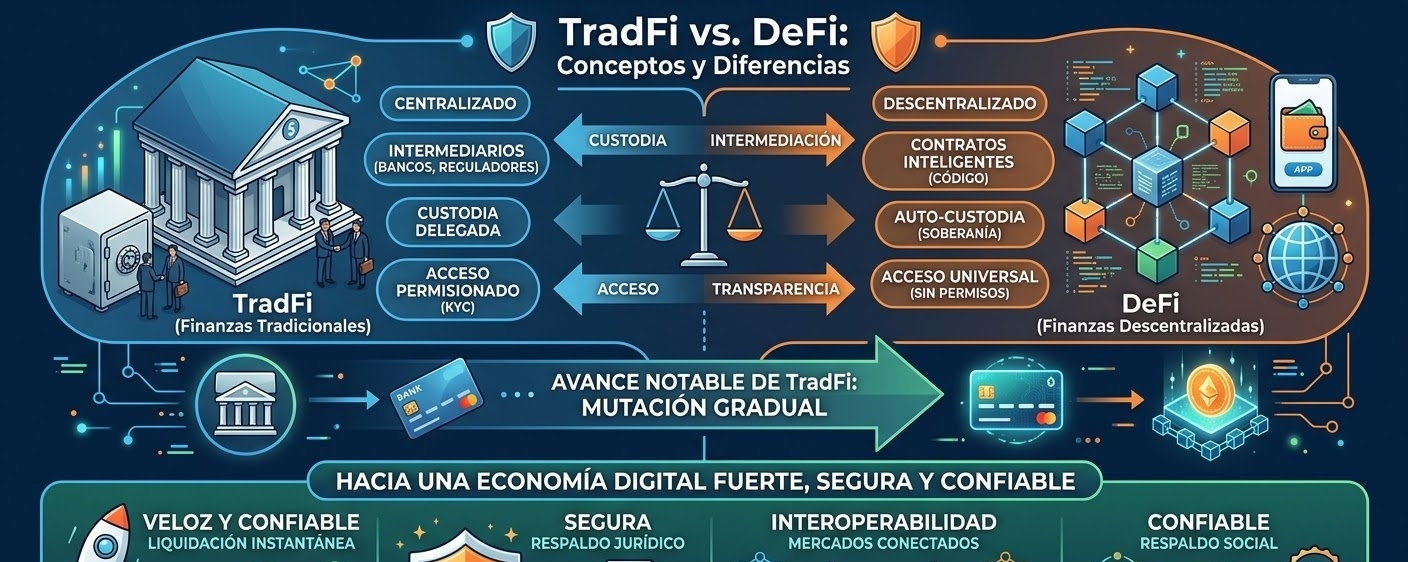

TradFi (Traditional Finance): It is the conventional centralized financial system, made up of central banks, commercial banks, stock exchanges, and regulators. It works through trusted intermediaries that custody assets, process transactions, and ensure regulatory compliance through closed rails (such as SWIFT or clearinghouses).
DeFi (Decentralized Finance): It is the ecosystem of financial services built directly on blockchain networks. It operates through self-executing smart contracts, eliminating human intermediaries to offer permissioned, transparent, and 24/7 availability of loans, exchanges, and yields.
Main Differences
Custody and Control: In TradFi, custody is delegated to financial institutions; in DeFi, users maintain sovereignty over their assets through non-custodial wallets (self-custody).
Intermediation vs. Automation: TradFi depends on executives, brokers, and manual or semi-automated clearing and settlement processes; DeFi replaces the intermediary with immutable code that executes predetermined rules.
Access and Requirements: TradFi requires identity verification (KYC/AML), credit history, and geographic restrictions; DeFi operates in a pseudonymous and universal manner, requiring only an internet connection and a digital wallet.
Transparency and Auditing: TradFi records are private and periodically audited internally or externally; in DeFi, transaction history and protocol code are public and verifiable on-chain in real time.
The Evolution of TradFi: Toward the Digital Economy
TradFi has not remained static in the face of technological disruption. On the contrary, global banking and financial markets are absorbing the efficiency principles of blockchain to evolve into a modern infrastructure.
1. Fast and Trustworthy (Operational Efficiency)
Traditional institutions are migrating from slow settlements (T+1 or T+2) to instant settlement (T+0) through the tokenization of real-world assets (RWA, Real World Assets). Issuing bonds, investment funds, and treasury bills over distributed networks drastically reduces transaction costs and processing times.
2. Global Interoperability
Through the development of central bank digital currencies (CBDCs) and the integration of financial messaging networks such as ISO 20022 with interoperability protocols between chains (such as CCIP), TradFi seeks to connect capital markets that have historically operated in isolated silos.
3. Social Backing and Legal Framework
The key differentiator with which TradFi leads the digital transition is social and institutional backing. Unlike the DeFi environment—which faces regulatory uncertainty and risks of code exploitation—TradFi provides:
Legal Security and Protection Schemes: Deposit insurance, clear regulatory frameworks, and formal dispute-resolution mechanisms.
Institutional Reliability: Rigorous compliance standards (KYC, anti–money laundering prevention) that build trust for the onboarding of large institutional capital.
This gradual convergence is giving rise to a hybrid model (TradFi + Blockchain), where the legal robustness and social backing of traditional banking are combined with the speed, transparency, and interoperability of distributed technology. #Binance #WriteToEarnUpgrade $BTC
