#cftc更新受监管机构代币化资产指引
You put the customer funds with a futures broker—now the rules are stated clearly the first time about where they can go.
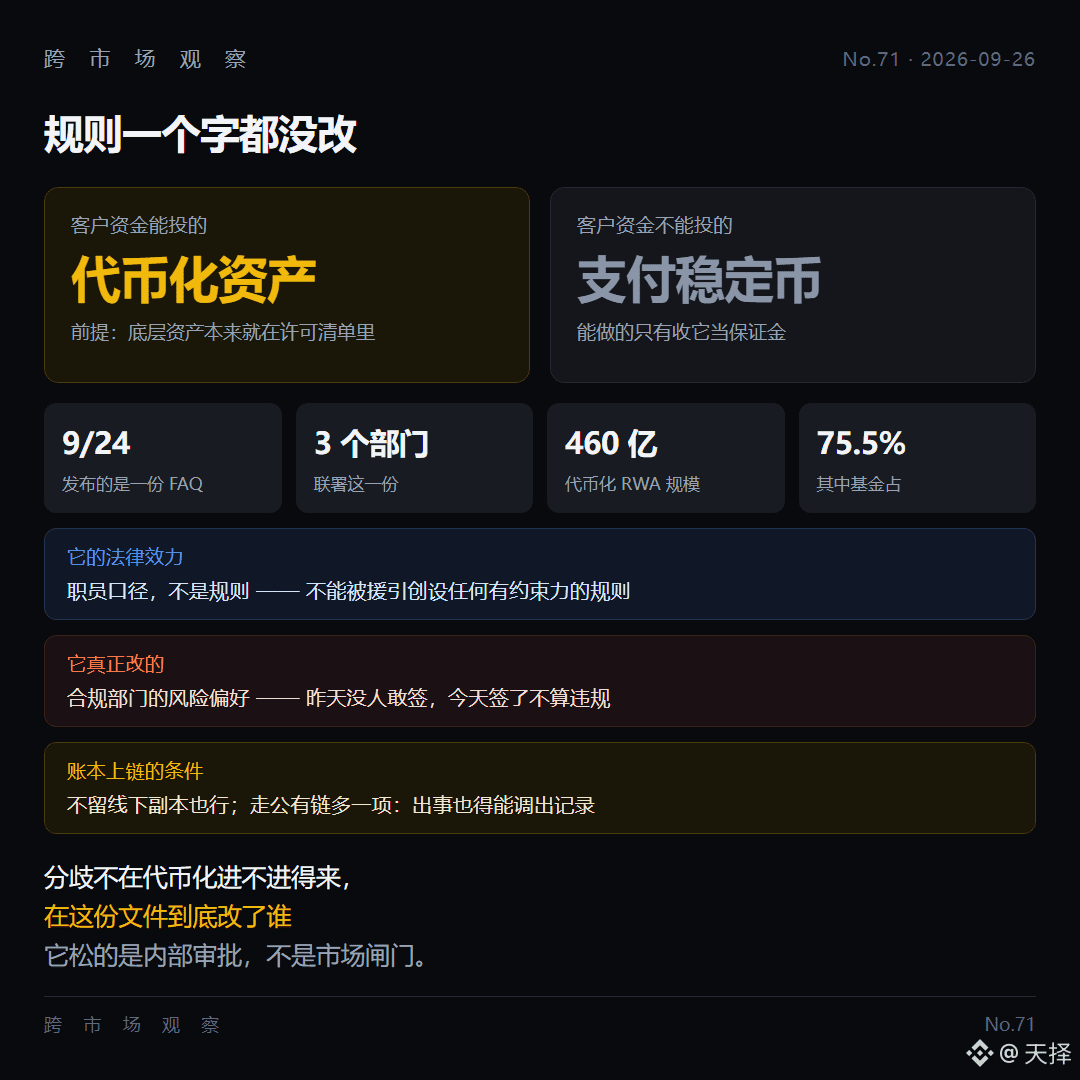
▪️ The 9/24 update is an FAQ, not the rules— the press release itself says “no changes to existing rules,” while the FAQ says it cannot be cited to create any binding rules
▪️ In the same document, customer funds may be invested in tokenized permitted assets, but payment stablecoins still cannot be invested in; what you can do is only take them as margin, or use your own as residual equity
▪️ The criteria are based on the underlying assets, not the digital format: tokenized government bonds equal government bonds—first look at what they are, then look at what they look like
▪️ If the ledger is put on-chain, there’s no off-chain duplicate copy for staff to manage and no one objects; using a public chain adds a layer—if the network fails, records must still be retrievable
The disagreement isn’t about whether tokenization is coming or not; it’s about who this document actually changed. It changed not a single word of the rules—it changed the compliance department’s risk appetite. Yesterday, no one dared to sign; today, signing doesn’t count as a violation. What it loosens is internal approvals, not the market gate.
Tokenized RWA is already 46 billion. Of that, funds account for 75.5%. The “door” written into the example is tokenized money market fund shares, facing the biggest portion.
Three points to watch:
① the first public case of placing customer funds into tokenized money market funds;
② when payment stablecoins would be upgraded from collateral to an investment product;
③ whether the staff’s wording will be written into a formal rule proposal.
Will you treat it as a loosening, or as a compliance department’s liability-exemption handbook?$BTC
You put the customer funds with a futures broker—now the rules are stated clearly the first time about where they can go.
▪️ The 9/24 update is an FAQ, not the rules— the press release itself says “no changes to existing rules,” while the FAQ says it cannot be cited to create any binding rules
▪️ In the same document, customer funds may be invested in tokenized permitted assets, but payment stablecoins still cannot be invested in; what you can do is only take them as margin, or use your own as residual equity
▪️ The criteria are based on the underlying assets, not the digital format: tokenized government bonds equal government bonds—first look at what they are, then look at what they look like
▪️ If the ledger is put on-chain, there’s no off-chain duplicate copy for staff to manage and no one objects; using a public chain adds a layer—if the network fails, records must still be retrievable
The disagreement isn’t about whether tokenization is coming or not; it’s about who this document actually changed. It changed not a single word of the rules—it changed the compliance department’s risk appetite. Yesterday, no one dared to sign; today, signing doesn’t count as a violation. What it loosens is internal approvals, not the market gate.
Tokenized RWA is already 46 billion. Of that, funds account for 75.5%. The “door” written into the example is tokenized money market fund shares, facing the biggest portion.
Three points to watch:
① the first public case of placing customer funds into tokenized money market funds;
② when payment stablecoins would be upgraded from collateral to an investment product;
③ whether the staff’s wording will be written into a formal rule proposal.
Will you treat it as a loosening, or as a compliance department’s liability-exemption handbook?$BTC