#cftc更新受监管机构代币化资产指引 却把稳定币关在了门外
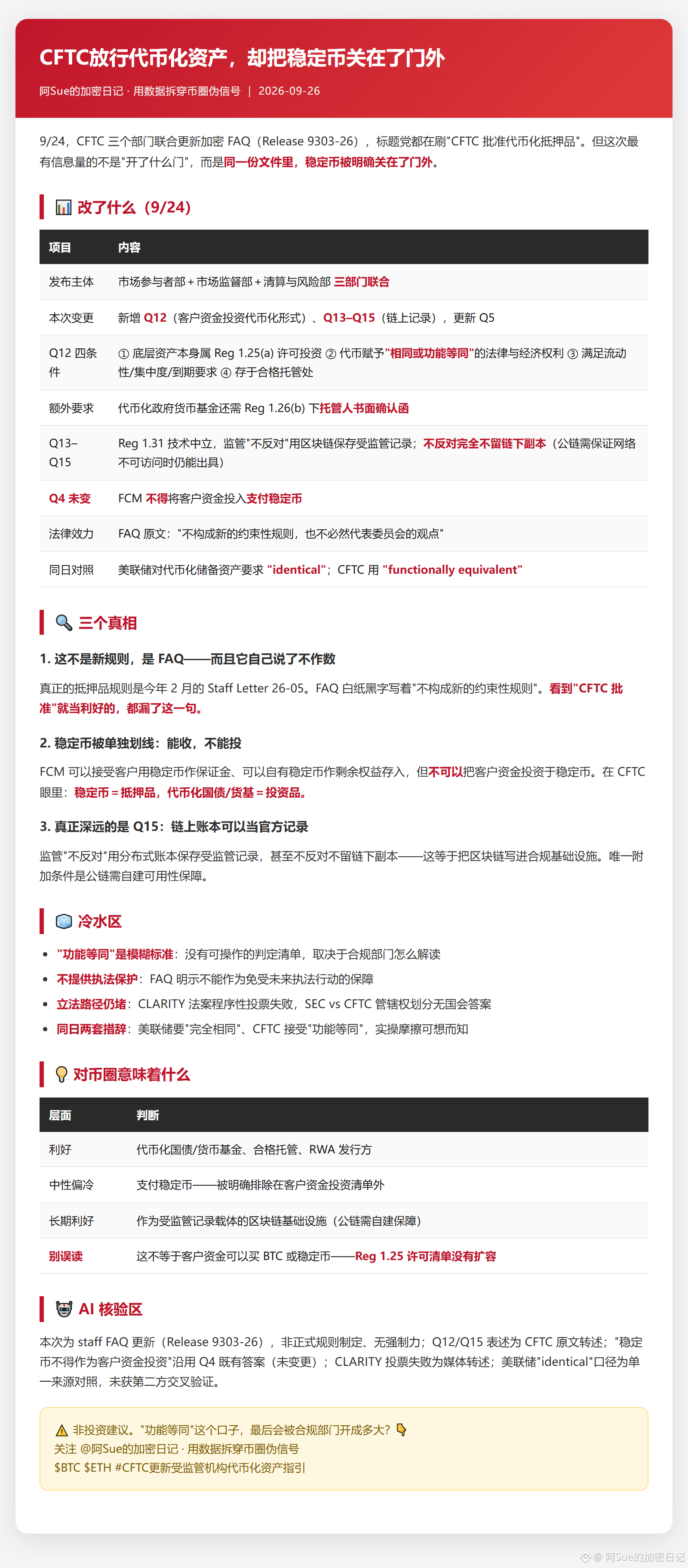
9/24, three CFTC divisions jointly updated the crypto FAQ (Release 9303-26). Clickbait headlines have been going around刷"CFTC approves tokenized collateral". But the most informative part this time isn’t “what door was opened”—it’s that in the same document, stablecoins are explicitly shut out.
📊 What changed
Added Q12: customer funds may be invested in the “tokenized form of an approved investment product,” subject to four conditions: the underlying asset itself is on the Reg 1.25(a) permitted list; the tokens grant “the same or functionally equivalent” legal and economic rights; liquidity/concentration/maturity requirements are met; and the tokens are held with a qualified custodian (for tokenized government MMFs, the custodian must provide a written confirmation letter).
Added Q13–Q15: Reg 1.31 is technology-neutral. The regulator “does not object” to using blockchain to store regulated records, and it even “does not object” to keeping no off-chain copy (public chains must ensure that records can still be produced if the network goes down).
Q4 unchanged: an FCM may not invest customer funds to pay for stablecoins.
🔑 Three real takeaways
This isn’t a new rule—it’s an FAQ, and the actual collateral rule (Staff Letter 26-05) already existed as early as February this year. Moreover, the FAQ itself states: “does not constitute new binding rules, nor necessarily reflects the Commission’s views.” The parts that look favorable are missing that sentence where stablecoins are singled out: they can be accepted as margin, and they can be deposited as residual interests using a firm’s own stablecoins—but customer funds cannot be used to buy them. In the CFTC’s eyes: stablecoins = collateral; tokenized Treasuries/MMFs = investment products. The truly far-reaching point is Q15: an on-chain ledger can serve as the official record—essentially embedding a distributed ledger into compliant infrastructure. The tradeoff: public-chain users must build their own availability guarantees.
🧊 Cold water: “functionally equivalent” is a vague standard with no actionable checklist. The FAQ expressly does not provide protection against future enforcement actions. The CLARITY Act’s procedural vote failed; the legislative pathway remains blocked. On the same day, the Fed’s requirements for tokenized reserve assets use “identical,” and the CFTC uses “functionally equivalent”—same day, same tool, two sets of wording.
💡 Who benefits: tokenized Treasuries/MMFs, qualified custodians, and RWA issuers. Don’t misread this: it doesn’t mean customer funds can buy BTC or stablecoins, and Reg 1.25’s permitted list hasn’t expanded.
How big a “functionally equivalent” opening will end up being—and how far compliance departments will allow it—remains the key question?
9/24, three CFTC divisions jointly updated the crypto FAQ (Release 9303-26). Clickbait headlines have been going around刷"CFTC approves tokenized collateral". But the most informative part this time isn’t “what door was opened”—it’s that in the same document, stablecoins are explicitly shut out.
📊 What changed
Added Q12: customer funds may be invested in the “tokenized form of an approved investment product,” subject to four conditions: the underlying asset itself is on the Reg 1.25(a) permitted list; the tokens grant “the same or functionally equivalent” legal and economic rights; liquidity/concentration/maturity requirements are met; and the tokens are held with a qualified custodian (for tokenized government MMFs, the custodian must provide a written confirmation letter).
Added Q13–Q15: Reg 1.31 is technology-neutral. The regulator “does not object” to using blockchain to store regulated records, and it even “does not object” to keeping no off-chain copy (public chains must ensure that records can still be produced if the network goes down).
Q4 unchanged: an FCM may not invest customer funds to pay for stablecoins.
🔑 Three real takeaways
This isn’t a new rule—it’s an FAQ, and the actual collateral rule (Staff Letter 26-05) already existed as early as February this year. Moreover, the FAQ itself states: “does not constitute new binding rules, nor necessarily reflects the Commission’s views.” The parts that look favorable are missing that sentence where stablecoins are singled out: they can be accepted as margin, and they can be deposited as residual interests using a firm’s own stablecoins—but customer funds cannot be used to buy them. In the CFTC’s eyes: stablecoins = collateral; tokenized Treasuries/MMFs = investment products. The truly far-reaching point is Q15: an on-chain ledger can serve as the official record—essentially embedding a distributed ledger into compliant infrastructure. The tradeoff: public-chain users must build their own availability guarantees.
🧊 Cold water: “functionally equivalent” is a vague standard with no actionable checklist. The FAQ expressly does not provide protection against future enforcement actions. The CLARITY Act’s procedural vote failed; the legislative pathway remains blocked. On the same day, the Fed’s requirements for tokenized reserve assets use “identical,” and the CFTC uses “functionally equivalent”—same day, same tool, two sets of wording.
💡 Who benefits: tokenized Treasuries/MMFs, qualified custodians, and RWA issuers. Don’t misread this: it doesn’t mean customer funds can buy BTC or stablecoins, and Reg 1.25’s permitted list hasn’t expanded.
How big a “functionally equivalent” opening will end up being—and how far compliance departments will allow it—remains the key question?