Brazil is now increasing the “visibility” of self-custodied wallets.
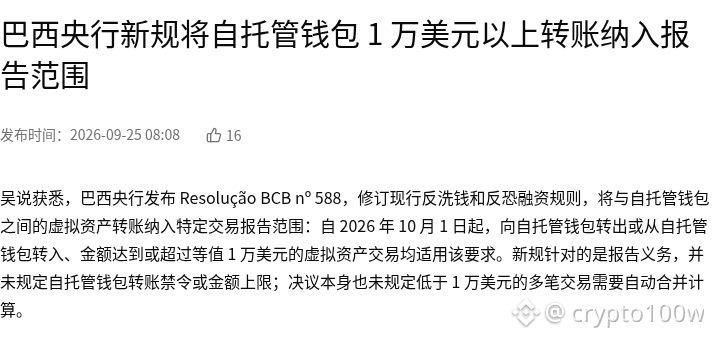
Wu Shuo has learned that the Central Bank of Brazil (Banco Central do Brasil) issued Resolução BCB nº 588, amending the existing rules on anti-money laundering and counter-terrorism financing: effective October 1, 2026, virtual-asset transactions that involve transfers out of or into self-custodied wallets with amounts equal to or exceeding the equivalent of USD 10,000 will fall within the scope of specific transaction reporting, and the relevant information will be submitted to the anti-money-laundering authority COAF.
This is not a transfer ban, and there is no amount cap; the resolution itself also does not specify that multiple transactions below USD 10,000 need to be automatically aggregated for calculation. For users, one point to note is that large inflows and outflows on-chain may become easier to trace. Another point is that the compliance costs for exchanges and local platforms—such as KYC, risk controls, and transfer review—may continue to rise.
Are you more concerned about how this affects self-custody privacy, or about its impact on compliance costs?
Figure 1: Brazil tightens self-custody wallet transfer reporting rules · Source page partial screenshot
Image source: https://www.wublock123.com/news/brazil-central-bank-reports-self-custody-wallets-over-10000-68978
Wu Shuo has learned that the Central Bank of Brazil (Banco Central do Brasil) issued Resolução BCB nº 588, amending the existing rules on anti-money laundering and counter-terrorism financing: effective October 1, 2026, virtual-asset transactions that involve transfers out of or into self-custodied wallets with amounts equal to or exceeding the equivalent of USD 10,000 will fall within the scope of specific transaction reporting, and the relevant information will be submitted to the anti-money-laundering authority COAF.
This is not a transfer ban, and there is no amount cap; the resolution itself also does not specify that multiple transactions below USD 10,000 need to be automatically aggregated for calculation. For users, one point to note is that large inflows and outflows on-chain may become easier to trace. Another point is that the compliance costs for exchanges and local platforms—such as KYC, risk controls, and transfer review—may continue to rise.
Are you more concerned about how this affects self-custody privacy, or about its impact on compliance costs?
Figure 1: Brazil tightens self-custody wallet transfer reporting rules · Source page partial screenshot
Image source: https://www.wublock123.com/news/brazil-central-bank-reports-self-custody-wallets-over-10000-68978