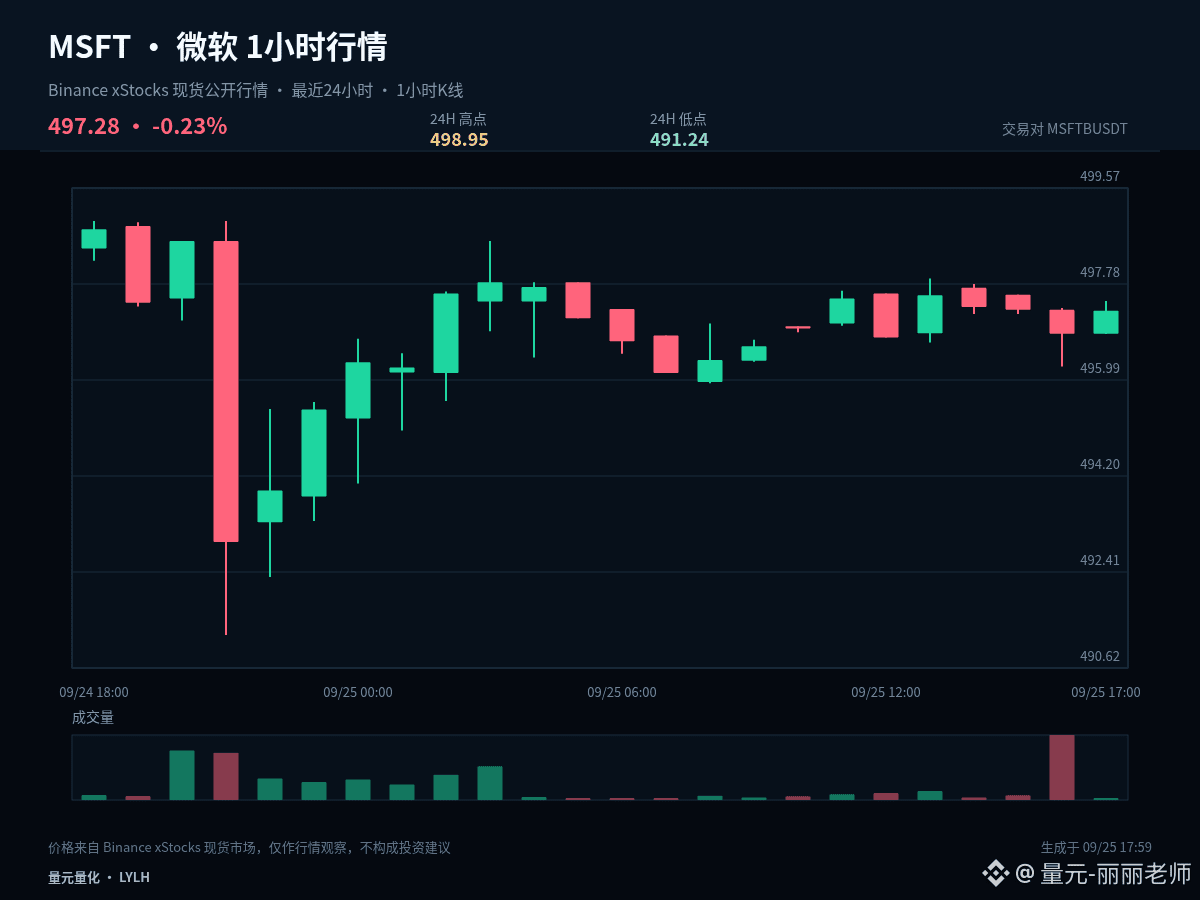
$MSFTB #MSFT Can this market action continue? It doesn’t depend on how much it has risen before; it depends on whether the trend can complete “push, consolidation, and then re-confirmation.” Current: 1 hour +0.09%, 24 hours -0.23%.
Current: 1 hour +0.09%, 24 hours -0.23%. These two timeframes have not formed sufficiently clear same-direction coordination. In a range-bound market, the tolerance for chasing or liquidating is relatively low. It’s more suitable to confirm the direction using the upper boundary, confirm support using the lower boundary, and treat the midline only as the divider between strength and weakness.
The first condition for the continuation structure is that 495.095 is not effectively broken down. The second condition is that the price can retest and hold above 498.95. If, after a push, price stays for a long time below the midline, it indicates that the active buying has weakened. If 491.24 is further lost, then the original continuation assumption needs to be cancelled.
Set clear execution conditions: after breaking above 498.95, you need confirmation—don’t chase just because you see a sudden spike. After dipping to 491.24, watch whether it can quickly reclaim—don’t jump in just because you see it falling. When the middle zone doesn’t offer sufficient upside potential, waiting itself is also part of the strategy.
Existing positions can be handled in stages based on key levels to avoid making all decisions at once. Those with no position should wait for confirmation of a breakout or for pullback and stabilization. For U.S. stock market instruments, pay attention to volatility caused by trading session transitions; the plan should be based on price conditions, not on emotion replacing execution.
Your trading plan must include invalidation conditions. If your judgment is correct, you can realize profits in segments. If your judgment is wrong, you must also be allowed to exit—you can’t use adding to conceal that the original logic has already changed. The market will update, and your viewpoint should adjust along with the price evidence.
#FedProposesRulesForBankIssuedStablecoins
Current: 1 hour +0.09%, 24 hours -0.23%. These two timeframes have not formed sufficiently clear same-direction coordination. In a range-bound market, the tolerance for chasing or liquidating is relatively low. It’s more suitable to confirm the direction using the upper boundary, confirm support using the lower boundary, and treat the midline only as the divider between strength and weakness.
The first condition for the continuation structure is that 495.095 is not effectively broken down. The second condition is that the price can retest and hold above 498.95. If, after a push, price stays for a long time below the midline, it indicates that the active buying has weakened. If 491.24 is further lost, then the original continuation assumption needs to be cancelled.
Set clear execution conditions: after breaking above 498.95, you need confirmation—don’t chase just because you see a sudden spike. After dipping to 491.24, watch whether it can quickly reclaim—don’t jump in just because you see it falling. When the middle zone doesn’t offer sufficient upside potential, waiting itself is also part of the strategy.
Existing positions can be handled in stages based on key levels to avoid making all decisions at once. Those with no position should wait for confirmation of a breakout or for pullback and stabilization. For U.S. stock market instruments, pay attention to volatility caused by trading session transitions; the plan should be based on price conditions, not on emotion replacing execution.
Your trading plan must include invalidation conditions. If your judgment is correct, you can realize profits in segments. If your judgment is wrong, you must also be allowed to exit—you can’t use adding to conceal that the original logic has already changed. The market will update, and your viewpoint should adjust along with the price evidence.
#FedProposesRulesForBankIssuedStablecoins