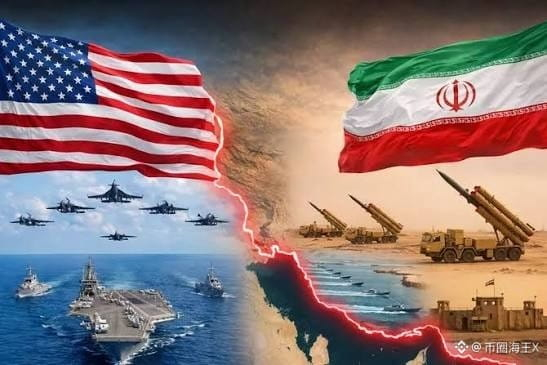
[Hormuz may restart in 7 days! BTC faces another key variable? 🔥]
💭 美伊战争动向进群聊
A new development has emerged in the Middle East situation.
Iranian Foreign Minister Hossein Amir-Abdollahian confirmed that Iran has submitted a “7-day plan” to the United States through intermediaries.
If the United States meets the relevant conditions, the Strait of Hormuz could reopen as quickly as within 7 days, while Iran and the U.S. resume negotiations to further discuss ending the conflict and the Iranian nuclear issue.
Why is this news so important for financial markets?
Because the Strait of Hormuz is a vital global energy transport route.
If it really reopens, market concerns about disruptions to oil supply may ease, and oil prices could face continued pressure.
And if oil prices fall, it triggers another important chain reaction:
Oil price ↓ → inflation pressure ↓ → pressure on the Fed to keep tightening ↓ → risk appetite improves → risk assets such as BTC gain support.
So the recent rebound in BTC shouldn’t be viewed only in terms of crypto-specific capital flows.
But here’s the question: Can the Strait of Hormuz truly reopen after 7 days?
At this point, it’s still too early to tell.
That’s because Iran’s proposal is a “conditional” plan, and the U.S. so far has only said that both sides are engaging in active and constructive communication through intermediaries—it has not confirmed acceptance of Iran’s plan.
📌 Therefore, what’s really worth watching next isn’t “it will definitely reopen in 7 days,” but three variables:
Whether there is substantive progress in U.S.-Iran negotiations, whether the Strait of Hormuz can restore normal navigation, and whether oil prices can continue to fall.
If all three variables improve at the same time, the macro environment for global risk assets may undergo a new shift.
#霍尔木兹海峡重开变数
💭 美伊战争动向进群聊
A new development has emerged in the Middle East situation.
Iranian Foreign Minister Hossein Amir-Abdollahian confirmed that Iran has submitted a “7-day plan” to the United States through intermediaries.
If the United States meets the relevant conditions, the Strait of Hormuz could reopen as quickly as within 7 days, while Iran and the U.S. resume negotiations to further discuss ending the conflict and the Iranian nuclear issue.
Why is this news so important for financial markets?
Because the Strait of Hormuz is a vital global energy transport route.
If it really reopens, market concerns about disruptions to oil supply may ease, and oil prices could face continued pressure.
And if oil prices fall, it triggers another important chain reaction:
Oil price ↓ → inflation pressure ↓ → pressure on the Fed to keep tightening ↓ → risk appetite improves → risk assets such as BTC gain support.
So the recent rebound in BTC shouldn’t be viewed only in terms of crypto-specific capital flows.
But here’s the question: Can the Strait of Hormuz truly reopen after 7 days?
At this point, it’s still too early to tell.
That’s because Iran’s proposal is a “conditional” plan, and the U.S. so far has only said that both sides are engaging in active and constructive communication through intermediaries—it has not confirmed acceptance of Iran’s plan.
📌 Therefore, what’s really worth watching next isn’t “it will definitely reopen in 7 days,” but three variables:
Whether there is substantive progress in U.S.-Iran negotiations, whether the Strait of Hormuz can restore normal navigation, and whether oil prices can continue to fall.
If all three variables improve at the same time, the macro environment for global risk assets may undergo a new shift.
#霍尔木兹海峡重开变数