

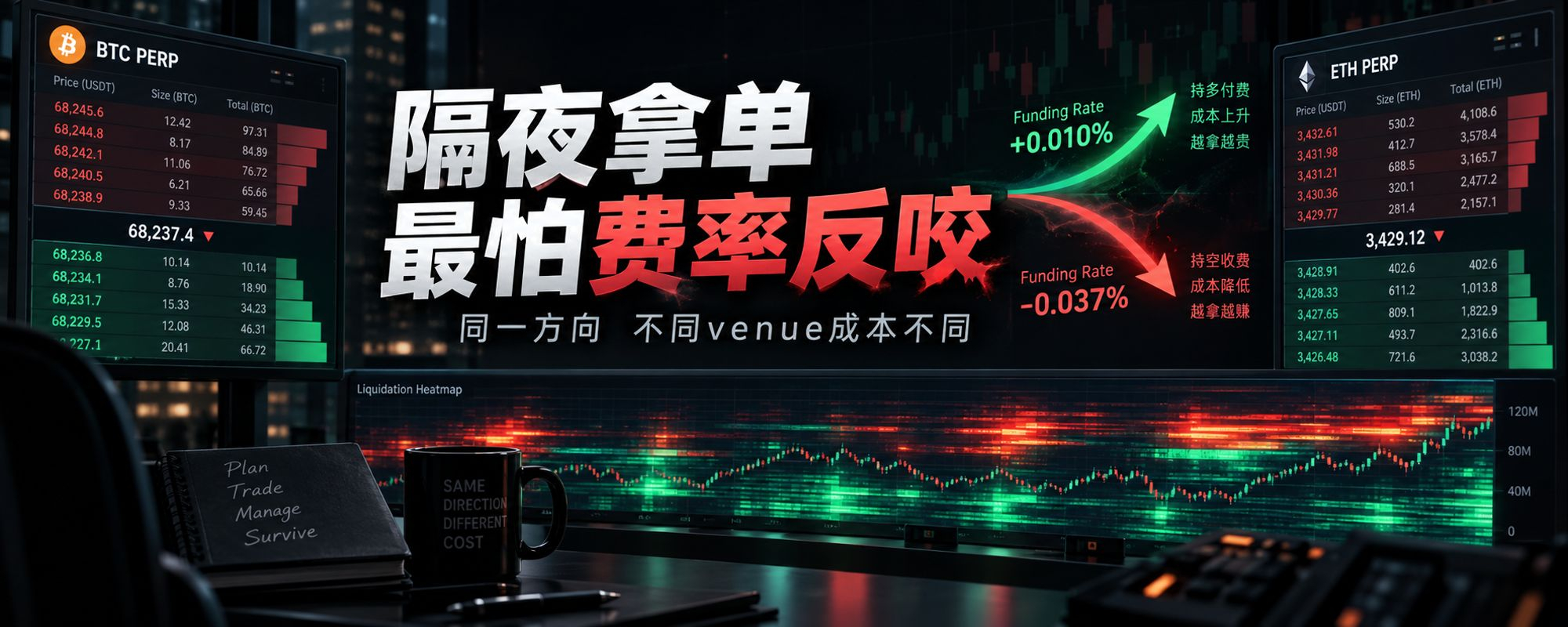

People who dared to hold their orders through the night should check the funding rate first today.
BTC is grinding back and forth around $84,000, and ETH hasn’t given a particularly decisive direction either. At times like this, many futures traders naturally think: since the big trend hasn’t turned bad, just take a light position for the night and wait for the next big bullish candle.
The issue is that the overnight futures order is most easily underestimated—not in direction, but in the cost of holding positions.
Same strategy: going long BTC, using the same 3x or 5x leverage, intending to hold until tomorrow morning. But the bill you receive can be completely different depending on the venue. Some places have deeper order books and smaller opening slippage; some places have fees that look low, but the funding rate is pushing against long positions; some places have a mark price that is easier to jerk apart in an instant, causing stop-loss triggers earlier than you imagine; and some places have very hot trading volume in the short term, but the depth that can truly close a larger position is uncomfortable.
That’s why I’m growing increasingly less fond of the one-liner: “Is now the right time to go long?”
The more real question should be:
How long do you plan to hold this long order?
If you hold it for 8 hours, how many times will you pay the funding rate?
If the market first pokes you with a quick spike and then comes back, which venue’s mark price and stop-loss rules are more likely to sweep you out?
If you’re not trading a small $500 position, but a $10,000 or $50,000 notional position, how much depth will market open/close orders consume at each step?
When many people review their losses, they only say: “The direction was right, but I got wicked out.” That sounds like bad luck, but usually there’s a whole chain of execution issues hidden inside: the entry location wasn’t suitable, you didn’t check the funding rate, you didn’t estimate slippage, you didn’t compare how the stop-loss trigger rules worked, and when closing, the order book suddenly thinned out.
Especially in a market like this right now—prices aren’t running in one direction nonstop—perps traders actually end up switching their opinions more frequently. Long in the morning, cut at noon, then think you can buy it back in the afternoon. Every click is an extra little cost piling on top. Fees, spreads, slippage, funding rates, trigger rules—individually they don’t sound scary, but spread across high-frequency churn over a whole day, they slowly grind away your profits.
To be a bit anti-consensus: in futures trading, “sticking with one entry” isn’t necessarily a good habit.
Spot users will compare paths before a Swap—see which route outputs more and has lower slippage. Perps should be handled the same way. You shouldn’t first decide where to open and then reluctantly accept that venue’s conditions; you should first choose the asset and direction, then compare each venue’s depth, fees, funding rates, mark price, and risk-control rules, and only then decide which route this trade should take.
If you just casually open the most familiar entry and do nothing else, it’s basically handing the variable of “execution conditions” over to habit.
And in Perp trading, sometimes habit is more expensive than direction.
I understand the value of Perp aggregators like PerpEX, and it’s becoming clear here: it’s not trying to tell you whether BTC will go up tomorrow—it fills in the comparison layer before you open the trade. First choose the asset, then look at the trading conditions each venue currently offers, and only then decide where to execute this order.
Direction is the trader’s own judgment.
But execution costs—best not to rely on gut feeling anymore.
#BTC #futures trading