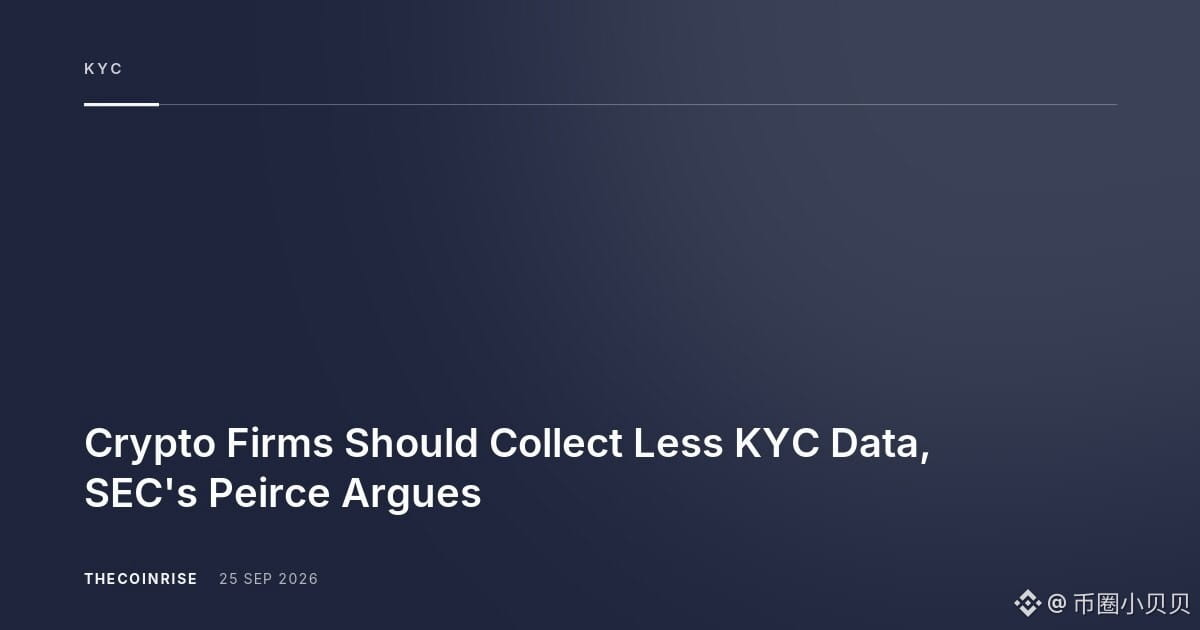
A regulatory commissioner about to depart left with a remark that conveniently points in the opposite direction to the last decade.. Her meaning was probably this: in the future, don’t collect so many identity materials.
🔄 进群看机构动作
Most people see it as “another official has offered a personal opinion,” with no rules being implemented, so they can glance at it and move on.. But what may be truly worth attention is that she broke two things apart—“identity verification” and “collecting information,” which were never the same thing.
What people do now is: if an institution needs to confirm you’re eligible, it has to keep your documents, address, and income.. To prove one fact, you shouldn’t have to hand over your entire draft—if they only need to know that “you’re over 18,” why must they also know your name and your address.
The tool she mentioned is zero-knowledge proofs. It sounds technical, but when you break it down, it’s actually straightforward: show the conclusion, don’t hand over the drafts.. Once this path works, identity verification shifts from “filing a closet full of photocopies” to “storing a proof”—data moves from being assets to becoming liabilities: the more you collect, the more you lose if you have a single leak. In the incidents these years, the things taken were never just money.
What’s even more interesting is the part it eliminates.. In the traditional process, every institution has to ask the same questions again, because nobody dares to simply trust the verification results from the upstream party.. If a proof can be reused, then what gets re-priced won’t be identity itself, but the verification step that can be shared.
From the perspective of capital rotation, this is a bit different.. Usually everyone watches returns and narratives, but what determines whether money can even get in the door is the identity process. Whoever can make compliance verification both cheaper and safer will collect tolls right at the entrance—roles like identity verification, custody, and auditing tools are often picked by capital first.
The bigger storyline is that privacy and compliance, which used to be treated as either-or, are now being layered together by someone: it’s not that they won’t collect, but they collect less and verify more precisely.. This is also where compliance begins shifting from being manpower-intensive to being cryptography-intensive.
But here’s the problem.. This is a personal opinion, not a rule, and none of the current requirements have changed—so there won’t be much market reaction in the short term.. What’s really worth watching isn’t what she said, but whether the first wave of institutions is willing to plug this into real business. Once they do, the “form” that’s acceptable will land before the rules do. And if, after a year, it’s still stuck in speeches, then the bottleneck won’t be technology—it’ll be responsibility: if something goes wrong, who signs.
Kind of interesting..
🔄 进群看机构动作
Most people see it as “another official has offered a personal opinion,” with no rules being implemented, so they can glance at it and move on.. But what may be truly worth attention is that she broke two things apart—“identity verification” and “collecting information,” which were never the same thing.
What people do now is: if an institution needs to confirm you’re eligible, it has to keep your documents, address, and income.. To prove one fact, you shouldn’t have to hand over your entire draft—if they only need to know that “you’re over 18,” why must they also know your name and your address.
The tool she mentioned is zero-knowledge proofs. It sounds technical, but when you break it down, it’s actually straightforward: show the conclusion, don’t hand over the drafts.. Once this path works, identity verification shifts from “filing a closet full of photocopies” to “storing a proof”—data moves from being assets to becoming liabilities: the more you collect, the more you lose if you have a single leak. In the incidents these years, the things taken were never just money.
What’s even more interesting is the part it eliminates.. In the traditional process, every institution has to ask the same questions again, because nobody dares to simply trust the verification results from the upstream party.. If a proof can be reused, then what gets re-priced won’t be identity itself, but the verification step that can be shared.
From the perspective of capital rotation, this is a bit different.. Usually everyone watches returns and narratives, but what determines whether money can even get in the door is the identity process. Whoever can make compliance verification both cheaper and safer will collect tolls right at the entrance—roles like identity verification, custody, and auditing tools are often picked by capital first.
The bigger storyline is that privacy and compliance, which used to be treated as either-or, are now being layered together by someone: it’s not that they won’t collect, but they collect less and verify more precisely.. This is also where compliance begins shifting from being manpower-intensive to being cryptography-intensive.
But here’s the problem.. This is a personal opinion, not a rule, and none of the current requirements have changed—so there won’t be much market reaction in the short term.. What’s really worth watching isn’t what she said, but whether the first wave of institutions is willing to plug this into real business. Once they do, the “form” that’s acceptable will land before the rules do. And if, after a year, it’s still stuck in speeches, then the bottleneck won’t be technology—it’ll be responsibility: if something goes wrong, who signs.
Kind of interesting..