

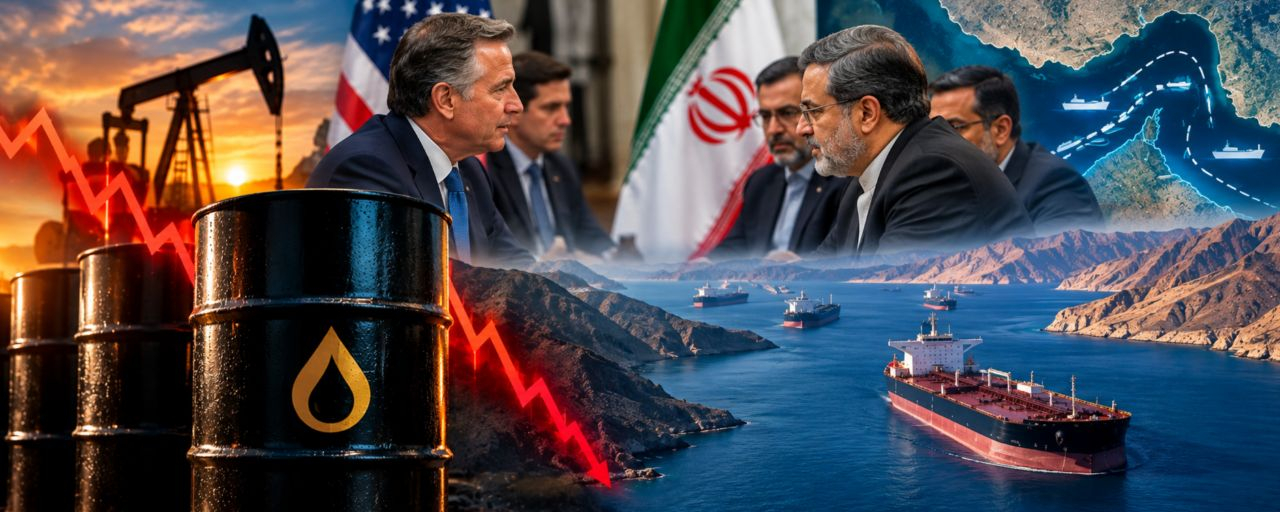

Crude prices pulled back from their session highs after word that American and Iranian negotiators, meeting in New York, are testing a phased arrangement that would have Tehran reopening the Strait of Hormuz in exchange for Washington lifting its economic blockade of Iran. Thursday brought a fresh push for a breakthrough, timed to the sidelines of the United Nations General Assembly.
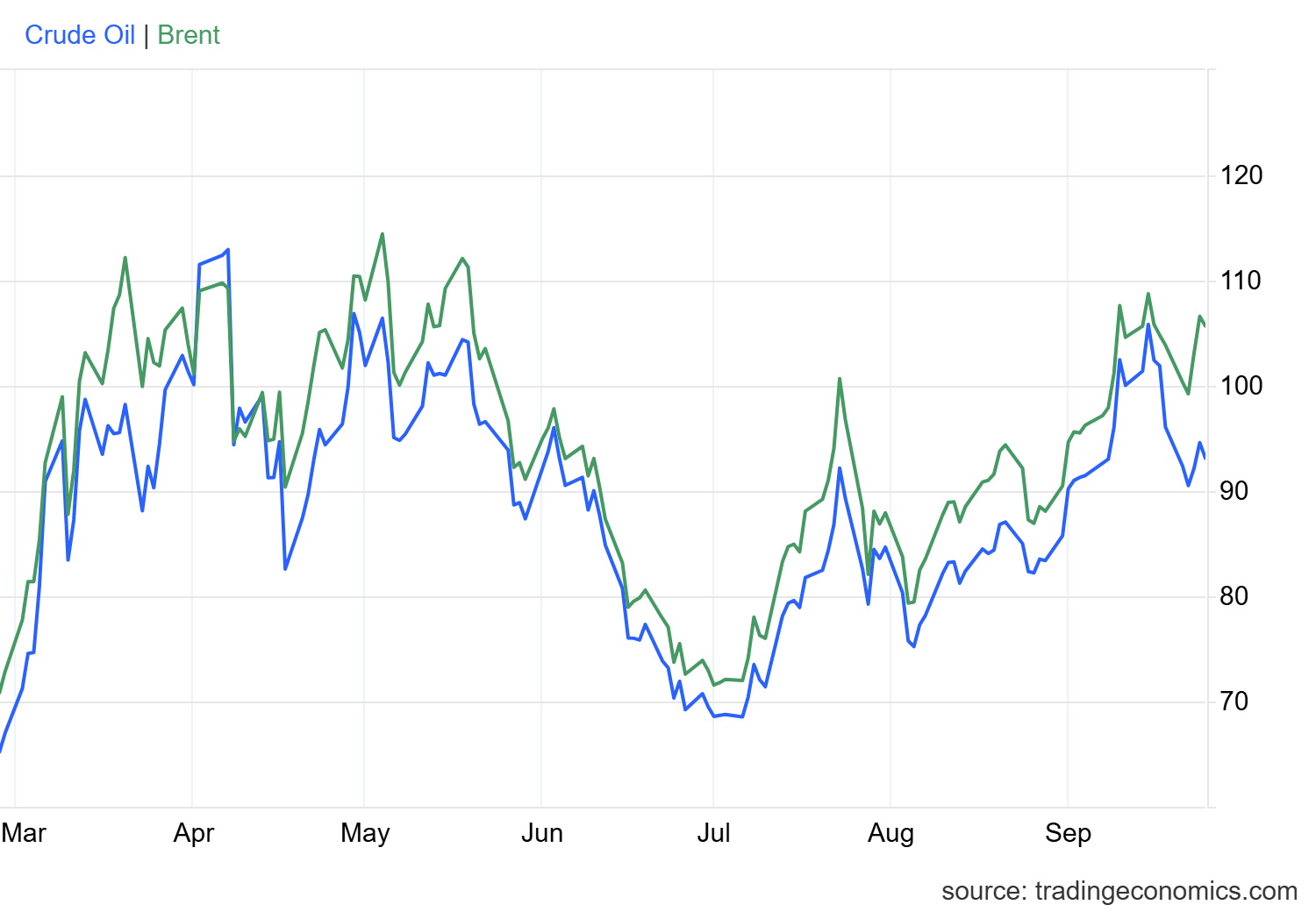
Oil still held on to some of its gains. Brent settled Thursday up 2.5% at $105.69 a barrel, and West Texas Intermediate closed 2.3% higher at $94.30. Neither move held through the next session. In late Asian trading Friday, WTI has given back 1.62% to trade around $93.08, while Brent has slipped 0.91% to $105.63, traders apparently unwilling to fully price in a deal both sides still describe as fragile.
Whether the fighting ends this year, in Tehran's telling, isn't Iran's decision to make. Iranian President Masoud Pezeshkian, in an interview with Fox News, said Tehran remains bound to the framework it signed with Washington earlier this year and is "still ready to move forward" on those terms. He rejected the idea that Iran had closed the Strait of Hormuz, insisting the waterway had stayed open throughout. He acknowledged his country was absorbing real economic pain, but said it would hold out regardless.
That defiance took on a sharper edge from Yahya Rahim Safavi, a senior military adviser to Iran's Supreme Leader, Mojtaba Khamenei. In remarks carried by the semi-official Fars news agency, Safavi warned that any fresh American or Israeli strikes on Iranian targets could widen the war considerably.
The fighting has already moved from the Persian Gulf and the Strait of Hormuz to the Red Sea and the Bab el-Mandeb Strait, he said, warning a renewed attack could push it "as far as the Indian Ocean, or perhaps even further."
Fires Along the Red Sea
Iran's allies in Yemen aren't waiting to find out whether that threat holds up. The Saudi-led coalition backing Yemen's government said Thursday it intercepted six ballistic missiles the Houthis fired toward the city of Taif and the Red Sea port of Yanbu, according to coalition spokesman Maj. Gen. Turki al-Malki. Hours later, the Houthis said they had hit what they called a sensitive target in Riyadh and an Aramco facility in Yanbu with a combination of missiles and drones.
A separate skirmish played out over the same stretch of coastline. Reuters reported that an air-defense unit staffed by Greek military personnel, deployed in Saudi Arabia, shot down a ballistic missile and a drone over the wider Yanbu region Thursday. A Greek security source said the battery's Patriot system fired two interceptors to bring both down, though the source did not say where either projectile had launched from.
Yanbu carries outsized importance because it is Saudi Arabia's main workaround whenever the Strait of Hormuz is disrupted, which lately has been often. The Houthis have generally concentrated their fire on southern Saudi Arabia since declaring a naval blockade in July, a move that opened a second front in the broader U.S.-Iran war.
Roughly two weeks ago, the group seized the whole of Yemen's Red Sea coastline in a rapid offensive that brought its fighters to the shores of Bab al-Mandeb. In the process, they knocked out a pipeline that had been diverting crude to Red Sea ports as an alternative to the Strait.
Aramco Hedges Its Bets
Repairs are moving faster than the headlines suggest. Aramco expects to restore the disrupted pipeline operations within days, President and CEO Amin Nasser said, and the company isn't stopping there. It is actively studying "a fourth and a fifth route" for its crude beyond the three it currently relies on, he told Nikkei Asia in an interview conducted in Tokyo.
Nasser said Aramco is also looking at expanding overseas storage capacity, including in Japan, as a buffer against future disruptions. He described the company's operations as built with enough flexibility to keep serving customers regardless. He also pushed back on the common assumption that Aramco has only two ways to market once its East-West pipeline is included, through the Strait of Hormuz or through the Bab el-Mandeb Strait. In fact, he said, there is a third option already in use: the 320-kilometer Sumed pipeline that Egypt operates to carry crude from the Red Sea to the Mediterranean.
Movement in The Strait
Qatar has increased the number of liquefied natural gas tankers passing through the Strait of Hormuz to its highest level in over two months, indicating that it is starting to feel more at ease navigating the waterway, according to ship-tracking data collated by Bloomberg. At least two loaded carriers have been pushed out via the tight strait in the past week, while at least two have proceeded in the opposite way to enter the Persian Gulf. One of the cargoes is en route to the west coast of India.
A Lonely Podium in New York
The diplomacy in New York had one more complication this week, and it had nothing to do with Tehran. Israeli Prime Minister Benjamin Netanyahu's address to the United Nations laid his isolation bare, delivered weeks before an election that caps nearly three years of war for his government. His relationship with Trump has cooled as well, closing off what Netanyahu and his allies had once hoped would be a boost from the American president on the campaign trail. Not the outcome anyone in his circle had banked on, with an election just weeks away.