The sky of the financial world really caved in yesterday!
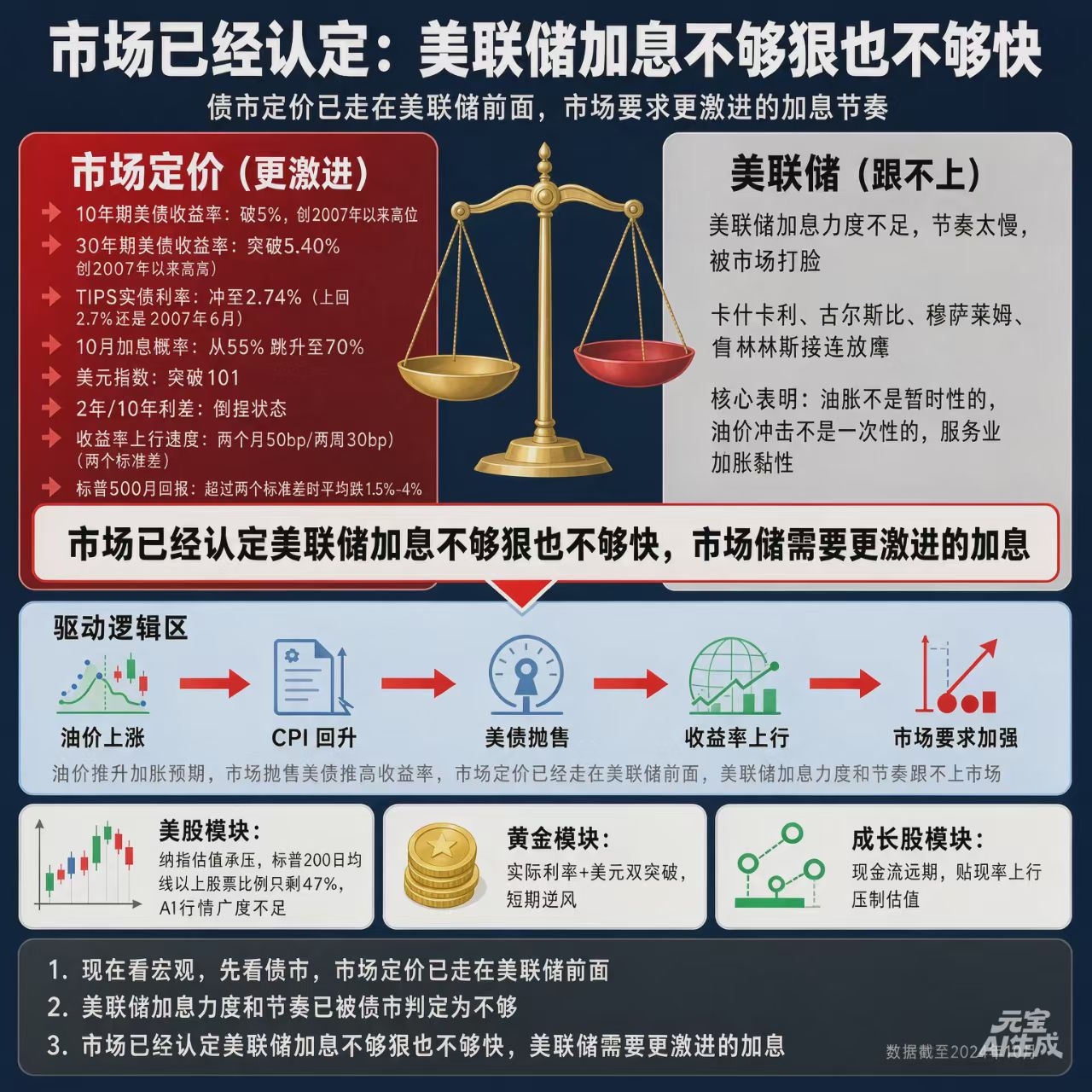
For U.S. Treasuries across most maturities, yields have all crossed the 5% psychological threshold.
5% doesn’t just mean “a bit expensive”—it’s the VaR shock plus an institutional risk-model stop-loss line, triggered at any moment. The model automatically cuts exposure, and stocks, bonds, gold, and crypto all get hit together as valuations are slashed.
What’s even more alarming is the speed.
The 10-year yield has been creeping up, and traders can still hold on; but a 50bp move over two months and a 30bp move over two weeks—that’s a two-standard-deviation kind of surge. The market will instantly reprice risk: is my position too big? is leverage too high? Should I exit first?
So it’s not as simple as “good PMI → selling long Treasuries” yesterday.
PMI is just a catalyst, not the root cause.
What truly triggers a market collapse-style repricing is this whole chain happening at the same time:
- 10-year U.S. Treasuries break above 5%
- TIPS real yields surge to 2.74% (the last time it topped 2.7% was June 2007)
- The dollar breaks above 101
- The short end is more vicious than the long end; the 2s10s yield spread keeps narrowing, indicating the market is pricing in “inflation hasn’t died and hikes are still coming”
- The probability of a rate hike in October jumps from 55% to 70%
The bond market has already cast its vote for the Fed.
Kashkari, Goolsbee, Moussalem, and Collins turn hawkish one after another:
Oil price shocks are not a one-off; inflation doesn’t stop at energy—it's the stickiness of services inflation that’s the real problem.
We used to be able to get away with calling it “transitory,” but this wordplay doesn’t work anymore.
Goldman has compared the S&P 500’s monthly returns against 10-year yields:
- Yields rise moderately → the stock market can usually still go up
- Yields jump by more than two standard deviations in a single month (as is happening now) → S&P 500 averages fall 1.5%–4%
- The Nasdaq, AI, software, and long-duration growth stocks are the worst hit, because cash flows are far in the future—once the discount rate jumps, the valuation anchor loosens immediately.
Now, the percentage of stocks in the S&P 500 above the 200-day moving average is down to just 47%.
50% is the watershed. If the AI rally doesn’t broaden, it’ll just be a few mega-caps propping up the index, while everything underneath is already unraveling.
Gold didn’t escape either.
When real yields break higher + the dollar breaks higher + energy prices rise + services inflation rises + election noise, inflation expectations get pinned at high levels.
As for G2 negotiations? That’s a gamble with big and small—nobody knows what cards are under the table.
So stop comforting yourself by only watching the U.S. stock market’s intraday moves.
Even if you never buy U.S. Treasuries in your lifetime,
Now, the very first thing each day should be to check what the bond market is saying.
The bond market has one message:
The Fed is behind the curve, and the market no longer waits for it.
Next isn’t a question of “whether to hike,”
It’s a matter of how much cost you pay if you’re late.
#Nasdaq #Gold #US Dollar #Inflation #Federal Reserve #US Treasuries #PMI #Interest Rate Futures