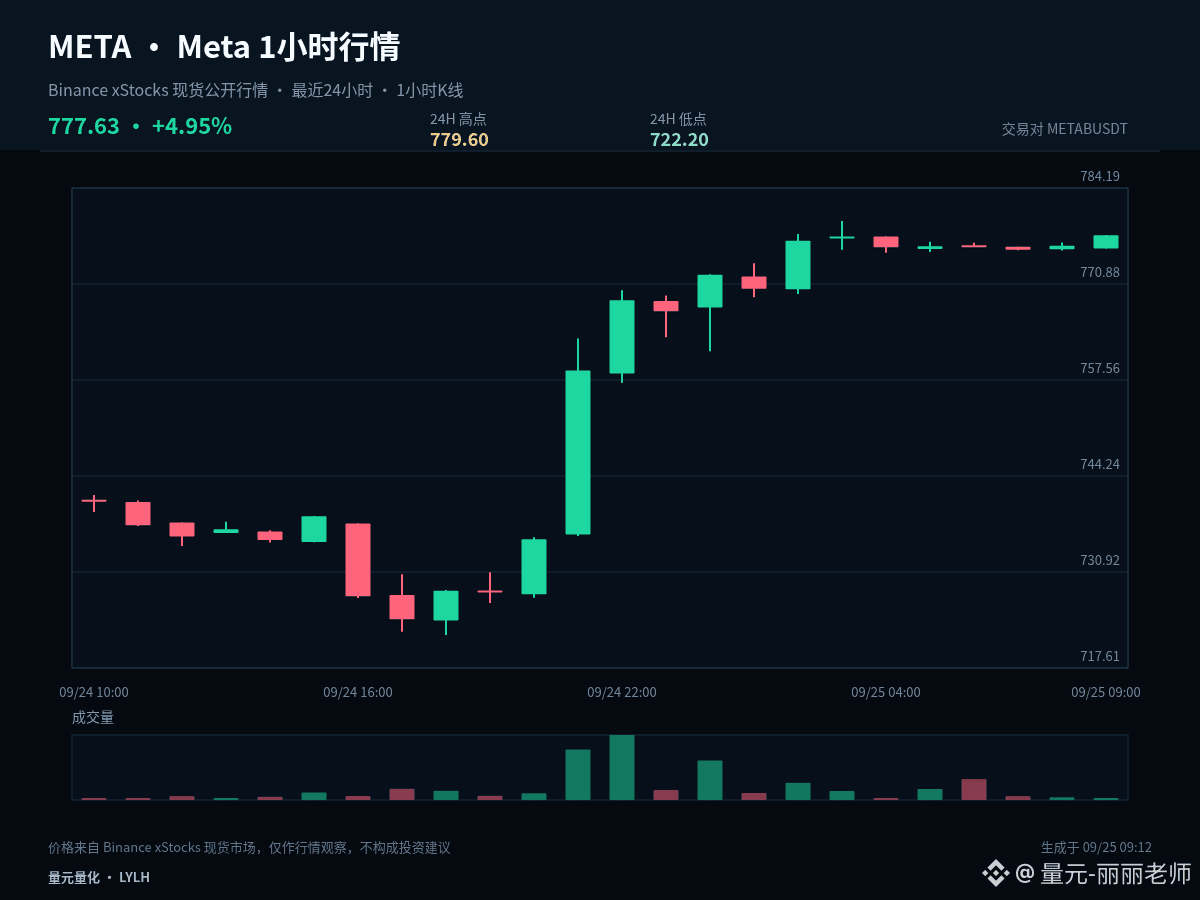
$METAB #META It’s currently more suitable to first do a rebound confirmation rather than defining a reversal in advance. The current price is 777.63, with a +0.19% move in the last 1 hour and a +4.82% move in the last 24 hours. Whether the two timeframes resume moving in the same direction is the key focus going forward.
The current price is close to the upper band of the last 24-hour range: +0.19% in 1 hour and +4.82% in 24 hours. The most important part of the high is to confirm the market’s acceptance after a breakout. If the price can stay above the upper band, it indicates that the market recognizes a higher range. If it only briefly pierces the upper band and then quickly recedes, you need to be wary of a false breakout.
If the rebound can reclaim 750.9 and then further hold above 779.6, it would suggest that buyers are starting to change the prior weakness. However, if it drops again after touching the midline—especially if it falls back toward 722.2—this looks more like a failed repair, and you shouldn’t continue relying on a bullish-strength expectation.
Confirming that the rebound has failed also requires evidence. Don’t simply chase a short position just because there was a run-up followed by a pullback. A more reasonable sequence is to observe whether resistance levels are rejected, whether the lows start moving downward again, and then decide what action to take based on whether subsequent rebounds reclaim key levels.
Position management should differentiate between swing (mid-term) and short-term trades. For existing swing positions, first check whether the structure has been broken—you don’t need to be repeatedly influenced by a single 1-hour candlestick. Short-term positions should be executed around support, resistance, and confirmation at the close. Traders with no position should not chase price in the middle of a range; waiting for clearer locations is usually more advantageous.
For short-term positions, the key is not to predict every candlestick, but to ensure there’s a basis for entry, scaling out, and exiting. If there’s no confirmation, do less. If a key level fails, redo the plan—control risk for each trade first, then discuss potential upside or downside from there.
#US10YTreasuryYieldHits19YearHigh
The current price is close to the upper band of the last 24-hour range: +0.19% in 1 hour and +4.82% in 24 hours. The most important part of the high is to confirm the market’s acceptance after a breakout. If the price can stay above the upper band, it indicates that the market recognizes a higher range. If it only briefly pierces the upper band and then quickly recedes, you need to be wary of a false breakout.
If the rebound can reclaim 750.9 and then further hold above 779.6, it would suggest that buyers are starting to change the prior weakness. However, if it drops again after touching the midline—especially if it falls back toward 722.2—this looks more like a failed repair, and you shouldn’t continue relying on a bullish-strength expectation.
Confirming that the rebound has failed also requires evidence. Don’t simply chase a short position just because there was a run-up followed by a pullback. A more reasonable sequence is to observe whether resistance levels are rejected, whether the lows start moving downward again, and then decide what action to take based on whether subsequent rebounds reclaim key levels.
Position management should differentiate between swing (mid-term) and short-term trades. For existing swing positions, first check whether the structure has been broken—you don’t need to be repeatedly influenced by a single 1-hour candlestick. Short-term positions should be executed around support, resistance, and confirmation at the close. Traders with no position should not chase price in the middle of a range; waiting for clearer locations is usually more advantageous.
For short-term positions, the key is not to predict every candlestick, but to ensure there’s a basis for entry, scaling out, and exiting. If there’s no confirmation, do less. If a key level fails, redo the plan—control risk for each trade first, then discuss potential upside or downside from there.
#US10YTreasuryYieldHits19YearHigh