

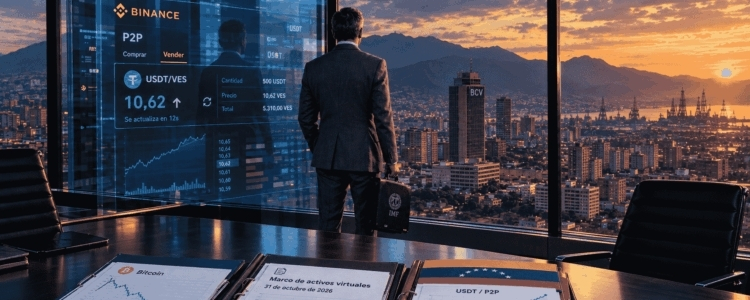

The IMF arrives in Caracas in the face of a decentralized market that moves billions of dollars beyond its auditable reach.
The IMF cannot license the trading of USDT on Binance P2P’s P2P marketplace; it must operate differently from what it has already done in Bolivia with the stablecoin and in El Salvador with bitcoin.
PDVSA and citizens use USDT as a transactional lifeline against sanctions and inflation.
Unlike Bolivia or El Salvador, in Venezuela there is no central intermediary that licenses.
The International Monetary Fund will land in Caracas to address a scenario unprecedented in its textbooks as it takes over supervision of a parallel market that operates outside traditional banking and moves billions of dollars beyond its auditable reach.
After the financial sanctions imposed by the United States, the state oil company PDVSA used Tether’s stablecoin USDT to collect its exports in the international market.
If the IMF confirms that this mechanism is still active, it will face an unprecedented paradox: the Venezuelan state would be both the authority that must regulate the economy and the dominant actor that moves funds outside traditional banking.
This scenario would create a dead end because the agency could not ask the state oil company to stop settling in stablecoins without offering an international banking alternative in return. Nor can the IMF license a peer-to-peer (P2P) market as if it were a centralized platform, nor audit wallets beyond its technical reach.
Although Tether froze USD 182 million in addresses linked to Venezuela in January 2026—after blocking 41 wallets associated with sanctions evasion in 2024—the power to freeze does not belong to the IMF; it is exercised by the stablecoin issuer under Washington’s regulatory pressure.
The IMF and Tether’s official response
If the IMF intends to audit the use of USDT in Venezuela, there is an actor that has already demonstrated the ability to intervene in that infrastructure: Tether, the issuer of the stablecoin. And it has exercised that power.
CoinDesk reported on January 12, 2026 that Tether froze more than USD 182 million in USDT in five wallets on the Tron network, in a coordinated action. The report did not explicitly link the freeze to Venezuela; it only attributed it to the OFAC sanctions framework of the U.S. Department of the Treasury.
Other media and network observers made that connection as well. They pointed out that «there are suspicions that these assets may belong to the Venezuelan government.»
However, Tether denies those links. In response to CriptoNoticias, a spokesperson stated:
Tether voluntarily complies with U.S. sanctions laws and regulations, including those applicable to the Venezuelan government. Claims that Tether froze USD 182 million in USDT in January 2026 in connection with Venezuela are inaccurate. The figure significantly overstates both the total amount of Tether freezes during that period and the amount frozen in relation to OFAC sanctions linked to Venezuela. Claims that these freezes date back to 2024 are also incorrect. The first Tether freeze related to Venezuela occurred in November 2025. Tether does not disclose specific freeze amounts or account-level details.
Tether.
The company did not specify the exact amount of the freezes or confirm whether it currently keeps funds blocked. It also did not respond to additional questions about its relationship with PDVSA.
On the other hand, in response to direct questions about its interactions with the Venezuelan government and the use of stablecoins, the IMF replied to CriptoNoticias:
At this stage, we are not in a position to comment in detail on our relationship with Venezuela or to discuss the substance of ongoing interactions.
Fernando Puchol, Senior Communications Officer at the IMF.
Despite declining to comment specifically on Caracas, the Fund’s spokesperson made clear its global position on cryptoassets such as USDT. In this regard, it stated the following:
The IMF acknowledges that stablecoins can make international payments faster and cheaper.
The agency warns that stablecoins can be used to bypass capital controls or evade international sanctions.
The IMF adds that demand for these assets grows in economies with volatile local currencies, which amounts to monetary substitution that erodes sovereignty and reduces the room for economic policy.
The institution concluded that a comprehensive regulatory framework is needed to address the macroeconomic risks of these digital assets.
What the dollar price in Caracas reveals
To assess day-to-day currency dynamics, CriptoNoticias verified the exchange rate of the dollar and the stablecoins USDT during the day of September 23, 2026.
The data obtained were as follows:
Reference Approximate value Gap vs Official
BCV Official Rate 853.49 VES / USD Base (0.00%)
Binance P2P (USDT) 970.53 VES / USDT +13.71%
The 13.71% spread confirms that USDT in the P2P market trades comfortably above the official benchmark, operating as one of the dominant transactional references in daily economic activity.
The functional hypothesis of an undocumented convergence
This section presents a functional hypothesis and not a documented coordination. There is no public file that proves fiscal formalization with USDT as an IMF requirement for Venezuela.
However, the analysis addresses a coincidence of institutional goals because we observe that behind this exchange-rate behavior there is a cross-section of interests.
At Jackson Hole on August 28, 2026, the IMF director, Kristalina Georgieva, linked the surge in stablecoins to tax evasion and emphasized the urgency of expanding the tax base and reducing primary deficits.
Just seven weeks earlier, Román Maniglia took over as executive director of the National Integrated Service of Tax Administration (SENIAT). A specialist in financial technologies and cryptocurrencies, Maniglia has acted as a key operator in bringing public administration closer to digital finance.
For its part, the roadmap outlined by the IMF after the resumption of formal contacts in April 2026 sets as a priority auxiliary goal for helping Venezuela restart the supply of the economic data required under the IMF Articles of Agreement.
So that the Fund needs metrics, SENIAT requires revenue collection, and both demand traceability. And along those same lines, Richard Ujueta, president of the Venezuelan Chamber of E-Commerce (Cavecom-e), stated at the Crypto Global Summit 2026 that e-commerce mobilized USD 51 billion through mobile payments during 2025. His thesis is that giving formality and traceability to this flow would triple tax revenue without needing to create new taxes.
The convergence is clear because USDT traceability meets the needs of both entities.
The real weight of P2P with USDT versus GDP
While the BCV issues an official rate, an informal circuit coexists—one that the state oil company itself has used. While SENIAT can require businesses to declare their income in USDT, PDVSA cannot make its financial statements transparent without exposing its architecture to sanctions.
At street level, metrics from reports such as TRM Labs’ for the first quarter of 2026 show the market’s predominance.
USDT: It accounted for 90.2% of active listings on Binance P2P in bolívares (2,313 out of 2,565 posts).
USDC: Recorded 3.7%.
Retail volume: Reached USD 17.9 billion attributable to Venezuelan users.
Global adoption: Venezuela rose from 22nd to 17th place in the global digital asset adoption index.
If the daily flow on Binance P2P keeps the USD 44 million average reported by Ecoanalítica, the annualized mass comes close to USD 16.06 billion. Compared with the projected GDP of USD 36 billion according to Deciphered in May 2026, the proportion is equivalent to 44.6% of GDP.
The estimate of 44.6% comes from cross-referencing two public sources:
Annualized P2P Volume: Ecoanalítica recorded a daily average of USD 44 million on Binance P2P between June 11 and July 13, 2026. Projected to 365 days:
USD 44,000,000×365=USD 16,060,000,000 per year
GDP Projection: estimated USD 36 billion for the end of 2026 (Deciphered, May 2026).
Proportional Relationship:
(USD 16,060,000,000 / USD 36,000,000,000) × 100 = 44.6%
The result represents an approximation that assumes transactional and macroeconomic stability during the fiscal year. It does not account for operations outside Binance P2P nor movements on platforms with formal licenses.
This means that almost half of Venezuela’s economic activity—expressed in stablecoin transactions between individuals—takes place outside the records and protocols that the IMF is able to audit.
To gauge the Venezuelan dilemma, it suffices to compare how the IMF has approached the adoption of digital assets in other countries in the region:
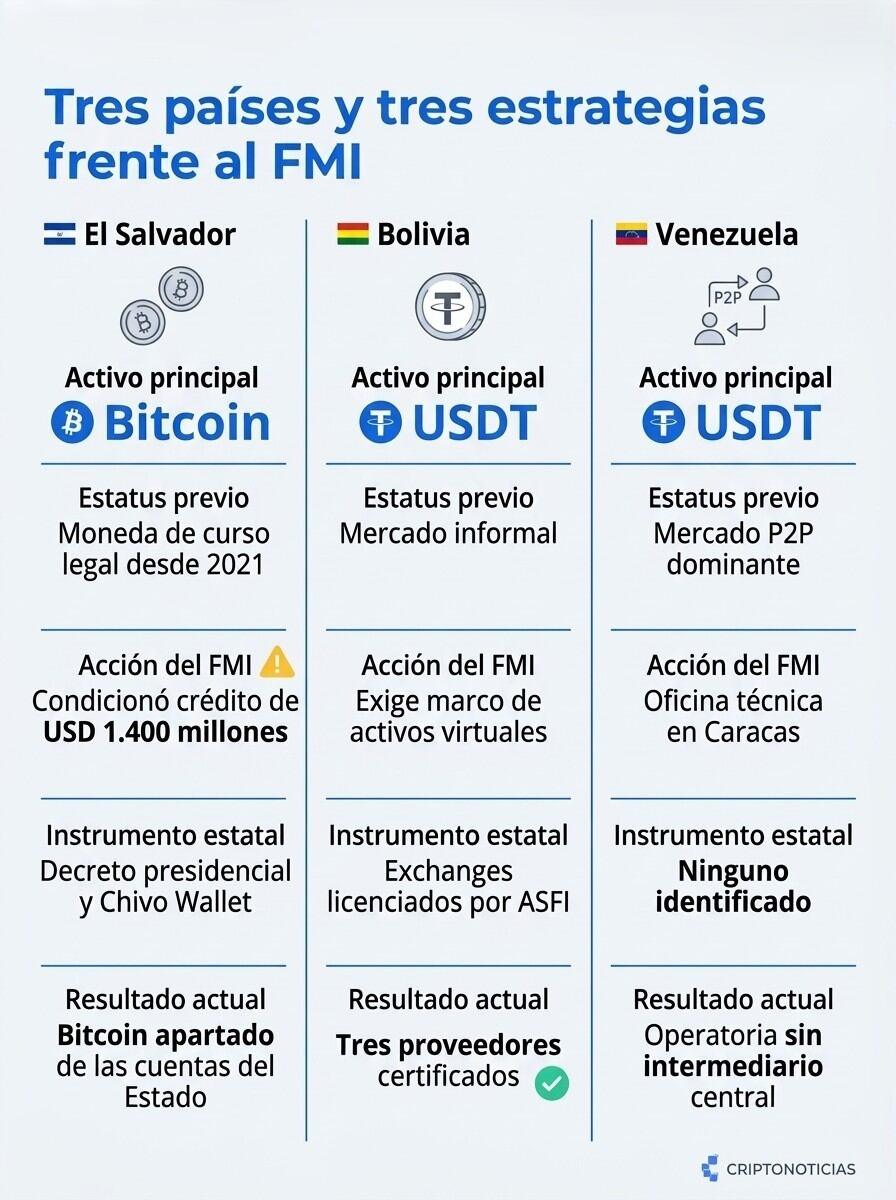
The IMF does not have a single doctrine for cryptoassets; it adapts it according to the infrastructure it faces. In El Salvador, it dismantled bitcoin from the state; in Bolivia, it licenses exchanges to integrate USDT into the payment system; in Venezuela, it will not find a central intermediary to demand KYC from.
Regulatory compliance with no obligated party in Venezuela
Regulatory compliance (compliance) requires a centralized intermediary to apply identity verification procedures (KYC). In Venezuela, that party lacks operational capability.
Binance P2P: operates outside Venezuela’s jurisdictional framework.
Kontigo has Sunacrip approval through January 8, 2027, while Crixto’s license is currently valid only through December 31, 2026. Both are the fully authorized platforms to operate legally in Venezuela; however, a significant portion of large transaction volumes (especially in stablecoins) continues to circulate through informal channels and unlicensed platforms.
Tether retains the ability to freeze funds, but it follows directives from U.S. regulators, not the IMF’s instructions.
The structural dilemma that the International Monetary Fund has not resolved is precisely the fate of this transaction infrastructure. This is because it cannot subject a decentralized P2P market to licensing, it cannot audit wallets whose access it does not have, and it cannot urge PDVSA to give up settlement in USDT without providing a path to international banking that is immune to sanctions.
Verifiable indicators for the third quarter of 2026
During October 2026, the firms Chainalysis and TRM Labs will publish their corresponding metric reports for the third quarter of the year (Q3 2026), which will make it possible to test the thesis of this dilemma.
Scenario Threshold Evaluated Market Interpretation
Thesis confirmed Retail volume exceeds USD 20 billion and USDT retains more than 90% on Binance P2P The IMF’s strategy in Venezuela does not replicate Bolivia’s or El Salvador’s schemes; it is an unprecedented monetary experiment.
Reversed thesis Volume falls below USD 15 billion. The currency normalization projected by economists such as Aurelio Grisanti would be contracting stablecoin adoption.
While the international body adjusts its oversight models from its Caracas offices, the Venezuelan economy continues along its own path of transactional survival.
Beyond whether next quarter’s metrics confirm or nuance this hypothesis, the reality on the street shows that stablecoins have stopped being merely a hedge against inflation and have become the infrastructure on which domestic commerce operates. The real challenge for the IMF will not only be auditing Venezuela’s numbers, but understanding a market that learned to operate without asking permission from banks or the state.
#BinanceP2P #FMI #venezuela #Tether #Latinoamérica $CL $BZ $BTC